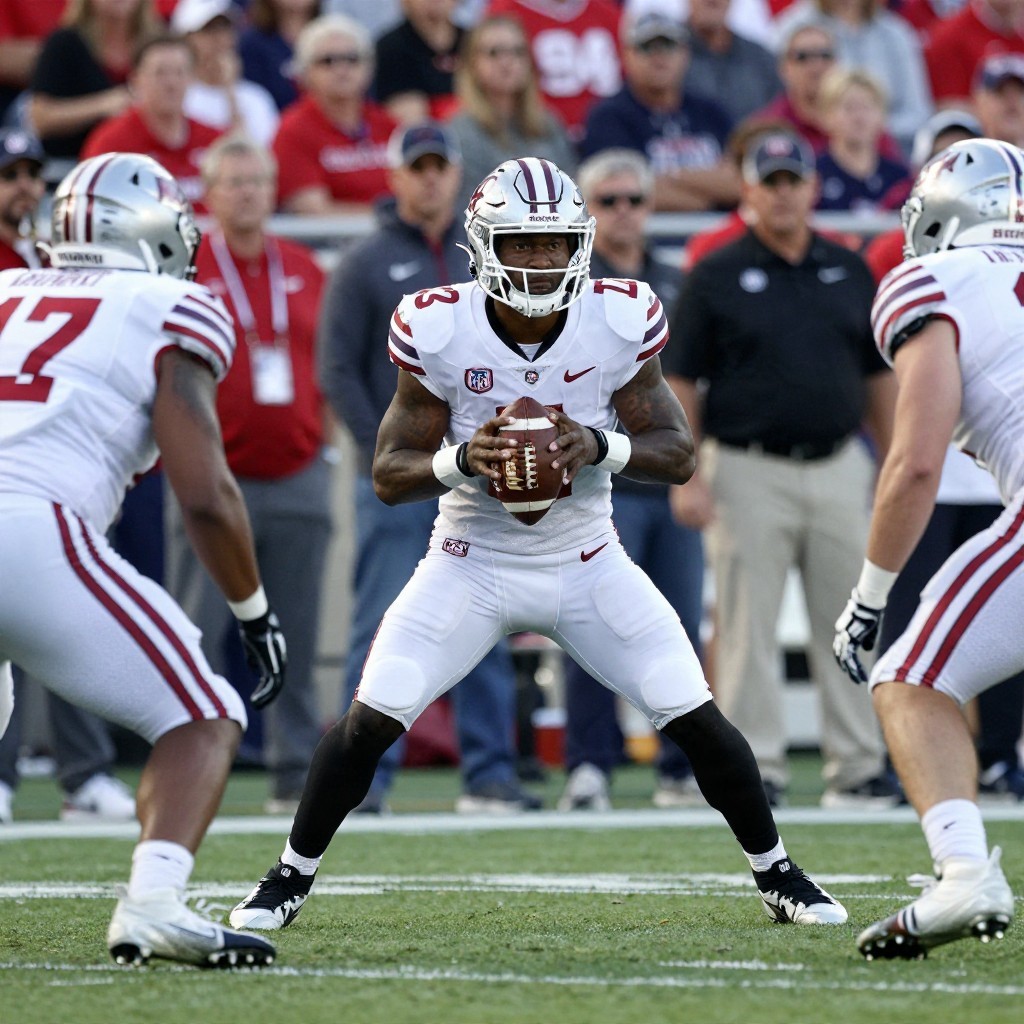
To judge which college stars are best positioned for the NFL, compare role-specific skills, quality of competition, and repeatable technique-not college statistics alone. The strongest projection usually combines traits that fit an NFL role with evidence against varied opponents and a realistic development plan. Treat draft rankings as forecasts, not proof of future NFL performance.
What Separates NFL-Ready College Stars
- Production comes from repeatable skills, not just favorable matchups or a narrow role.
- The player has faced varied alignments, coverages, fronts, or assignments.
- Movement skills and physical dimensions fit a plausible professional role.
- Technique holds up when the first read or initial move is taken away.
- Film shows useful decisions under pressure and after the play changes.
- Potential weaknesses have a specific coaching or role-based development path.
How to Read College Production Against NFL-Level Competition
Use production to identify what a player did; use film and context to estimate whether the underlying skill can hold up in the NFL. When evaluating NFL draft prospects, move through these criteria before comparing totals or draft grades:
- Role and assignment: Identify what the player was asked to do. A receiver used mainly on screens presents different evidence from one asked to win outside, while a quarterback in a defined read system may have fewer examples of full-field progression work.
- Opponent and matchup: Review plays against different levels of competition and against opponents capable of testing the prospect’s likely NFL role.
- Repeatability: Separate a recurring skill from a highlight. Look for consistent route detail, leverage, balance, processing, or finishing technique across multiple games.
- Response to adjustment: Check what happens when an opponent changes coverage, rush plan, blocking surface, or personnel matchup.
- Independent contribution: Ask how much of the result came from the prospect’s own decisions and execution versus scheme, protection, space, or a teammate’s setup.
- Physical translation: Compare speed, length, strength, and change of direction with the demands of the projected role, not with a generic ideal.
- Evidence of development: Note whether technique or decision-making improved during the season and which issues remain visible.
College football player rankings can help build a watch list, but they are not a substitute for this review. Compare prospects with players doing similar work, then record what the film supports and what remains projection.
Which Traits Translate Best at Each Position
There is no single best profile across positions. Use the table to compare role-specific strengths and development risks, then choose the option that matches the team’s need and tolerance for uncertainty.
| Вариант | Кому подходит | Плюсы | Минусы | Когда выбирать |
|---|---|---|---|---|
| Quarterback: processing and pocket control | Teams prioritizing decision-making, timing, and command of the offense | Can support efficient play without relying on repeated improvisation; skills are visible in progression and pressure responses | College structure may simplify reads; NFL coverage disguises can expose slow recognition | Choose when film shows sound decisions across varied looks and the team can build around the player’s current strengths |
| Offensive tackle: pass protection and recovery | Teams seeking a dependable edge protector or a developmental starter | Footwork, balance, hand placement, and recovery can translate across systems | Length, anchor strength, or exposure to speed rushers may create a role or technique concern | Choose when the prospect’s movement and technique match the intended side and protection responsibilities |
| Wide receiver: separation and catch-point skill | Teams needing a route winner, boundary target, or space creator | Release variety, route pacing, tracking, and contested-catch technique offer distinct role value | College production can be inflated by open-field touches or favorable coverage; press technique may need work | Choose after identifying how the receiver wins and whether that method fits the team’s route tree |
| Defensive back: coverage recognition and recovery | Teams looking for a corner or safety suited to their coverage structure | Ball skills, communication, leverage, and transitions can support multiple assignments | A small sample of targeted throws can hide weaknesses; role changes may test processing and tackling | Choose when the player’s coverage evidence matches the intended alignment and assignment range |
| Edge defender: rush plan and run responsibility | Teams seeking pressure from the edge with a defined front and assignment fit | Get-off, hand usage, counters, and disciplined run defense can create multiple paths to snaps | College wins may rely on a single move; NFL tackles can punish undeveloped counters or inconsistent leverage | Choose when the prospect has more than one credible way to affect the play and fits the front’s responsibilities |
For a practical comparison, match each prospect to one role before consulting NFL draft player rankings. That keeps a versatile prospect from being judged against a job he was not asked to perform.
How Scheme and Supporting Cast Shape Draft Comparisons
- If a quarterback worked in a defined-read offense, then prioritize evidence of timing, accuracy, and decisions after the first option is covered; do not assume college efficiency proves full-field NFL readiness.
- If a receiver had frequent open-field touches, then separate designed opportunities from route wins and evaluate releases, stems, and catches through contact.
- If a lineman played beside a strong teammate, then inspect his individual assignment, leverage, and recovery rather than crediting the whole unit’s result to him.
- If a defender benefited from a favorable front, then check whether his pressure came from his own rush plan or from protection attention directed elsewhere.
- If a defensive back saw few targets, then assess positioning, communication, and route recognition on snaps that do not end in a throw.
- If a prospect changed roles during the season, then distinguish evidence from the old assignment from evidence that supports the projected NFL role.
For top college football players entering the NFL, supporting cast is context, not a verdict. It can explain why a player’s opportunities were limited or unusually favorable, but the projection still needs to rest on observable skills.
Where the Transition Usually Breaks Down: Speed, Size, and Complexity
Use this quick selection process to test whether a prospect’s college strengths have a plausible NFL application:
- Name the target role. Specify alignment, assignment, and the kind of opponent the player must handle.
- Identify the main translatable trait. Choose a skill shown repeatedly on film, such as route separation, pocket movement, or a rush counter.
- Test the speed of the task. Ask whether the player can recognize, move, and execute before an NFL opponent closes the available space.
- Check physical fit. Evaluate functional strength, length, balance, and movement for the role; avoid treating body measurements as a complete evaluation.
- Add complexity. Consider how the prospect responds to disguised coverage, varied rush plans, changing protections, or assignments beyond a college tendency.
- Define the development cost. Write down the most important weakness and the coaching, time, or role adjustment it may require.
- Choose by fit and evidence. Prefer the prospect whose strengths answer the team’s need and whose risks can be managed, rather than the one with the most impressive raw total.
A Side-by-Side Scorecard for Tracking Top Prospects
Use the same scorecard for every player, and distinguish observed evidence from projection. Avoid these common comparison errors:
- Ranking prospects by college totals without accounting for role, opportunities, and opponents.
- Treating a highlight play as proof of a repeatable skill.
- Comparing players at different positions as if they faced the same assignments.
- Assuming athletic testing or physical dimensions guarantee on-field success.
- Ignoring weaknesses because a prospect has a high ceiling or strong draft reputation.
- Confusing limited opportunities with proof that a player lacks ability.
- Calling a projection a proven NFL result before the player has performed in the league.
Decision path for a short list
- If the prospect’s best trait directly answers the team’s role, keep him under consideration; if not, compare him only with players who fit the same role.
- If the trait appears consistently against varied looks, treat it as stronger evidence; if it depends on a narrow scheme or matchup, mark it as uncertain.
- If the main risk has a clear coaching or usage plan, weigh the prospect against that development cost; if no credible plan exists, move to a better-fitting option.
- If two prospects remain, prefer the one with more role-relevant film evidence for an immediate need, or the one with a manageable development path when the team can wait.
What to Watch in a Rookie’s First Season
In a rookie’s first season, track whether college strengths appear in the intended NFL role, whether opponents expose the weaknesses identified during evaluation, and whether the player adjusts. The best choice for an immediate role is often the prospect with the clearest evidence of assignment-ready skills; the best choice for a longer development window may be a player with a higher-upside trait and a specific coaching plan. Neither is a guarantee of NFL success.
Scouting the College-to-NFL Jump
Are college statistics useful for predicting NFL performance?
They are useful context, but they do not establish that a skill will translate. Check role, opponent, opportunity, and film before using production to compare prospects.
How should I compare prospects at different positions?
Compare each player with the demands of his projected role, then weigh fit against the team’s need. A shared ranking cannot replace role-specific evaluation.
What does “NFL-ready” mean in a prospect evaluation?
It means the player has skills that appear usable in a defined NFL role with a manageable development plan. It does not mean success is certain or that every part of his game is finished.
How much should scheme affect a draft comparison?
Scheme explains assignments and opportunities, so it should shape how evidence is interpreted. Look for skills that remain useful beyond the college system’s most favorable situations.
Should a team favor a high floor or a high ceiling?
That depends on roster need, role, and development capacity. A player with clearer assignment-ready skills may fit an immediate need, while a more developmental prospect may suit a team able to provide time and coaching.
When can a college-to-NFL transition be judged?
Early usage can show whether a player is earning a role, but it does not settle long-term potential. Evaluate performance in context and track whether the player adapts to NFL responsibilities.