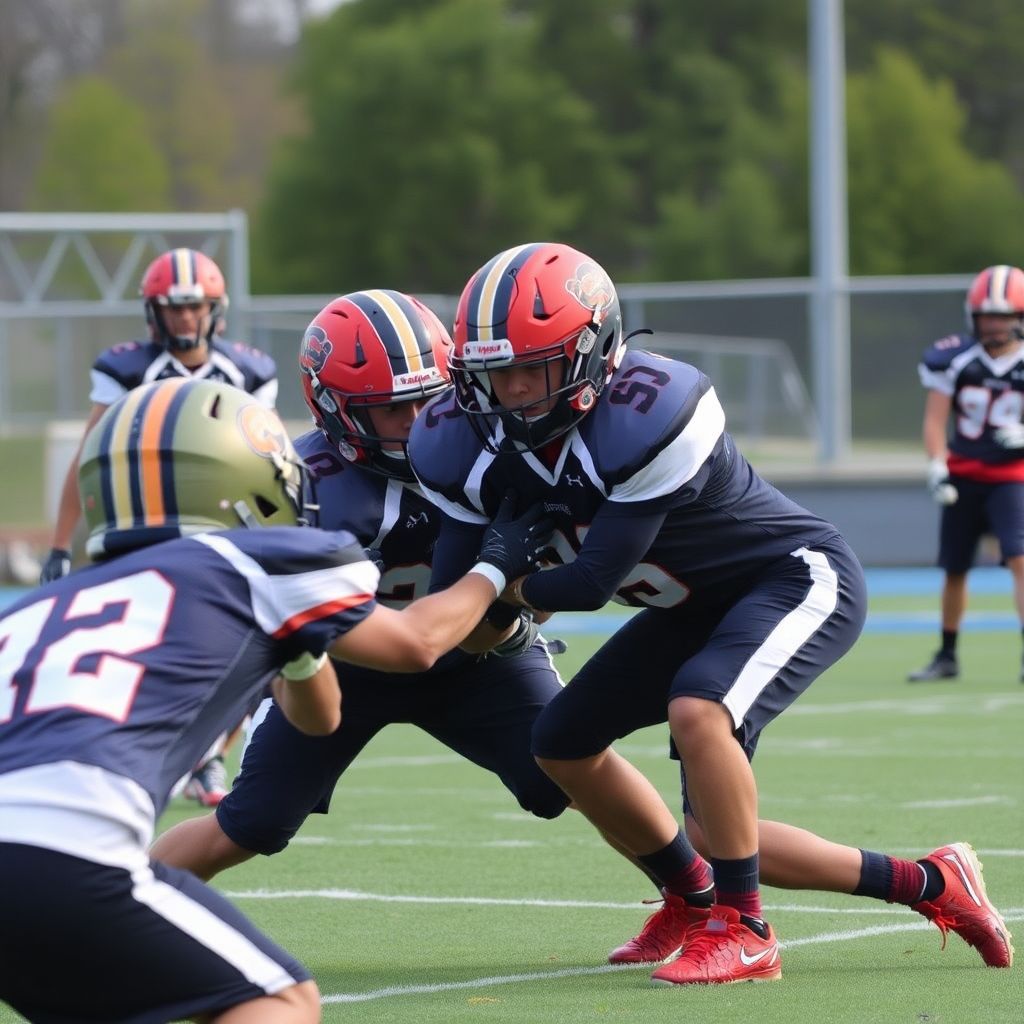
Safe, effective tackling starts with a low, balanced body position, eyes up, and shoulder-led contact that protects the head and neck. Use progressive, non-contact drills before live hits, emphasize wrapping and driving through the target, and align technique with current safety rules and properly fitted equipment to reduce avoidable injury risk.
Core Principles for Effective and Safe Tackling
- Keep the head out of contact: lead with shoulder and chest, not the crown.
- Maintain a wide, stable base and low center of mass before and during contact.
- Track the near hip of the ball carrier to control angles and reduce whiffs.
- Accelerate on contact, then continue leg drive through the tackle window.
- Use arms to wrap and clamp, not to grab or reach from poor position.
- Match technique to current rules to avoid penalties and dangerous contact zones.
- Combine quality football tackling technique training with modern safety equipment and surfaces.
Biomechanics of a Sound Tackle
Tackling mechanics here apply to American football and rugby-style shoulder tackling for intermediate athletes who have basic strength and mobility. Do not perform live-contact tackles if you have unresolved neck, back, or concussion history, or if you lack proper coaching supervision, medical clearance, or appropriate field and equipment.
Prep checklist before focusing on biomechanics
- General warm-up completed (light jog, dynamic mobility, torso activation).
- Neck is pain-free in flexion, extension, and rotation.
- Cleats or footwear matched to surface, laces secured.
- Helmet, shoulder pads, and mouthguard properly fitted and fastened.
- Designated, clear tackling lane free of obstacles and bystanders.
Core mechanical elements
- Base and bend: Feet slightly wider than shoulders, knees and hips flexed, chest up, back flat.
- Eyes and spine: Eyes on the near hip, neck in neutral alignment, no chin-to-chest collapse.
- Leverage line: Hips lower than the ball carrier's hips at contact to win leverage.
- Contact surface: Near-side shoulder and chest strike into the midsection or near hip, never the facemask or crown.
- Wrap and clamp: Arms shoot through the target, elbows tight, hands locking behind the runner if possible.
- Drive phase: Short, powerful steps through the target, finishing with balance and control.
Progress markers for biomechanics
- You can hold a low, balanced tackling stance for at least several breaths without heel lift or knee collapse.
- On film, your helmet stays outside and behind the contact point instead of snapping down or across the ball carrier's knees.
Risk-mitigation note: Stop any drill immediately if the athlete repeatedly drops the head, loses balance into the knees of the ball carrier, or reports neck discomfort.
Progressive Drill Sequence for Skill Acquisition
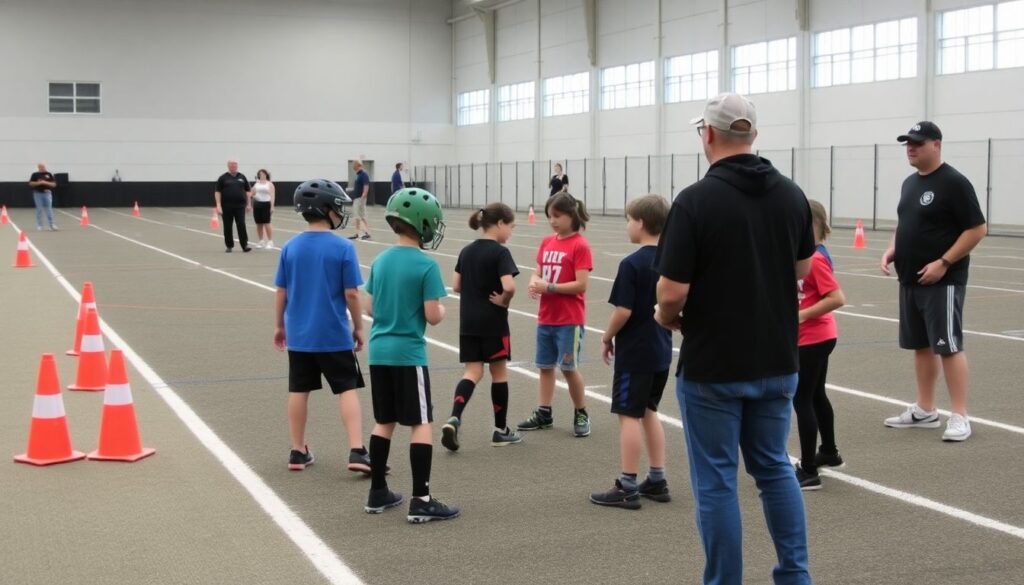
This progression builds from non-contact patterning to controlled contact using bags and pads. It is appropriate for youth through adult players, provided equipment is age-appropriate and supervision is consistent. Avoid skipping steps in preseason; move forward only when athletes show stable, repeatable form at each level.
Prep checklist before running a tackling progression
- Coaches agree on teaching language and cues (no mixed messages).
- Enough space reserved for every drill lane to avoid collisions.
- At least one coach or experienced player per lane for real-time feedback.
- All pads, bags, and cones inspected for damage or tripping hazards.
- Clear communication of contact level (non-contact, thud, or live) to players.
Suggested drill sequence
- Stance and fit on a dummy — Player starts in proper stance, shuffles a short distance, then "fits" shoulder and chest into a stationary tackling dummy without driving it. Focus on pad level, head position, and wrap.
- Angle tracking with tags — Without pads, players track a ball carrier at a 45-degree angle and tag the near hip with two hands. This reinforces leverage and footwork before contact is introduced.
- Shuffle-to-contact on pads — Using rugby tackling pads for sale or existing shields, players shuffle laterally then strike the pad with near shoulder, wrapping and driving three controlled steps.
- Short-space form tackle — Fully padded, tackler and ball carrier start within a few yards. Tempo is controlled; finish on feet, not by driving opponents into the ground.
- Open-field tackle scenario — Later in the teaching cycle, introduce realistic game angles and speeds, limiting reps to preserve quality and reduce fatigue-related errors.
Progress markers for the drill sequence
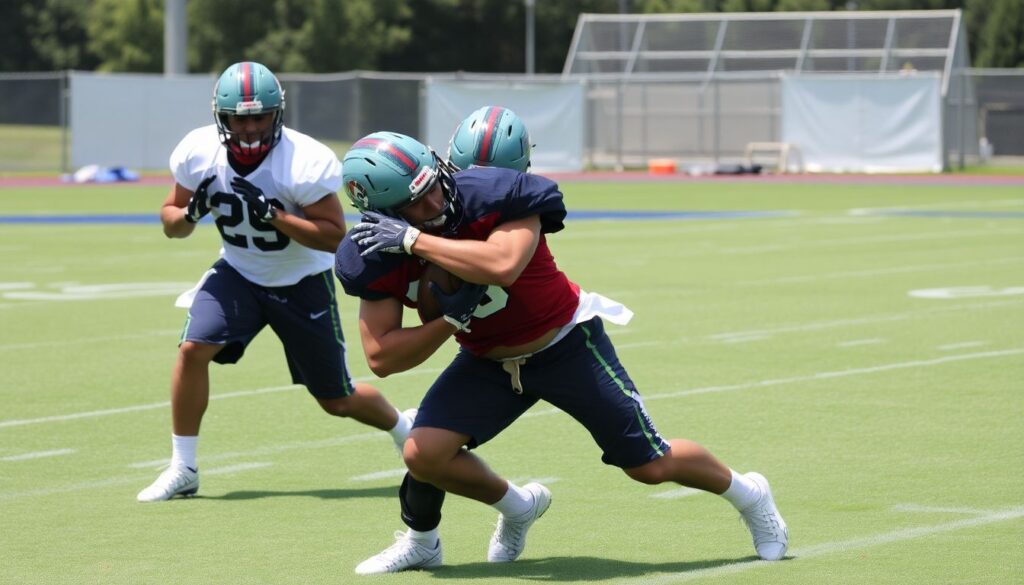
- Players consistently keep eyes up and maintain shoulder-led contact in at least most controlled drill reps.
- Fewer missed tackles and fewer "head across the bow" contacts appear on practice film as the progression advances.
Risk-mitigation note: Cap live-contact reps per session and rotate positions so the same athlete is not absorbing most collisions.
Head Placement and Neck Safety Protocols
Head and neck safety is the non-negotiable part of every tackle. These steps describe a shoulder-led, head-out tackling approach appropriate for most American football contexts where spearing and targeting rules are strictly enforced.
Prep checklist for neck-safe tackling
- Medical staff or first-aid resources are on-site or readily accessible.
- Each player has an american football helmet with latest safety technology or a well-maintained, properly certified model.
- Helmet is fitted (jaw pads snug, chinstrap centered and secured on all straps).
- Players demonstrate basic neck isometrics (front, back, side) without pain.
- Coaches have clearly banned "spearing" and crown-first contact in all drills.
- Establish a neutral neck position — Stand tall, look straight ahead, and gently tuck the chin so the ears align over the shoulders. This neutral alignment must be maintained when dropping into stance and when closing space to the ball carrier.
- Lock eyes on the near target — As you approach, fix your gaze on the ball carrier's near hip or near number. This limits last-second head swings and helps keep the neck aligned with the torso instead of twisting at impact.
- Place the head behind or to the side — On contact, the head should be behind the ball carrier (for inside-out tackles) or on the upfield side (for outside-in tackles), never in front of the knees. Avoid crossing the head across the bow just to chase a big hit.
- Lead with the near shoulder and chest — Strike through the target with your near shoulder while the chest follows. The helmet may brush the opponent as part of the pad level, but it must not be the first or primary point of contact.
- Finish with strong, active neck — On contact, think of "pressing" your helmet away from the target, engaging neck muscles. This active tension helps resist sudden whiplash and keeps the crown out of danger.
Progress markers for head and neck safety
- On video review, the crown of the helmet does not strike first in any teaching-rep tackle.
- Players can demonstrate the full sequence (eyes up, head placement, shoulder strike) at reduced speed on command.
Risk-mitigation note: Any report of neck pain, numbness, or "stingers" after contact is an automatic stop and medical evaluation; do not let players "shake it off."
Rule Evolution and Its Practical Impact on Technique
Modern tackling rules in American football emphasize removing the head from contact, protecting defenseless players, and eliminating launches and hits to the head and neck area. Technique must adapt so that players can tackle aggressively while staying within the evolving rule framework.
Instead of teaching "put the head across the bow" or drive through with helmet contact, coaches now emphasize rugby-influenced shoulder tackling, strike zones between the shoulders and mid-thighs, and "see what you hit" principles. An up-to-date online football coaching course tackling module can clarify league-specific nuances, but the intent is consistent: reduce avoidable head impacts.
Compliance checklist for rules-aligned tackling
- Head is never the first point of contact in drills or live play.
- No launching: feet stay connected to the ground as contact begins.
- Strike zone targets torso and near thigh, not head, neck, or knees from the side.
- Tackles on receivers or quarterbacks avoid late, high, or blind-side contact.
- Defenseless players are not contacted in the head/neck area under any circumstance.
- Coaches promptly correct any "highlight hit" tendencies that risk flags or injury.
- Practice scripts clearly label contact type so intensity matches rules (e.g., thud vs. live).
- Film review sessions include rule-focused clips, not just scheme corrections.
Progress markers for rule adaptation
- Penalties for targeting, unnecessary roughness, or hits on defenseless players decrease across the season.
- Players can explain, in their own words, why a given hit is legal or illegal when shown on film.
Protective Equipment, Contact Surfaces, and Risk Control
Even the best technique is compromised without proper gear and safe practice environments. For youth athletes especially, combining sound mechanics with age-appropriate protective equipment and surfaces is essential to reduce injury risk.
Prep checklist for equipment and surface safety
- Helmets and shoulder pads inspected before each contact practice for cracks or loose hardware.
- youth football tackling safety equipment (mouthguards, pads) cleaned and checked for fit regularly.
- Grass or turf field checked for holes, debris, or hard spots before tackling drills.
- Non-contact days built into the weekly plan to let bodies recover from collisions.
- Tackling pads, sleds, and shields stored properly to prevent water damage and hardening.
Common mistakes that increase risk
- Allowing players to use worn-out helmets instead of models that meet current safety standards.
- Running full-speed tackling drills on hard, unforgiving surfaces such as packed dirt or indoor courts.
- Skipping equipment checks and letting loose chinstraps, missing mouthguards, or misaligned shoulder pads slide.
- Overusing live tackling instead of controlled drills with sleds or shields when possible.
- Ignoring mild symptoms after contact (headache, dizziness, neck stiffness) instead of pulling the player.
- Using makeshift equipment instead of proper tackling pads, even though rugby tackling pads for sale and similar tools are widely available.
- Letting fatigue dictate reps, continuing live-contact segments long after technique quality has dropped.
- Failing to communicate clearly that "toughness" includes reporting pain, not hiding it.
Progress markers for risk control
- Pre-practice equipment checks become routine, taking minimal time because players know their responsibilities.
- Coaches can document a reduction in injury timeouts or practice stoppages related to poor gear or unsafe surfaces.
Risk-mitigation note: Establish a simple, enforced standard: no correct equipment and no clear surface equals no contact participation.
Coaching Cues, Decision Triggers and Pre-Play Checklist
Clear, repeatable coaching cues help athletes make fast, safe decisions in real game speed. A concise pre-play checklist keeps focus on alignment, assignment, and tackling responsibility, so players avoid desperation lunges or head-first dives.
Prep checklist for coaching communication
- Staff agrees on a small set of core tackling cues used at every level.
- Cues are posted in the locker room or meeting space as simple phrases.
- Signals and terminology are consistent across practice, meetings, and any online football coaching course tackling content you share.
- Players understand when to throttle down and when to fully commit to contact.
Core coaching cues
- "Eyes through the target" — Keeps the head up and vision locked on the near hip.
- "Feet first, then strike" — Reminds players that footwork creates the tackle, not lunging.
- "Shoulder, wrap, drive" — Simple sequence that reinforces head-out contact and finishing on balance.
- "Same foot, same shoulder" — Encourages stepping with the contact-side foot to gain power and stability.
Decision triggers and safe alternatives
- Close enough to wrap — If you can square your hips and get close enough to wrap, execute a full shoulder tackle. If you are off-balance or out of phase, throttle down and opt for a leverage-based "slow and shadow" instead of a desperate launch.
- Sideline as an extra defender — When the ball carrier is near the sideline, angle your pursuit to force them out of bounds. This is a safer alternative to high-speed, last-second hits that often draw penalties.
- Gang tackle vs. solo tackle — If multiple defenders are converging, the first man focuses on body control and wrap, while teammates strip or finish. When isolated in space, priority shifts to secure tackle, not ball disruption.
- Pass breakup vs. big hit — On high passes to receivers, choose to play the ball or chest, avoiding high hits on a defenseless player. The safer alternative is to separate the receiver from the ball, not the receiver from their feet.
Pre-play checklist for defenders
- Know run/pass key and your primary gap or coverage zone.
- Identify likely ball carrier based on formation and tendency.
- Visualize your angle to the near hip before the snap.
- Commit mentally to head-out, shoulder-first contact on any tackle opportunity.
Progress markers for decision-making
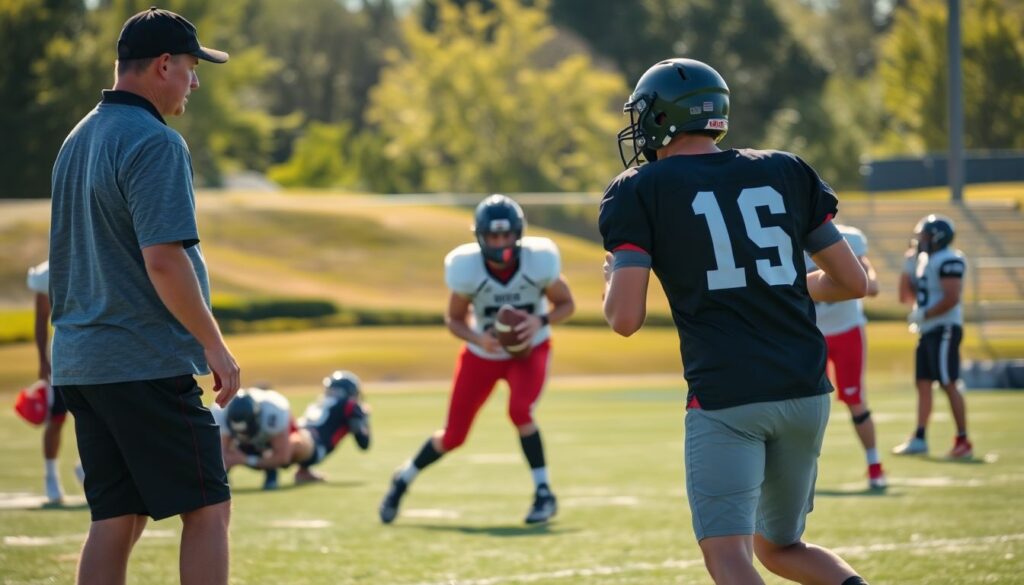
- Fewer missed tackles from lunging and over-committing show up on film over time.
- Players can quickly explain their tackling decision (hit, leverage, or escort to sideline) after each rep.
Risk-mitigation note: Celebrate technically sound, safe tackles as much as highlight hits to reinforce the correct risk-reward mindset.
Practical Answers to Common Tactical and Safety Concerns
How often should we practice live tackling during the season?
Use live tackling sparingly and prioritize quality over volume. Most weeks, emphasize form and thud drills, using full-speed, take-to-ground tackling only in controlled, limited-rep segments to keep technique sharp without excessive collision load.
What is the safest age to introduce full-contact tackling?
Introduce full contact only after athletes demonstrate consistent form in non-contact and pad drills and have appropriate youth football tackling safety equipment. Follow your league's age and contact guidelines, and progress gradually rather than switching abruptly to live hits.
How can smaller defenders tackle bigger ball carriers safely?
Smaller defenders must win with leverage, angles, and timing. Target the near thigh or hip, keep hips lower than the runner's, and use wrap-and-roll or drive-out techniques instead of trying to stop momentum with a straight-on collision.
Are helmets with advanced technology enough to prevent concussions?
An american football helmet with latest safety technology can help manage impact forces, but no helmet can eliminate concussion risk. Proper technique, limited live-contact volume, and quick removal from play after symptoms are equally important parts of protection.
Should we teach the same tackling style for special teams and defense?
The core principles remain the same, but special teams often involve higher speeds and more open field. Emphasize angle discipline, throttling down under control, and using the sideline as an ally rather than aiming for big collision hits.
How do we correct a player who keeps dropping their head on contact?
Temporarily remove live contact and rebuild with slow, controlled drills focused on eyes-up posture. Use clear cues like "show me your facemask" and provide video feedback, progressing only when neutral neck position is consistent.
Can we rely on online courses alone to teach tackling?
An online football coaching course tackling module is useful for concepts, rules, and drill ideas, but it cannot replace on-field supervision. Athletes still need in-person coaching to adjust body position, angles, and timing in real time.