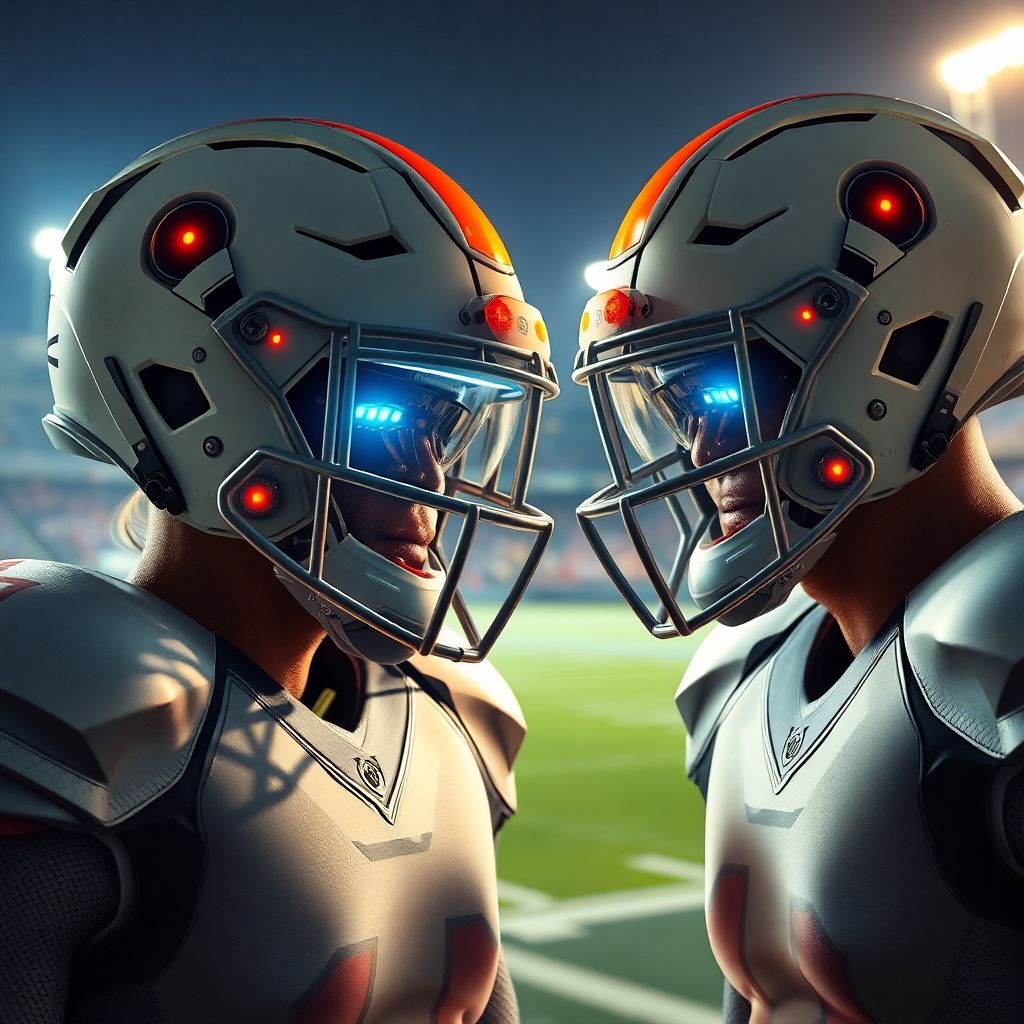
Future football helmets aim to reduce, not eliminate, concussion risk by combining smarter shell design, advanced padding materials, and embedded electronics such as impact sensors and telemetry. These systems manage linear and rotational forces, flag potentially dangerous hits in real time, and guide coaching, medical, and rule changes across youth, high school, college, and professional play.
Executive Summary: Innovations Targeting Concussion Risk
- Helmet technology is shifting from simple impact absorption toward systems that measure, manage, and monitor head impacts over time.
- New designs focus heavily on rotational forces, which traditional standards and many legacy helmets did not adequately address.
- Embedded sensors and wireless telemetry provide objective data on impacts but do not diagnose concussions or make return-to-play decisions.
- Next-generation foams, adaptive polymers, and modular liners aim to tailor protection to position, level of play, and individual fit.
- Evidence shows promising reductions in certain impact measures, but there is no universally accepted list of the best football helmets to prevent concussions.
- Real-world adoption is slowed by certification requirements, cost, integration with existing workflows, and education for coaches and parents.
Common Misconceptions About Helmet Safety and Concussions
The most persistent misconception is that a better helmet can make football concussion-free. Even the most advanced football helmet technology for concussion protection can only lower the probability or severity of certain brain injuries; it cannot stop the brain from moving inside the skull during a hit.
A second misconception is that a higher price tag or newer brand name automatically means safer equipment. In reality, safety depends on a combination of lab-tested performance, proper fit, maintenance, and how players are coached to use their bodies. A poorly fitted “top” model can perform worse than a correctly fitted mid-range option.
Third, many people assume sensor-equipped helmets can detect or diagnose concussions. Impact sensors detect motion, not symptoms. They can highlight unusually hard or frequent impacts, but only a clinician can diagnose a concussion using symptoms, examination, and sometimes imaging or neurocognitive testing.
Finally, parents sometimes believe that buying the safest youth football helmets for head injury prevention is a complete substitute for safer drills, rule enforcement, and honest symptom reporting. Helmets are one layer in a broader risk-management strategy that includes coaching techniques, practice design, officiating, and medical protocols.
How Modern Impact Sensors and Telemetry Detect Risk
Impact-sensing systems turn a helmet into a data-collection device that tracks how the head moves during contact. Most use small accelerometers and gyroscopes placed in the shell or liner to estimate linear and rotational acceleration during every hit, then transmit that information for later analysis or real-time alerts.
- Measurement of head kinematics: Sensors measure how quickly the head speeds up or slows down (linear acceleration) and how it twists (rotational velocity and acceleration) during each impact.
- Onboard processing and thresholds: Some smart football helmets with impact detection for sale include onboard algorithms that compare each impact against preset thresholds, triggering lights or wireless alerts if a hit is unusually high for that player or level.
- Wireless telemetry to the sideline or cloud: Many systems send impact data to a tablet or secure server, allowing athletic trainers to see patterns over a game, season, or career, and to flag clusters of sub-concussive blows.
- Player and position profiling: Over time, data can reveal typical impact profiles for linemen, linebackers, or receivers, informing position-specific coaching and equipment choices.
- Integration with video and practice planning: When synchronized with video, telemetry helps coaches redesign drills, modify contact periods, and adjust technique where high-risk impacts are most common.
- Alerts as prompts, not diagnoses: Impact alerts are best treated as a trigger for sideline evaluation, not proof that a player has or has not sustained a brain injury.
Mini-scenarios of sensor use:
- Youth practice: A coach uses telemetry reports showing repeated high impacts in tackling drills. They shorten contact time, add more form-tackling instruction, and re-measure in later practices to confirm impact levels decreased.
- High school game: An alert shows a single, unusually high rotational impact to a running back. The athletic trainer pulls the player for immediate evaluation, even though the player denies symptoms.
- College season review: Staff compare cumulative head-impact exposure for linemen across two different practice formats, then permanently adopt the format with fewer high-magnitude hits.
Advanced Materials: From Traditional Foam to Adaptive Polymers
The inside of a modern helmet increasingly relies on engineered materials rather than uniform foam. Designers use multi-density foams, air or gel pods, and adaptive polymers that change stiffness depending on how quickly they are loaded, aiming to cushion both frequent smaller hits and rarer, more severe impacts.
These materials can be arranged in zones to match the impact patterns for different positions. Linemen may receive more frontal and crown protection, while receivers and defensive backs might need more coverage for oblique and side impacts. Modular padding systems also allow easier replacement and maintenance over a helmet’s service life.
Some companies explore 3D-printed lattice structures that compress in a controlled way, potentially tuning response to a player’s weight, speed, and level of play. Others use fluid or gel elements that redistribute force over a wider area, reducing local pressure peaks at the skull.
Mini-scenarios of material innovation:
- Youth league equipment day: A club choosing the safest youth football helmets for head injury prevention selects models with softer, energy-managing liners tuned for lower-mass athletes, rather than simply buying scaled-down adult helmets.
- Varsity program upgrade: A high school replaces older, single-density padding with multi-layer liners and position-specific pad configurations, then trains staff to check liner condition weekly.
- College customization: Athletic trainers work with a manufacturer to 3D-scan players’ heads and install custom-fit liner sets, improving both comfort and stability so the helmet stays correctly positioned during contact.
Design Strategies for Managing Energy Transfer and Rotational Forces
Future helmet shells and liner systems are increasingly designed as integrated energy-management devices rather than rigid shells with passive padding. Designers focus on how energy enters the helmet, how it is redirected, and how quickly it is transmitted to the head, with special attention to off-axis and glancing blows that create rotation.
Because no design is perfect for every hit, trade-offs are inevitable. A shell that is too stiff may transmit more rotational energy; a shell that is too flexible may bottom out during severe linear impacts. Advanced designs often combine shell geometry, varied stiffness zones, and internal slip-planes or rotational dampers.
Advantages of modern energy-management designs
- Multi-layer or “floating” shells can spread force over a larger area and extend impact duration, reducing peak acceleration.
- Internal slip liners or rotational discs allow limited movement between the head and shell, lowering rotational forces from oblique hits.
- Asymmetric padding layouts can target known high-risk regions for specific positions or tackling styles.
- Improved fit systems (inflatable pads, multi-point adjustments) help keep the helmet stable, preserving the intended protection profile.
- Some designs integrate sensor cavities from the start, avoiding performance compromises when teams buy high tech football helmet with sensors add-ons later.
Limitations and trade-offs designers must manage
- Helmets must still meet existing certification tests, which may emphasize linear impacts more than rotational ones.
- Added components for rotational management can increase weight or complexity, affecting comfort and neck fatigue.
- Highly tuned systems may perform best only within certain impact speed ranges or directions.
- Custom or modular systems can be harder for equipment managers to maintain and may require more training.
- Cost constraints often limit how far cutting-edge designs can be deployed in youth and underfunded programs.
Evidence Review: Clinical Studies, Field Data, and Current Gaps
Research on helmet innovation spans lab tests, on-field impact monitoring, and clinical follow-up, but the picture is incomplete. Many studies focus on how well helmets reduce certain impact metrics, while fewer directly link specific helmet models or technologies to long-term brain-health outcomes.
- Mistaking lower impact metrics for guaranteed clinical benefit: A helmet that lowers average acceleration in lab tests is promising, but that does not automatically translate to fewer concussions or better cognitive outcomes for every athlete.
- Overgeneralizing from small or biased samples: Results from a single team, level, or playing style may not apply broadly to all athletes or leagues.
- Ignoring fit, maintenance, and use patterns: Studies rarely capture daily realities such as loose chinstraps, worn padding, or players leading with the head, all of which can undermine lab-tested performance.
- Confusing correlation with causation: A team that invests in newer helmets often also improves coaching, medical staffing, and protocols, making it hard to isolate the effect of equipment alone.
- Relying on marketing claims instead of independent data: Independent lab ratings and peer-reviewed studies are more reliable than promotional materials, especially when choosing the best football helmets to prevent concussions for a specific program.
- Neglecting sub-concussive hits: Many investigations focus on diagnosed concussions, even though repeated smaller impacts may also contribute to long-term changes in brain health.
Barriers to Adoption: Certification, Cost, and Real-World Integration
New helmet technologies must satisfy safety standards, league rules, and buyer budgets before they ever reach a player. Certification tests often lag behind innovation, especially for rotational-force management and integrated electronics, forcing manufacturers to design around older metrics while still marketing future-focused benefits.
Cost is another barrier. Systems that combine advanced liners, custom fitting, and fully integrated sensors can be more expensive than traditional helmets, particularly once you include ongoing subscription fees for data platforms. Many youth and small-school programs must balance desired protection features against the number of players they can afford to outfit.
Integration into daily workflows is often overlooked. Athletic trainers and coaches need training on interpreting sensor data, adjusting practice plans, and explaining equipment choices to parents and administrators. Without that support, even technically impressive helmets may end up used as if they were conventional models, losing much of their potential value.
Mini-case: transitioning to a sensor-enabled helmet program
Consider a suburban high school that decides to adopt smart helmets. The athletic director selects a model from a vendor promoting smart football helmets with impact detection for sale, aiming to improve monitoring rather than to rely on sensors for diagnoses.
- The school forms a small working group: athletic director, head coach, athletic trainer, and a parent representative.
- They compare vendors on three axes: helmet fit and comfort, independent safety ratings, and the usability of the data dashboard.
- To control costs, they begin with starters and high-contact positions rather than outfitting the entire roster immediately.
- The athletic trainer creates a simple protocol: any impact alert triggers removal from play and a standardized clinical evaluation, regardless of game importance.
- Coaches review impact heat maps monthly and modify two drills with consistently high head-impact loads.
- At season’s end, the group reviews outcomes, player feedback, and budget impact, then decides whether to expand, adjust vendors, or supplement with additional coaching changes.
Practical Questions Coaches, Players, and Clinicians Commonly Ask
Can a football helmet fully prevent concussions?
No. Helmets reduce certain forces to the skull and brain but cannot stop the brain from moving inside the skull during impacts. They are one part of a broader strategy that includes coaching, rule enforcement, conditioning, and medical oversight.
What should I prioritize when choosing a new helmet model?
Prioritize proper fit, independent performance ratings, and suitability for your level and position. A well-fitted, consistently maintained helmet that players will actually wear correctly often provides more real-world benefit than the most complex design worn loosely or inconsistently.
Are sensor-equipped helmets worth the extra cost?
They can be, if your program has the staff and training to use the data. Sensors provide objective information about impacts and can prompt evaluations, but they do not replace medical judgment or remove the need for honest symptom reporting.
Do youth players need different helmets than adults?
Yes. Youth athletes differ in body mass, neck strength, and style of play. Many manufacturers design youth-specific models or liner systems, and leagues often have their own requirements for the safest youth football helmets for head injury prevention in younger age groups.
How often should helmets be reconditioned or replaced?
Follow manufacturer guidance and league requirements, which typically specify inspection and reconditioning intervals. Replace helmets with visible shell damage, degraded padding, or after their recommended service life, even if they still look acceptable from the outside.
Will future helmets change the way football is played?
Likely yes, but gradually. As more impact data becomes available and designs better manage rotational forces, rules, practice structures, and coaching techniques will continue to evolve to reduce unnecessary head contact while preserving core elements of the game.
Where can I purchase advanced helmets with embedded technology?
Many major manufacturers and specialty vendors offer models with integrated or compatible sensor systems. Before you buy high tech football helmet with sensors, verify league approval, support for your level of play, and the total cost of ownership, including software and maintenance.