
Advanced game analytics go beyond the box score by modeling possession value, player impact, and context, but they are often misused through small samples, overfitting, or ignoring tactics. To prevent mistakes, standardize definitions, validate models out-of-sample, explain uncertainty to coaches, and integrate analytics outputs into existing workflows and language.
Persistent Myths and Reality Checks in Advanced Game Analytics
- Myth: One metric (PER, WAR, xG, plus-minus) can rank every player correctly. Reality: Each metric encodes specific assumptions, inputs, and contexts; use dashboards, not single-number verdicts.
- Myth: More features in sports analytics software automatically mean better predictions. Reality: More variables increase overfitting risk; regularization and honest validation matter more than feature count.
- Myth: A real-time game analytics system tells coaches exactly what to do next. Reality: Models provide probabilities and trade-offs; decisions still depend on strategy, risk tolerance, and matchups.
- Myth: Tracking data and biomechanics remove all subjectivity. Reality: Sensors have noise, missing data, and labeling errors; interpretation still requires domain knowledge.
- Myth: If a metric correlates with winning in one league, it must work in others. Reality: League style, rules, and data quality change the meaning and reliability of advanced stats.
Debunking Popular Misconceptions About Modern Metrics
Modern game analytics focuses on estimating how actions and players change the expected outcome of possessions, games, or seasons. Metrics like RAPM, WAR, and expected goals (xG) are not magic truth devices; they are statistical models that transform noisy event and tracking data into structured estimates of value.
The central error is treating these models as opaque “ratings” instead of conditional probabilities based on assumptions. When teams buy basketball advanced stats tools or a football data analytics platform, they often skip the step of asking what the model assumes about roles, lineups, and opponent quality. Misalignment between model assumptions and coaching philosophy produces frustration, not insight.
Another frequent problem is conflating description with prediction. For example, a lineup’s historical net rating describes past performance but may be a poor predictor if minutes are limited, injuries changed rotation, or opponent strength shifted. High-performing sports performance analytics solutions therefore distinguish clearly between descriptive, predictive, and prescriptive outputs.
Core Concepts: Expected Values, Probabilities, and Extended Plus-Minus
- Expected value of a possession: Instead of logging “shot made/missed,” advanced models estimate the expected points of an action:
EV = Σ (outcome probability × outcome value). For a three-point attempt: EV = P(make) × 3 + P(miss) × 0. - Context-adjusted shot quality: Inputs like location, defender distance, speed, and time remaining feed shot-probability models. Two identical box-score shots can have very different expected values once you include these spatial and temporal features.
- Extended plus-minus logic: Basic plus-minus tracks score margin while a player is on the court. Extended models (RAPM, RPM, lineup-adjusted metrics) decompose that margin into individual contributions, controlling for teammates, opponents, and sometimes play style via regression or Bayesian techniques.
- Probabilistic game states: Football and basketball models often track the probability of winning from each game state (score, time, field position/possession). Actions are valued by how much they change win probability, not just yards or points.
- Uncertainty and intervals: Every estimate (xG, WAR, RAPM) has a range of plausible values. Especially for bench players and small samples, communicating this uncertainty is as important as the point estimate.
- Regularization to fight noise: When you have thousands of features-from a real-time game analytics system or tracking data-regularization (L1/L2 penalties, priors) shrinks extreme estimates toward the average, reducing overfitting and making metrics more stable.
Player-Level Models: WAR, RAPM, xG and How to Interpret Them
Player-level models aim to translate noisy on-field actions into interpretable estimates of contribution. Below is a comparative overview of common metrics and their trade-offs.
| Metric | Typical Inputs | Primary Strength | Main Limitation |
|---|---|---|---|
| WAR (Wins Above Replacement) | Play-by-play events, roles, minutes, league baselines | Connects player impact to team wins and roster value | Sensitive to model assumptions about replacement level and context |
| RAPM / Adjusted Plus-Minus | On/off scores, lineups, opponent lineups, possessions | Captures off-ball impact and spacing not in box score | Needs large samples; noisy for low-minutes players |
| xG (Expected Goals) | Shot location, body part, situation, defenders, assist type | Separates shot quality from finishing; supports chance-creation analysis | Underestimates rare skill or tactical patterns if not in training data |
| Tracking-based load metrics | Player positions, speed, accelerations, collisions | Links external load to fatigue and injury risk management | Sensor noise; context-free loads can be misinterpreted |
Typical application scenarios and fast error checks
- Roster construction and contracts: WAR-style metrics help compare players across positions. Quick safeguard: always cross-check with role, usage, and injury history; a “high WAR” player in a specific scheme may not translate elsewhere.
- Lineup optimization: RAPM can highlight complementary lineups that outperform the sum of individual box-score stats. Error to avoid: reading RAPM as an individual skill rating without considering who a player usually shares the court with.
- Shot selection reviews: xG surfaces which shooters generate high-quality chances and which patterns (cut, pick-and-roll, cross) produce efficient shots. Fast prevention: never label a player “bad finisher” solely from low conversion in a small xG sample.
- Load and rotation management: Tracking metrics and sports performance analytics solutions flag exposure spikes. Common mistake: reacting to single-game peaks instead of multi-game trends and player history.
- Scouting across leagues: When using a football data analytics platform to compare players from different competitions, build league-adjustment layers; otherwise, you risk importing players whose metrics were inflated by league style or pace.
Event and Tracking Data: From Optical Systems to Biomechanical Signals
Event data (passes, shots, turnovers, fouls) captures the “what” of the game. Tracking and biomechanical data (positions, velocities, accelerations, joint angles) capture the “how” and “where.” Modern sports analytics software increasingly fuses both to understand tactical structure and physical load together.
Advantages of rich event and tracking data
- Reveals off-ball movements, spacing, pressing, and rotations that never appear in the box score.
- Enables construction of spatial models (control maps, passing lanes, pressure indices) that explain why certain plays succeed.
- Supports individualized conditioning plans by linking tactical roles to actual external load and movement profiles.
- Improves attribution of credit and blame by separating system-created shots from individual brilliance.
- Allows near real-time monitoring through a real-time game analytics system for substitutions and matchup adjustments.
Constraints, pitfalls, and quick prevention tips
- Tracking noise and gaps: sensors drop frames, players swap IDs; always run quality checks before model training.
- Labeling inconsistencies: what counts as a “press,” “contest,” or “big chance” can change across analysts-standardize definitions early.
- Sample bias: only televised or high-level matches may have tracking, skewing models toward elite playstyles.
- Over-detail: adding dozens of biomechanical variables without clear hypotheses increases false patterns; start from specific questions.
- Privacy and ethics: combine load and biomechanical data with consent and clear policies; misuse erodes trust and cooperation.
Causal Inference, A/B Logic and What Analytics Truly Reveals to Coaches
Advanced metrics are often misinterpreted as proofs of causality when they are usually measuring association. For practitioners, the quickest way to avoid mistakes is to adopt a simple A/B logic: “Compared to what?” and “Holding what constant?”.
Typical errors and how to avoid them quickly
- Confusing correlation with causation: A lineup with high net rating may benefit from facing weak benches. Prevention: compare similar possessions, situations, and opponents; use matched samples or stratified splits when possible.
- Ignoring selection bias: “Clutch” plays often involve star players against set defenses. Prevention: when testing late-game strategies, compare possessions with similar time, score, and defensive readiness, not the full game sample.
- Overreacting to small samples: A few hot shooting games can distort any metric. Prevention: predefine minimum sample thresholds (minutes, possessions, attempts) before trusting a finding.
- Cherry-picking validation windows: Testing a model only in its best-performing stretch inflates confidence. Prevention: use rolling windows or cross-validation; plot performance over time for coaches.
- Forgetting counterfactuals: “We switched coverage and then we won” does not prove the switch caused the win. Prevention: simulate or review comparable games where the coverage did not change to see if outcomes differ meaningfully.
Operationalizing Insights: Validation, Production Pipelines and Stakeholder Buy-in
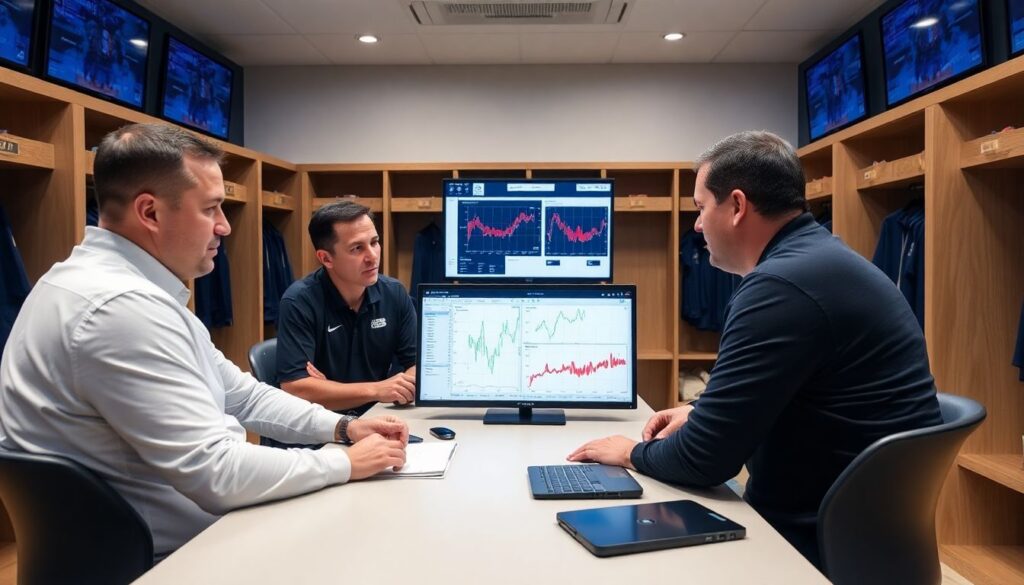
To move beyond interesting charts, teams need a simple but reliable pipeline: clean data, stable models, clear outputs, and communication aligned with coaching language. Tools-from specialized basketball advanced stats tools to integrated sports analytics software-should serve this pipeline, not define it.
Mini-case 1: Shot selection redesign
A club integrated xG and tracking data into weekly offensive reports. Initial analysis suggested a certain wing was taking “bad” threes. After checking the model inputs, analysts saw that many attempts followed late-clock, bailout situations. Instead of benching the player, coaches redesigned sets to free him earlier in the clock, which raised both his xG and actual efficiency without changing his role classification.
Mini-case 2: Rotation and load management
A staff used a real-time game analytics system combined with tracking-derived load indices. Early in the season they overreacted to single-game spikes, cutting minutes aggressively and disrupting rhythm. After revising their process, they only acted when three conditions aligned: sustained load elevation over several games, reported fatigue, and upcoming congested fixtures. Injuries did not disappear, but panic-driven rotation changes did.
Practical 5-step checklist for implementation and communication
- Define questions and thresholds first: Before opening any dashboard or football data analytics platform, write down the decision you want to support and the minimal sample you need.
- Document metric definitions: Maintain a short glossary for coaches and players that explains each metric, its inputs, and at least one limitation.
- Validate out-of-sample: For every new model (xG, RAPM, WAR), hold out recent matches or use cross-validation; never sell a model based only on in-sample fit.
- Present ranges, not just ranks: Show intervals or stability indicators alongside player or lineup rankings to stop overconfident decisions on noisy differences.
- Translate into actions: Every report should end with 1-3 concrete, coach-friendly options (lineup tweaks, training focuses, scouting filters) instead of raw numbers.
Common Misconceptions and Quick Clarifications for Practitioners
Do advanced metrics replace traditional scouting and coaching judgment?
No. Advanced metrics highlight patterns and probabilities that are hard to see, but they cannot capture every tactical nuance, locker-room dynamic, or health concern. The best use is to have data challenge or confirm what video and experience already suggest.
Is more data from tracking and sensors always better?
Only if you can clean, validate, and interpret it. Extra variables without a clear question often create misleading noise. Start from a small set of well-understood metrics and expand deliberately as your workflow and staff capacity grow.
Can a single metric tell me who the “best” player is?
No. Each metric focuses on specific aspects: scoring efficiency, playmaking, defense, load, or impact on winning. Use multiple views and make sure the role, system, and matchup context are considered before labeling anyone as best or worst.
Why do different models sometimes disagree on the same player?
They use different inputs, weights, and assumptions. A player may look average in box-score-based models but excellent in impact models that capture screens, spacing, or defensive versatility. Disagreement is a signal to investigate, not to pick a favorite metric blindly.
How can I quickly tell if a metric is trustworthy for my team?

Check three things: whether the definitions match your style of play, whether performance holds up on recent unseen games, and whether the metric gives stable ratings for players with similar roles over reasonable samples.
Do I need custom models if I already use commercial analytics tools?
Not always. Many teams get strong value from off-the-shelf tools if they invest in data literacy, validation, and communication. Custom models are most valuable when your tactics or league differ significantly from the assumptions behind generic products.
Is it safe to base big decisions on short playoff or tournament samples?
Be very cautious. High-pressure games are few and opponent-specific. Use playoff data to refine understanding, but anchor evaluations in larger regular-season or multi-season samples to avoid reacting to outliers.