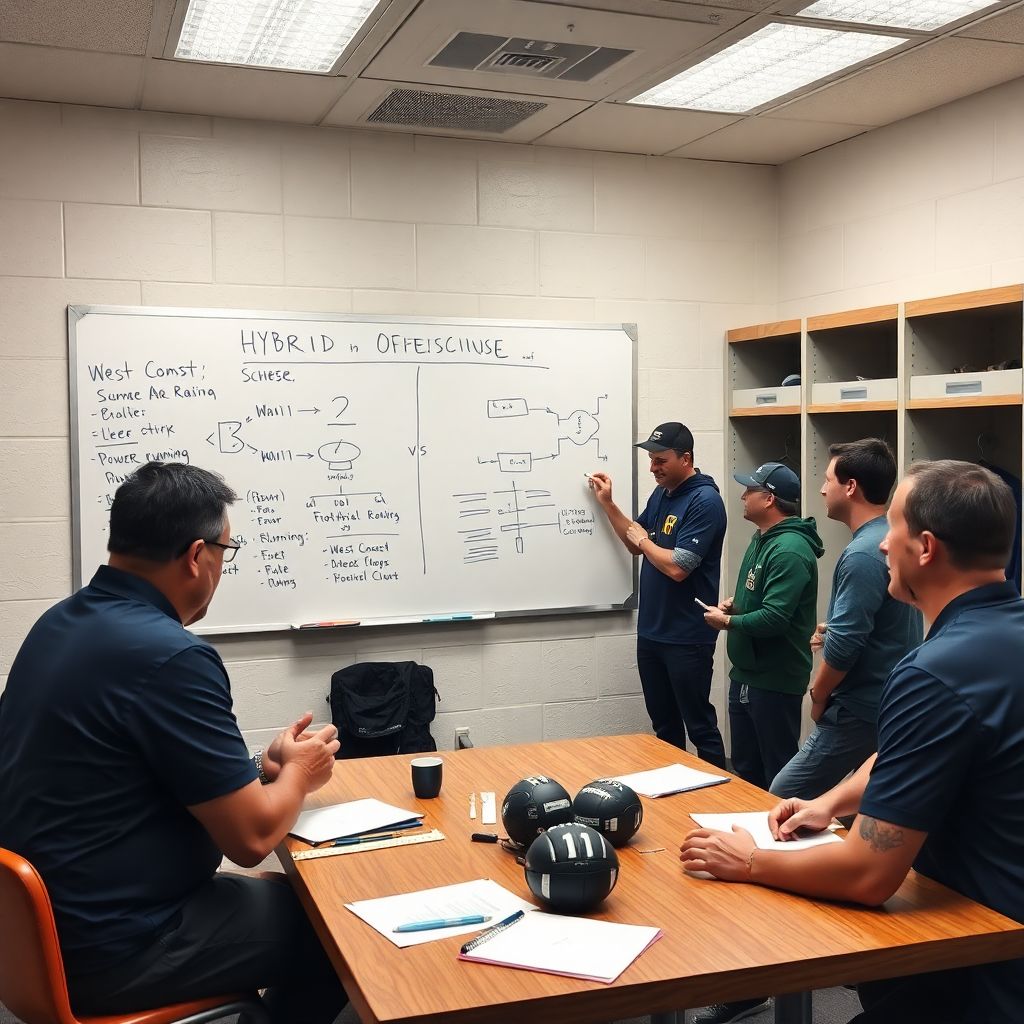
To choose the best offensive philosophy, match scheme to players, teaching time, and budget. West Coast favors timing, progression reads, and controlled passes; Air Raid stretches space with simplified concepts and tempo. Run-heavy systems stabilize weaker rosters. Blend elements: one core identity, two complementary packages, and a clear play-calling process that players can execute fast.
Strategic Snapshot: Core Offensive Principles
- Start from personnel, not from your favorite playbook: build your structure around what your quarterback and offensive line can reliably execute.
- Pick one base passing family (West Coast or Air Raid-style) and one base run family (zone or gap) instead of chasing every trend.
- Use tempo (huddle, no-huddle, sugar huddle) as a game-management tool, not a gimmick; script your first 10-15 plays with clear contingencies.
- Install cheap, high-value tags (RPOs, motions, formation shifts) that dress up your base concepts without bloating the playbook.
- Call plays in sequences: every core concept should have at least one constraint (screen, draw, counter, shot) to punish defensive overplays.
- Track what you actually call on game day and trim anything that never makes the sheet, even if it looked great in that nfl offensive playbooks pdf you downloaded.
West Coast vs. Air Raid: Conceptual Foundations
Choosing between West Coast and Air Raid principles is less about labels and more about matching clear criteria to your environment.
- Quarterback skill set and processing
West Coast demands timing, footwork tied to progressions, and quick full-field processing on concepts like slant/flat and drive. Air Raid emphasizes space recognition, simple mirrored concepts, and option routes. If your QB is accurate but still developing processing, a simplified Air Raid tree is usually friendlier. - Practice time and staff size
With limited practice time or few assistants, you benefit from repetition of a small menu. Air Raid-style menus with a handful of core concepts (e.g., mesh, four verts, stick) are easier to rep than a large West Coast tree. If you have more staff and meeting time, a West Coast build-out gives finer game-plan control. - Receiver depth and skill diversity
West Coast thrives with versatile route runners who can adjust splits, stems, and break points, plus a reliable Y/TE in the short and intermediate game. Air Raid can survive with fewer polished technicians if they can run, threaten space, and master 5-6 routes at tempo. - Offensive line quality and protection comfort
A traditional West Coast approach often carries a broader protection menu: full slide, half slide, 6- and 7-man protections. That is powerful but teaching-heavy. Many budget-conscious programs prefer Air Raid protection rules (e.g., half-slide + back) and quick-game emphasis to simplify for a weaker line. - Run game identity
Classic West Coast systems (think Shanahan tree) marry wide zone runs with play-action and keepers, stressing discipline and angles. Modern Air Raid branches often lean on inside zone, draw, and quick RPOs as “run game by extension.” If you want a robust under-center play-action world, West Coast is a better base. - Defensive environment in your league
If you regularly see complex pattern-match coverages and disguised rotations, West Coast tools can let you attack specific rules with adjusted splits and progression designs. If opponents play simpler spot-drop zone or man-free shells, spacing concepts from Air Raid approaches are more than enough and easier to drill. - Weather and field conditions
Weather is not an automatic veto on passing, but it shapes the kind of passing game you want. In harsh weather regions, a West Coast build that marries the run game and short controlled throws travels better than pure spread tempo. In favorable climates, Air Raid tempo and wide sets can punish thin defensive depth. - Scouting and self-scout capacity
West Coast game plans lean hard on opponent-specific tweaks. Without video tools or staff to self-scout tendency breakers, a large menu becomes inefficient. A stripped-down Air Raid menu with formation and motion tags is easier to chart, self-scout, and adjust using simple spreadsheets. - Playbook access and learning resources
If you are teaching yourself, resources like a west coast offense playbook download or a spread offense playbook for coaches can tilt your choice. Pick the tree you can study deeply, not the one that looks flashiest in cut‑ups or in an online course football play calling advertisement.
Run-Heavy Schemes and the Evolution of Modern Ground Games
Run-centric philosophies stabilize offenses with inconsistent quarterback play, undersized receivers, or bad weather. Below is a practical comparison of common modern ground approaches.
| Вариант | Кому подходит | Плюсы | Минусы | Когда выбирать |
|---|---|---|---|---|
| Wide Zone / Outside Zone with Play-Action | Teams with athletic OL, disciplined backs, QBs comfortable under center or in pistol. | Creates horizontal stretch; explosive play-action shots; scalable from budget installs to NFL-level detail; pairs well with West Coast concepts. | Requires many reps to master aiming points and combo blocks; can struggle vs penetrating DL if technique is poor. | Choose when you want one core run repeated often and a marriage with keeper boots and deep crossers as your shot game. |
| Gap / Power and Counter Run Game | Physical lines, heavier personnel, and backs with good vision and patience; ideal for smaller schools with “phone-booth” athletes. | Angle blocks are OL-friendly; power and counter give clear identities; easy to pair with simple RPOs or quick play-action. | Less naturally explosive on the perimeter; pulling linemen demand conditioning and practice; can be predictable without constraint plays. | Choose when you can win with downhill physicality and want a teaching-friendly menu for part-time staffs. |
| QB Run-Centered Spread (Zone Read, Power Read) | Teams with tough, mobile QBs and adequate depth behind them; OL that move well laterally. | Adds “+1” run-game numbers; stresses edges; great equalizer vs more talented fronts; meshes well with simple spread pass concepts. | QB injury exposure; requires a QB willing to run inside; some leagues limit QB hits; needs option decision training. | Choose when your QB is clearly your best runner and you’re willing to design protection and depth around that reality. |
| RPO-Driven Inside Zone / Duo | Teams with accurate QBs and at least one conflict-creating receiver; moderate OL talent is enough. | Lets you “call two plays at once”; punishes aggressive backers; gives cheap answers vs loaded boxes without changing the run. | Rules complexity at WR/QB; risk of ineligible downfield penalties; requires disciplined practice and clear read rules. | Choose when you want a simple core run (IZ/duo) and prefer post-snap answers over constant pre-snap audibles. |
| Under-Center Heavy Personnel Play-Action Ground Game | Programs with strong TEs/fullbacks, willing to be patient; QB with strong play-fake skills and comfort turning back to defense. | Clouds defensive keys; compresses the box to set up deep shots; excellent in bad weather and for clock control. | Less friendly for hurry-up tempo; requires more install time for run fits and pass protections; fewer plug-and-play spread resources. | Choose when you value physical identity, ball control, and explosive play-action more than raw snap volume and tempo. |
For resource-limited coaching staffs, the gap/power and RPO-driven inside zone families are often the most budget-friendly: they use simple rules, translate directly from many spread offense playbook for coaches resources, and require fewer specialized athletes than some wide zone or QB-run-heavy approaches.
Tempo, Scripted Drives, and Game-Pace Management
Tempo and scripting should serve your roster and budget, not imitate NFL TV aesthetics. Use these scenario-based guidelines.
- If your depth is thin, then favor controlled huddle or “sugar” huddle tempo. Use 10-15 scripted openers emphasizing runs and quick-game to reduce exposure for your defense. A budget-conscious staff should rehearse this script heavily in practice rather than chasing a full no-huddle package.
- If your sideline communication is limited, then build a simple wristband or one-word call system and run no-huddle primarily as a way to keep your own operation clean, not purely to go fast. Many nfl offensive playbooks pdf examples overcomplicate signal systems; start with one family of one-word calls (e.g., all inside zone tags) before layering more.
- If your team is outgunned athletically but well-conditioned, then consider using tempo as a weapon in specific windows: after explosive plays, during two-minute drives, and against heavy defensive personnel groups. Script “tempo pockets” (three-play sequences you run at speed) that are simple to execute but strain substitution rules.
- If your QB is inexperienced, then slow the game down early with a highly curated script of simple reads: mirrored quick-game, basic play-action, and one or two full-field concepts. As confidence grows, build a package of “green-light” tempo calls the QB can check into when you catch a predictable defensive look.
- If you have the personnel for a premium tempo package (deep OL and WR groups, experienced QB), then build full-drive no-huddle systems with sideline boards or signalers, plus a small set of tempo-only plays. Budget-limited teams can emulate this in miniature: 4-6 core concepts with simple code words, without expensive technology or massive practice scripts.
- If you need to protect a lead, then deliberately shift to heavier personnel, motion, and longer play clocks in second halves. Script “four-minute” sequences: run, safe constraint, safe boot, change-up run. Track average time per snap and adjust; this is where even a basic spreadsheet beats guesswork.
Personnel Packages, Matchups, and Scheme Fit
Use this stepwise checklist to choose and tailor an offensive philosophy to your roster.
- Grade your quarterback first
Answer plainly: Is he a distributor, a runner, or a true dual-threat? Can he handle full-field progression reads or just half-field and pre/post-snap one-key reads? This choice alone points you toward West Coast, Air Raid, QB-run spread, or a run-heavy identity. - Inventory offensive line mobility and depth
Count how many linemen can reach and climb in space versus how many are better on down blocks and doubles. Limited, heavy-footed lines tilt you toward gap/power or duo; more athletic, interchangeable linemen make wide zone and tempo protections viable. - Map your skill groups into base personnel
List how many real outside receivers, slot types, tight ends, and backs you trust. If your best 11 includes three wideouts and one tight end, 11-personnel spread is likely your base. If TEs and backs dominate, 12 or 21 personnel with under-center elements makes more sense. - Choose one primary run and one primary pass family
From your inventory, pick a core run (e.g., inside zone or power) and a core pass family (e.g., quick-game + boot or mesh + four verts). Resist the urge to add concepts just because you saw them in the “best nfl offensive schemes explained” thread or a clinic; only keep what fits your players. - Assign personnel packages to specific matchup goals
For each package (10, 11, 12, 21, etc.), decide its purpose: spread the field, attack base personnel, or force base from sub? Attach 4-6 calls that highlight a star player in that grouping instead of building huge generic menus. - Define your change-ups and constraints
For every bread-and-butter concept, add at least one screen, counter, or tag that punishes defensive overreaction. These do not require an entirely new scheme; a simple bubble screen or bootleg off your main run is usually enough for budget-limited programs. - Finalize with a realistic call sheet
Translate your scheme into a game-day sheet your staff can actually use. Group calls by situation (openers, third-and-medium, red zone, backed up, two-minute). If it does not fit on a single, clearly organized sheet, your scheme is probably too big for your context.
Play-Calling Mechanics: From Signal Systems to In-Game Adjustments
Common mistakes in choosing and executing an offensive philosophy often come from mechanics, not ideas.
- Overbuilding the menu from pro-film
Copying entire NFL systems or downloading a giant west coast offense playbook download, then trying to install it wholesale, overwhelms players and staff. Trim to what you can drill every week. - Lack of clear language and tagging rules
Inconsistent terminology (same word, different meaning) or constantly changing tags creates confusion. Set a simple, durable naming system before expanding concepts. - No feedback loop between call sheet and film
Failing to log what was actually called and what worked leads to the same bloated sheet every week. Even a basic chart of calls, situations, and results will drive smarter game-plan adjustments. - Ignoring protection when choosing pass concepts
Choosing sexy route combinations before deciding protection rules invites free runners at the QB. Start your pass game with what your line can protect, then layer concepts. - Changing identity weekly
Reinventing yourself every opponent (“we’re Air Raid this week, under-center next week”) robs players of mastery. Maintain a consistent core and use formations, motions, and a few new tags for opponent-specific tweaks. - Unrealistic in-game communication systems
Building elaborate signal systems that require extra staff or perfect sideline organization will collapse under Friday-night chaos. Match your mechanics to your real sideline, not to what big programs can do. - Ignoring down-and-distance and field zone tendencies
Calling your favorite plays without regard for tendencies lets defenses sit on your habits. Regular self-scouting, even informally, helps you design counters and constraint calls. - Underusing simple educational resources
Skipping structured learning, like a solid online course football play calling or well-organized clinic notes, in favor of random clips can leave your system half-built and inconsistent.
Analytics, Risk Management and Budget-Conscious Implementation
West Coast-anchored systems are often best for teams with accurate, processing-friendly quarterbacks, strong staff resources, and a desire to tie the run and pass together with detailed game plans. Air Raid-leaning or simple spread/RPO systems are usually best for leaner staffs, limited practice time, and rosters needing a streamlined, repetition-heavy approach. Hybrid ground-heavy schemes built on gap/power or inside zone plus basic play-action are best when your quarterback ceiling is modest but your line and backs can carry the load.
Practical Clarifications and Quick Answers
Is West Coast or Air Raid better for a high school team with limited practice time?
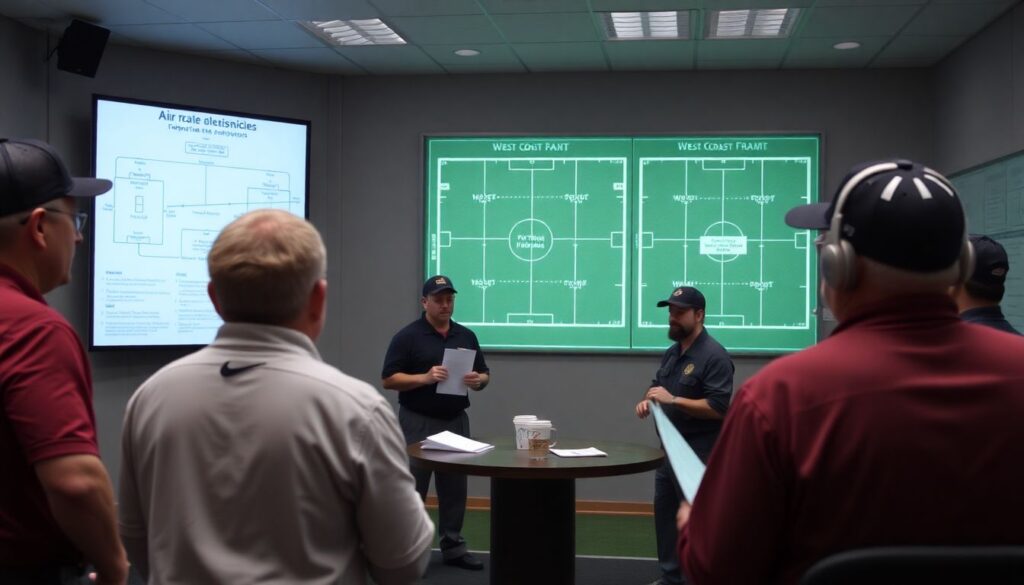
Air Raid-style systems are usually easier to install because they rely on fewer core concepts repeated often. A slimmed-down West Coast menu can work, but only if you commit to a small route tree and heavy emphasis on protections and play-action instead of a huge third-down package.
How many core run schemes should I carry in a season?
Most intermediate-level teams are better off with one main run (inside zone or power) and one change-up (counter, wide zone, or QB run) instead of four or five different runs. You can create variety with formations, motions, and tags rather than constantly adding new schemes.
Can I mix West Coast passing with spread run concepts?
Yes, and many modern offenses do exactly that. You can pair wide or inside zone and RPO tags with West Coast passing language and progression structures, as long as your terminology is consistent and your protections are clearly tied to specific passing families.
What is the easiest way to start learning play-calling structure?
Begin by studying a small, well-organized system rather than a massive playbook. That might be a concise spread offense playbook for coaches, a focused clinic series, or a reputable online course football play calling, and then applying it to your own personnel instead of copying it blindly.
How much should I worry about mirroring what NFL offenses do on Sundays?
Use the NFL more for ideas and teaching tape than as a template. Pro systems assume full-time players, large staffs, and deep playbooks. Your main filter should be whether a concept fits your quarterback, line, and practice time, not whether you saw it on a broadcast.
Is a run-heavy approach still viable in pass-oriented leagues?
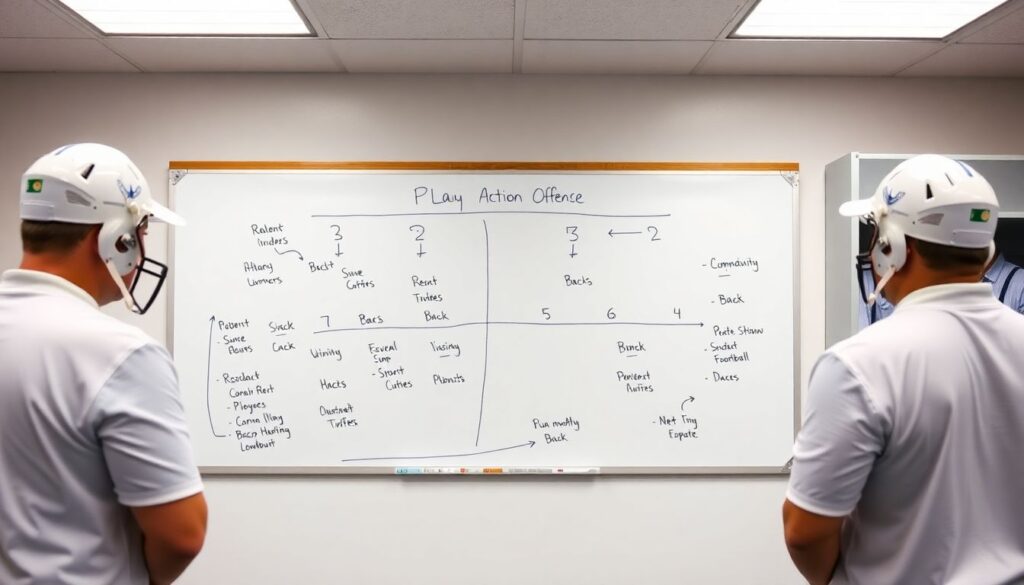
Absolutely, especially if your personnel favors linemen and backs over receivers. A run-heavy identity, paired with efficient play-action and selected shot plays, can shorten games, protect your defense, and create explosive opportunities against opponents built to defend spread passing attacks.
How do I keep my playbook from getting too big during the season?
Set a weekly rule that any new concept must replace something on the call sheet. Track actual game calls, cut unused concepts, and focus practice reps on what you know you will call in critical situations.