
Advanced analytics reshape play calling by turning film and tracking data into concrete probabilities for each option in a given situation. Coaches use models to compare expected points, success rates, and clock impact for every call. The most effective programs blend these insights with experience, roster realities, and live game context rather than obeying models blindly.
Strategic Highlights: How Analytics Reshape Play Calling
- Down-and-distance decisions increasingly rely on predictive models that estimate expected points and conversion likelihoods instead of gut feel alone.
- Real-time play calling optimization tools for coaches provide live win-probability shifts after each snap to guide tempo, aggressiveness, and fourth-down choices.
- Opponent tendencies and coverage shells are profiled using tracking and charting data, exposing highly specific call-vs-look advantages.
- Personnel and formation packages are optimized via clustering methods that reveal which groupings quietly drive efficiency by situation and field zone.
- Risk-aware coaches use analytics to frame trade-offs, not to dictate decisions, preserving room for injuries, weather, and locker-room dynamics.
- Both college football advanced stats subscription services and in-house NFL play calling data analytics platform builds are converging around similar core metrics.
- Smaller staffs increasingly lean on sports analytics consulting for football teams to jump-start model building and staff education.
How Predictive Models Inform Down-and-Distance Decisions
Predictive models help answer the core questions of play calling: run or pass, go for it or kick, tempo or clock bleed. They estimate outcomes such as expected points, turnover risk, and likely yardage for each option in a specific game state: score, time, field position, formation, and personnel.
This approach is best suited for programs that already self-scout, tag their film consistently, and are willing to adjust long-held tendencies. It pays off when you can commit to the process over a season, not just for a single game or headline decision.
It is not ideal when:
- Your data quality is poor or inconsistent, so models would be learning noise instead of signal.
- Staff bandwidth is so limited that maintaining the model will steal time from core preparation tasks.
- Leadership expects models to be perfect and blames analytics for every unlucky outcome.
- Key tactical constraints (roster depth, QB health, kicker reliability) are not yet captured in your data.
Safe first steps include using off-the-shelf football analytics software for play calling, reviewing its fourth-down and two-point charts, and then customizing thresholds to your own roster and league context before changing live game behavior.
Real-Time Game-Flow Adjustments Driven by Live Data
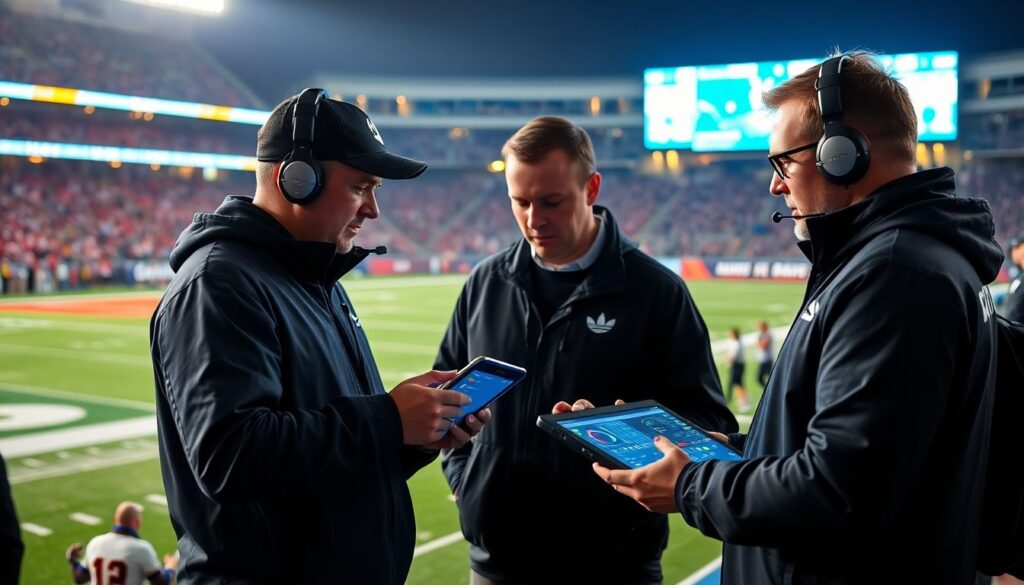
Live analytics turn static pre-game tendencies into dynamic guidance across four quarters. The goal is to update your expectations after each drive: how the opponent is calling coverages, where you are winning matchups, and how aggression should shift as win probability moves.
To run real-time analytics reliably, you will need:
- Data sources
- Play-by-play feed (league, in-house logger, or nfl play calling data analytics platform output).
- Tagging of formations, motions, coverages, and pressures from your booth or sideline staff.
- Optionally, player tracking or GPS data, if your league and resources allow.
- Tools and infrastructure
- A stable tablet or laptop workflow with real-time play calling optimization tools for coaches.
- Simple, prebuilt dashboards: current win probability, fourth-down recommendations, opponent blitz rates, and target share by receiver.
- Clear procedures for data entry to avoid latency and errors; late or wrong data is worse than none.
- People and communication
- One designated analytics voice in the headset to avoid confusion.
- Shared terminology between analysts and coaches for concepts like “aggression index” or “clock leverage” so advice is instantly actionable.
- Agreed rules on when to override the model (injury, weather, protection issues).
- Process safeguards
- Dry-run simulations during practice or scrimmages to test latency and clarity of reports.
- Post-game reviews that compare recommended vs. actual decisions and outcomes to refine thresholds.
College programs often lean on an external college football advanced stats subscription to supply baseline models, while many NFL clubs integrate those feeds into a bespoke nfl play calling data analytics platform tuned to their scheme and terminology.
| Metric | College impact | NFL impact | Coaching implication |
|---|---|---|---|
| Expected points by down-and-distance | Higher variance due to talent gaps and explosive plays; aggressive choices can swing outcomes quickly. | More stable, tighter ranges; small expected edge can still justify bold calls. | Use to set default go/kick thresholds, then adjust for roster and weather. |
| Success rate by personnel group | Helps identify mismatches vs. overmatched defenses or unconventional fronts. | Highlights subtle efficiency gains in common packages against elite competition. | Promote top packages into base calls for key downs; trim underperforming looks. |
| Coverage/pressure tendency by situation | Reveals aggressive DCs who may over-blitz in high-leverage spots. | Uncovers situational patterning in otherwise balanced NFL defenses. | Script constraint plays and shots targeted to those predictable calls. |
| Fourth-down conversion expectation | Can justify more fourth-down attempts given higher scoring environments. | Marginal gains still matter in close, possession-limited games. | Define zone-based rules (own territory, midfield, red zone) before kickoff. |
| Explosive play probability | Captures big-play threats and bust-prone defenses. | Shows when to selectively chase explosives vs. stay on schedule. | Decide where in the script to embed high-risk, high-reward calls. |
Opponent Modeling: Tendencies, Variance, and Counterstrategies
Before building step-by-step models, it is crucial to recognize the main risks and constraints in opponent analysis.
- Small sample sizes for specific situations can exaggerate apparent tendencies that are actually random.
- Personnel changes, injuries, or scheme adjustments can invalidate last year’s data quickly.
- Film charting inconsistencies (coverage labels, pressure types) can mislead models.
- Overfitting to one opponent may leave your own scheme too rigid for the rest of the schedule.
- Time pressure in game week limits how complex your modeling can realistically be.
With those caveats in mind, use the following safe and practical steps to build opponent models that genuinely inform your calls.
- Define the game-plan questions you want data to answer
Start with a short list of decisions, such as how the opponent defends trips, reacts to motion, or pressures on third-and-medium. This focus keeps your modeling tight and usable instead of drowning staff in dashboards.
- Assemble and clean opponent data
Pull play-by-play, charted film, and any tracking data across multiple games to cover different scripts and game states.
- Standardize labels for formations, motions, coverages, and fronts.
- Flag garbage-time and desperation situations so you can analyze them separately.
- Remove obvious data entry errors before any modeling.
- Estimate core tendencies with simple, transparent methods
Begin with basic split tables and visualizations rather than complex models. Look at run/pass, coverage shells, and pressure rates by down, distance, field zone, and offensive personnel.
- Highlight only the most stable, repeated patterns across multiple games.
- Note where the opponent shows deliberate self-scout corrections week to week.
- Measure variance and disguise, not just averages
For each identified tendency, assess how often the opponent breaks its own pattern. A tendency that flips in high-leverage spots is more dangerous to over-trust than a consistent baseline.
- Mark “can’t-help-it” behaviors (e.g., DC always brings pressure backed up) separately from situational gambles.
- Identify where game script (leading vs. trailing) shifts their behavior.
- Design counter calls tied directly to tendencies
Translate each robust tendency into one or two specific calls you like when you get that look or situation. Keep the mapping from pattern to play simple so it is usable under headset pressure.
- Build a small menu of “if they do X, we call Y” rules for third downs, red zone, and two-minute.
- Integrate these rules into your call sheet in a dedicated opponent-specific column.
- Stress-test the plan with “what if they break tendency” scenarios
Run through scenarios where the opponent intentionally flips its patterns. Decide in advance how many series you will tolerate being surprised before you reclassify their behavior and adjust.
- Close the loop with post-game review
After the game, compare predicted vs. observed opponent calls, documenting where your model held and where it failed. Update your templates so the same misreads are less likely next time.
If your staff is newer to this level of work, engaging sports analytics consulting for football teams can accelerate building these workflows while keeping them realistically sized for your resources.
Personnel and Formation Optimization through Clustering and Matchups
Clustering methods group plays by similar personnel, formation, motion, and defensive response, revealing which combinations quietly drive efficiency. To ensure your optimization efforts are on track, use this practical checklist.
- Key personnel groupings (e.g., specific WR or TE combinations) are clearly tagged and consistently recorded across games.
- You can quickly identify your top and bottom formations by success rate in core situations (early downs, third-and-medium, red zone).
- Your call sheet highlights a small set of “go-to” packages for high-leverage downs, informed by data rather than habit.
- Underperforming formations are either improved (route tweaks, motion changes) or consciously de-emphasized in the game plan.
- Matchup notes (who blocks or attacks which defender) are attached to specific personnel/formation combinations on the sheet.
- Clustering analysis accounts for opponent strength so strong results vs. weak teams do not drive decisions alone.
- Staff can explain in plain language why each featured package is on the plan, based on data-backed advantages.
- New or experimental groupings are trialed in low-risk situations first before being trusted in crucial downs.
- There is a regular cadence (weekly or bi-weekly) to refresh clustering outputs rather than relying on outdated conclusions.
- Feedback from position coaches and players is captured to validate that analytically favored formations are comfortable and executable.
Risk Management: Balancing Model Recommendations and Coach Judgment
Analytics should widen a coach’s field of view, not narrow it. Many missteps come from either overtrusting numbers or ignoring them altogether. These are common pitfalls to avoid when blending models with human judgment.
- Treating model outputs as orders instead of estimates, leaving no room for context like injuries or matchup issues.
- Using a single global threshold (for fourth downs or two-point tries) without adjusting for roster strengths or game stakes.
- Failing to communicate model assumptions to staff, causing confusion when recommendations differ from intuition.
- Updating models too rarely, so they continue to recommend plays based on an outdated depth chart or scheme.
- Ignoring data latency and feeding coaches live recommendations that are a play or drive behind the real game.
- Overfitting models to one season’s trends and being surprised when league-wide tactics evolve.
- Measuring success solely by single high-profile decisions instead of evaluating the overall edge gained across many calls.
- Letting confirmation bias creep in by only highlighting model wins when they match preexisting beliefs.
- Undertraining new staff on tools, leading to misuse of dashboards during critical moments.
- Skipping post-game audits that compare what the model advised to what was actually called and why.
Operationalizing Analytics: Integrating Models into College and NFL Playbooks
Turning analytics into a reliable part of your playbook can follow several paths, depending on budget, staff size, and league rules. These alternatives can be combined or phased in over time.
- Lightweight external subscription model
Rely on a college football advanced stats subscription or similar service for standardized metrics, while internal staff translates insights into your terminology. This suits smaller college programs or high schools starting out.
- In-house integrated platform
Build or license an nfl play calling data analytics platform that merges scouting, self-scout, and in-game data into one system. This fits larger college and NFL organizations that can support dedicated analysts and engineers.
- Hybrid plus consulting support
Combine off-the-shelf football analytics software for play calling with periodic sports analytics consulting for football teams. External experts help tune models and workflows, while your staff owns daily operations.
- Playbook-embedded decision guides
Instead of heavy tech, encode analytics as simple rules and charts directly into the call sheet and practice scripts. This is effective where technology access on the sideline is constrained or staff prefers minimal devices.
Implementation Concerns and Practical Answers
How do we start without overwhelming our current staff?
Begin with one or two decision areas, such as fourth-down choices and red-zone calls. Use simple reports generated from existing data rather than building a full platform. Expand only after coaches confirm the first outputs are understandable and useful.
What if our data is too messy for reliable models?
Focus first on cleaning and standardizing your charting process for formations, coverages, and outcomes. Until quality improves, favor descriptive stats and film-backed insights over complex modeling. You can also lean on external providers whose data pipelines are already stable.
How do rule and hash differences affect college vs. NFL analytics?
College hash marks and clock rules change field spacing, run-pass balance, and tempo value. Models and thresholds built for the NFL should not be copy-pasted into college. Calibrate recommendations using league-specific data and film before trusting them.
Can we safely use real-time tools if our sideline connectivity is unreliable?
Yes, if you design your system to degrade gracefully. Preload static decision charts for common situations, then treat live updates as a bonus rather than a dependency. Regularly test your setup in stadium conditions before game day.
How do we prevent players from feeling like decisions are made by computers?
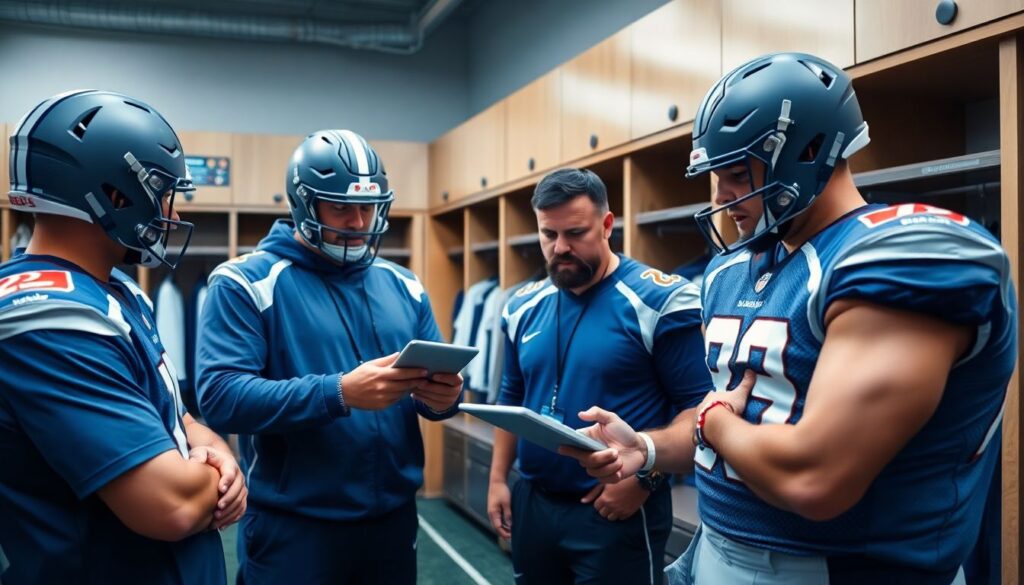
Emphasize that analytics inform decisions but do not replace coaches’ trust in players. Share high-level reasoning with leaders in each position group, framing data as another way to put them in favorable situations, not to micromanage them.
Is it worth hiring outside consultants instead of building everything in-house?
Consultants can accelerate design and training, especially for teams without analytics background. However, long-term success requires internal ownership. A common path is to use consultants early, then transition to a small permanent analytics group.
How should we measure whether analytics are actually helping our play calling?
Track decision quality over time: expected value of choices made vs. model alternatives, not just results of individual plays. Look for consistent improvement in efficiency metrics in targeted situations rather than chasing single-game validation.