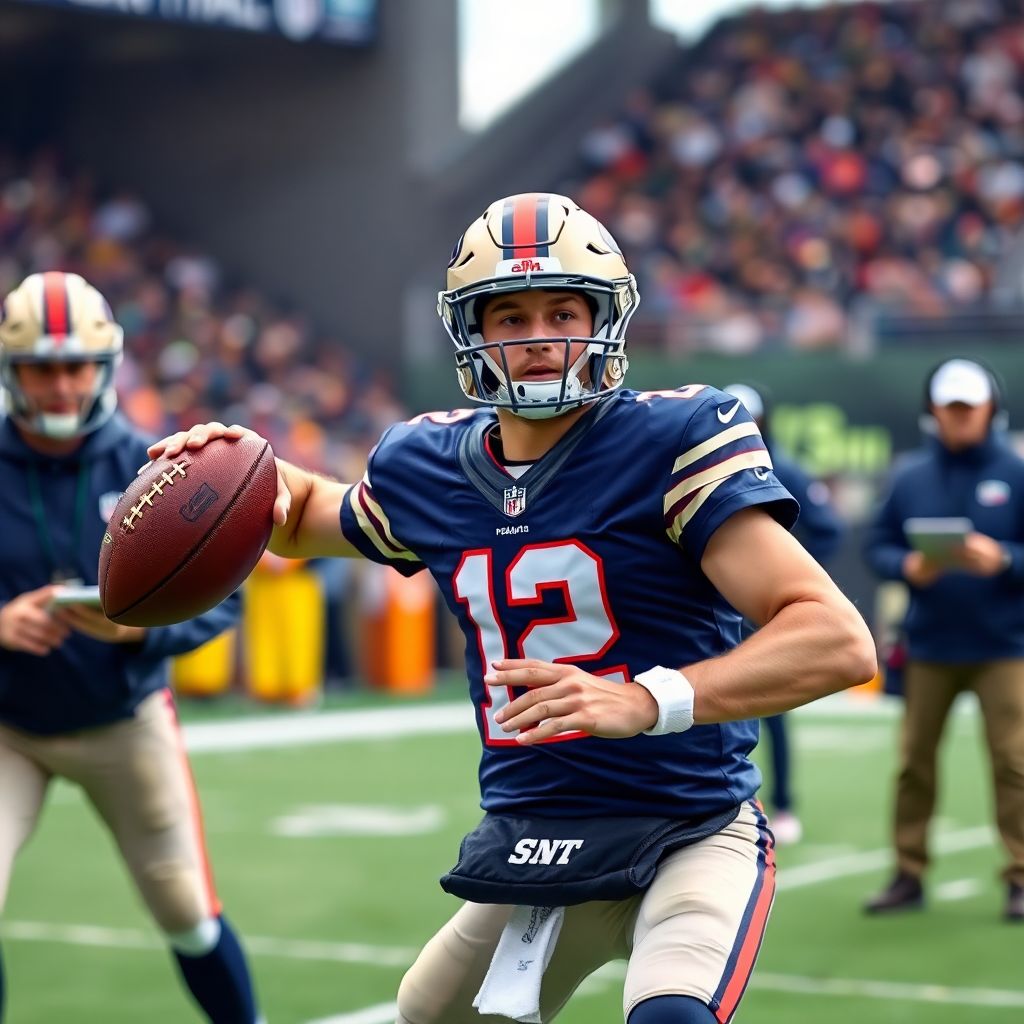
Rookie quarterbacks are redefining NFL offenses by forcing coaches to streamline reads, lean into mobility, and build pass games around day-one strengths instead of complete playbooks. The result is more spread, play‑action, option looks, and defined read progressions that trade raw volume for efficiency, clarity, and faster on-field decision making.
Core Concepts: How Rookie QBs Reshape Offenses
- Coaches trim playbooks and emphasize concepts the rookie already executed in college.
- Tempo, formation variety, and motion are used to simplify defensive pictures.
- Run game and protection rules are adjusted to protect the rookie and widen throwing windows.
- Route structures become more defined, with clearer primary and secondary reads.
- Quarterback movement (boots, sprint-outs, RPOs) is used to offset processing growing pains.
- Personnel decisions and usage patterns increasingly revolve around the rookie’s comfort zones.
How Rookie QBs Change Play-Calling and Tempo
NFL rookie quarterbacks 2024 and beyond are changing how coordinators script games. Instead of dropping a newcomer into an existing system untouched, staffs now rebuild weekly plans around what the rookie can process, protect, and attack. That shifts everything from opening scripts to red-zone menus and two-minute strategy.
Play-calling typically moves from breadth to depth. Rather than 15 slightly different concepts, coaches call a narrower set of families (e.g., slant/flat, flood, scissors) from multiple formations and motions. The rookie sees the same coverage beats repeatedly, which speeds recognition and confidence.
Tempo is also weaponized. Faster tempo limits defensive disguises and exotic pressures because the defense has less time to substitute and spin safeties. Coordinators may use “tempo pockets” after explosive plays or first downs, stringing two or three calls the rookie already knows by heart to keep him out of the huddle and in rhythm.
On early downs, offenses lean into play-action, quick game, and defined half-field reads to stay ahead of the sticks. On third down, many coordinators accept fewer deep, full-field progressions and call more bunch, rub, or pick concepts that naturally shake free the first or second read.
Predictive Metrics: Traits That Signal Immediate Offensive Impact
When projecting which passers might become the best rookie quarterbacks in the NFL in any given class, teams do not just chase arm strength. They look for indicators that a rookie can keep an offense on schedule from Week 1.
- Processing speed under pressure: How quickly the quarterback gets from first to second to third read while bodies close in, both on film and in timed decision-making drills.
- College third-down performance: Conversion rate in obvious passing situations, especially against man coverage and simulated pressures, shows whether the QB can create in tight windows.
- Accuracy in the short and intermediate areas: Ball placement on slants, digs, and option routes determines if quick-game heavy scripts are viable early.
- Pocket movement and escapability: Subtle climbs, lateral slides, and controlled escapes keep more plays on schedule even when protection is imperfect.
- Pre-snap command: Evidence of protection checks, hot adjustments, and audibles on college tape suggests the rookie can handle more at the line.
- Explosive-play creation: Ability to generate chunk gains off-script, via scrambling or deep shots, can lift an entire playbook even while other areas develop.
- Turnover profile: Decision quality on risky throws, not just raw interceptions, drives how aggressive coaches are willing to be with early play-calling.
Scheme Adaptations: Simplifying Concepts Without Limiting Upside
NFL offensive schemes for rookie QBs share one core priority: simplify the quarterback’s world while keeping the defense stressed. Done well, it feels to the rookie like a pared-down system, but the defense still has to honor vertical shots, motion, and varied personnel looks.
1. Leaning on familiar college concepts
Coaches import staples from the rookie’s college playbook: mirrored outs, shallow cross, Y-cross, quick RPOs. Terminology changes, but the pictures stay familiar. This fast-tracks confidence and lets coordinators call aggressive concepts sooner because the QB already understands their timing and answers versus common coverages.
2. Building around half-field and layered reads
Instead of full-field “pure progressions,” many staffs use half-field reads: a high-low on the sideline paired with a checkdown, or a three-level flood on one side. The rookie is told exactly where his eyes go; backside routes are often “clear-out” or late answers, not core reads.
3. Marrying the run game and pass concepts
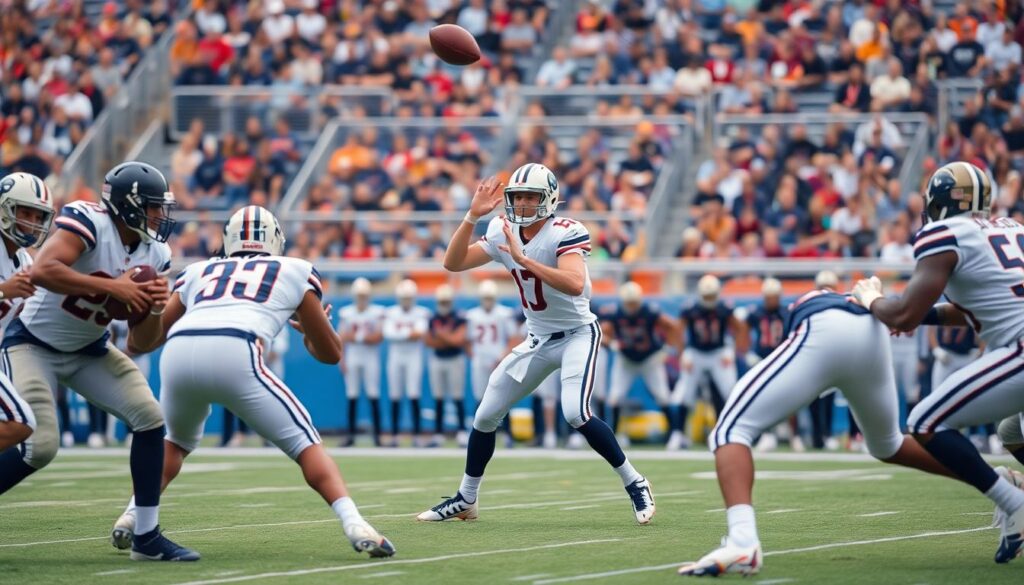
Play-action, bootlegs, and RPOs connect the run game directly to the pass. The line blocks wide zone, the back sells the run, and the QB is reading a single defender. That singular key (force defender, backside linebacker, or slot defender) replaces an entire coverage shell in the rookie’s decision tree.
4. Using formation and motion as the hard work
Instead of asking the rookie to process dozens of coverages, coordinators do the heavy lifting with shifts and motion. Bunch, stacks, and jet motion create leverage and easy answers versus man or zone. The QB learns simple rules: “If the defender chases motion, throw X. If he bumps, throw Y.”
Mini-scenarios: applying adaptation ideas in real situations
Scenario: backed up near your own goal line. Call mirrored quick outs with a running back checkdown. Protection is simple, reads are fast, and the QB has a safe throw versus both man and soft zone while avoiding long-developing concepts in a dangerous area.
Scenario: second-and-medium after a successful run. Use a bootleg off the same run look. The rookie fakes the handoff, rolls into the flat, and reads a three-level flood to one side. If the flat is capped, he hits the intermediate crosser or throws it away without ever needing to see the backside coverage.
Scenario: red zone versus a pressure-heavy defense. Dial up a quick pick-route concept from a tight bunch. Tell the QB pre-snap where the ball should go versus man or zone. His job is not to be a hero; it is to identify leverage and throw on time.
Adjusting the Supporting Cast: O-Line, Running Game, and Receiver Roles
Redesigning an offense for a rookie passer is not only about what the QB does; it is about what everyone around him stops doing or starts doing. Protection, run game emphasis, and receiver deployment all quietly change to keep the rookie upright and his reads uncluttered.
These changes bring clear advantages, but they also impose ceilings. An offense built to insulate a young QB can become predictable if it never gradually expands. Staffs must balance short-term stability with the long-term goal of building a full, sustainable system as the quarterback matures.
Benefits of reshaping the supporting cast
- Simplified protections: More slide and half-slide schemes reduce communication errors and free the QB from constantly re-mapping fronts.
- Run-first sequencing: Heavier early-down runs and play-action help keep pass rushers honest and create bigger throwing windows.
- Defined receiver roles: Veterans handle option-heavy routes, while younger receivers run clearer landmarks, giving the QB dependable timing targets.
- Protection-friendly route trees: More quick-breaking routes and built-in hot throws give the line better odds against pressure.
- Use of tight ends and backs in pass pro: Keeping extra bodies in helps survive elite rushers while the rookie learns to manage the pocket.
Limitations and trade-offs to monitor
- Constrained vertical attack: Extra protectors can mean fewer vertical threats, allowing safeties to sit on intermediate concepts.
- Predictable tendencies: Over-reliance on certain formations or protection types can tip defenses to runs or specific pass concepts.
- Stalled development of full-field reads: If the offense never moves beyond half-field concepts, the QB’s growth can plateau.
- Receiver frustration: Playmakers used primarily as decoys or blockers may disengage if they rarely get progression priority.
- Run game overexposure: Leaning too heavily on the ground game invites stacked boxes and tougher down-and-distance situations.
Coaching Practices to Accelerate In-Game Decision Making
Even with a friendly scheme, rookie quarterbacks only thrive if daily coaching habits are tailored to NFL speed. The transition from college to professional defenses is less about memorizing a playbook and more about shrinking decision time from snap to release without panicking mechanics.
- Mistake: overloading the weekly install. Myth: “If he learns more on the board, he will play faster.” Reality: too many new concepts lead to hesitation and late throws. Tight, repeated installs beat encyclopedic game plans.
- Mistake: chasing the perfect look instead of good answers. Some coaches burn timeouts and delay-of-game penalties hunting ideal plays. Teaching the rookie to work within a “good” call and find his pressure answers matters more.
- Mistake: grading outcome, not process. A completed pass after a late, risky read can be a worse rep than an incompletion thrown on time to the right matchup. Process-based grading accelerates long-term decision quality.
- Mistake: neglecting situational walk-throughs. Rookies often struggle most in two-minute, four-minute, and red-zone situations, not base downs. Daily, scripted situational work builds automatic responses when the clock and score compress choices.
- Mistake: assuming mobility solves everything. A dual-threat rookie can mask bad reads with scrambling, but that habit stalls development. Coaches must pair movement calls with strict rules about when to throw, when to reset, and when to run.
Illustrative Case Studies: Recent Rookies Who Altered Team Identities
Recent seasons have shown how fast a young passer can reshape an entire franchise. While names and systems differ, the patterns are consistent: condensed playbooks, tempo shifts, and heavy use of movement and play-action as bridges to a more complete offense.
Case pattern 1: college carryover offense. A team drafts an RPO-heavy college star and immediately layers his favorite glance and bubble tags into the NFL run game. The rookie is given simple pre-snap box counts and a post-snap key defender. Passing volume is modest, but efficiency spikes and the offense looks structurally different overnight.
Case pattern 2: protection-first rebrand. Another club inherits a rookie with strong pocket skills but average mobility. The offensive line coach and coordinator pivot to quick-game concepts, condensed splits, and heavy use of tight ends in protection. Sacks drop, and the team leans on ball control while the vertical game is built piece by piece.
Case pattern 3: explosives as the identity. A big-armed rookie enters a previously conservative system. Coaches accept some volatility and design shot plays off max protection, plus controlled scramble drills. Even before the QB is fully polished, the franchise’s reputation flips from methodical to explosive, forcing defenses to play lighter boxes and respect the deep ball.
These evolving approaches also ripple into adjacent spaces. Fantasy football rankings rookie quarterbacks now weigh scheme fit, rushing role, and early play-calling aggression, not just draft slot. Fans tracking NFL jerseys rookie quarterbacks for sale are often reacting to these changing offensive identities as much as to raw stat lines.
Practical Questions Coaches and Analysts Ask
How many concepts should a staff realistically feature for a rookie quarterback early in the season?
Most staffs focus on a small set of core concepts run from many looks rather than a huge play menu. The key is depth of mastery: repeated reps of a few families (quick game, play-action, boot, basic dropback) so the QB recognizes answers instantly on Sundays.
What kinds of plays best protect a rookie from disguised coverages and exotic blitzes?
Play-action, half-rolls, RPOs, and defined half-field reads blunt disguise because the QB’s eyes are anchored on a limited slice of the field. Bunch and motion also reveal man versus zone, giving the rookie simpler pre-snap pictures and safer post-snap rules.
When should coaches start expanding to full-field progressions with a young passer?
Expansion should follow consistent mastery of half-field reads and situational football, not a calendar date. Once the rookie repeatedly hits his first or second read on time, protects the ball, and manages protections, coaches can layer in backside routes and more multi-break patterns.
How do rookie tendencies affect defensive game-planning against them?
Defenses often test rookies with late safety rotations, simulated pressures, and tight red-zone windows, betting on slow processing. If the offense leans too heavily on obvious quick game, defenders will jump routes; if it leans too much on deep shots, they bring pressure and force faster decisions.
What should analysts watch for to judge whether a rookie QB is actually improving?
Improvement shows in earlier decisions, fewer protection busts, better pocket movement, and more consistent ball placement on routine throws. Even if raw stats fluctuate, quicker checkdowns versus pressure and smarter throwaways are strong signs of growth in an evolving offensive structure.
How does all of this change how we value rookies in fantasy football formats?
Scheme and usage are critical. Dual-threat rookies in QB-friendly systems with designed runs, RPOs, and play-action often out-produce their pure-passer peers early. That is why fantasy football rankings rookie quarterbacks now emphasize rushing role, red-zone design, and coordinator tendencies as much as draft pedigree.