
If you coach offense at any level, you’re not just calling plays anymore — you’re managing a 100‑year experiment in how to move the ball. The whole journey from three-yards-and-a-cloud-of-dust to five-wide and RPOs isn’t just history trivia; it’s a toolbox you can actually use on Friday nights or Sunday afternoons.
Below is a practical guide to treating the evolution of offensive schemes as something you can install, teach, tweak, and fix — not just read about.
—
Why the Evolution of Offense Matters to You
Defenses now prepare with a modern offensive football schemes playbook on their laptops and in their meeting rooms. They’ve seen everything on Hudl. You don’t win anymore by running one clever concept; you win by understanding where your scheme came from, what it’s good at, and how to adapt it in real time.
Short version: if you know how ground-and-pound, West Coast, spread, and Air Raid ideas fit together, you can build a system that fits your players instead of forcing your players to fit a system.
—
From Ground-and-Pound to Space and Pace
The Power Roots: Ground-and-Pound as a System
Early offenses were brutally simple: overloading gaps, double-teams at the point of attack, and hammering the ball until the defense broke. Think I‑formation, fullback leads, iso, power, trap, toss.
Long paragraph: The important thing here isn’t nostalgia; it’s understanding *why* this stuff still works. Ground-and-pound is about certainty: fewer reads, more bodies at the point of attack, and a physical identity that travels in bad weather and high-pressure games. If you coach youth, small-school, or roster‑limited teams, that mentality — not just the formations — can still be your competitive edge.
Short point: The DNA of every good run game today still traces back to those gap, iso, and zone concepts.
—
The Shift: From Brute Force to Controlled Passing
As rules protected quarterbacks and receivers and hash marks changed spacing, passing became less of a gamble and more of a weapon. West Coast, Erhardt–Perkins, and timing-based systems turned passes into “long handoffs” and extension of the run game.
This shift matters for you because it reframed offense as math and timing, not just muscle. Quick game, spot concepts, and horizontal stretches helped smaller, smarter teams level the playing field. If you coach in a league where you’re usually out-sized, this is the chapter of history you should be stealing from every week.
—
The Spread and Air Raid Era
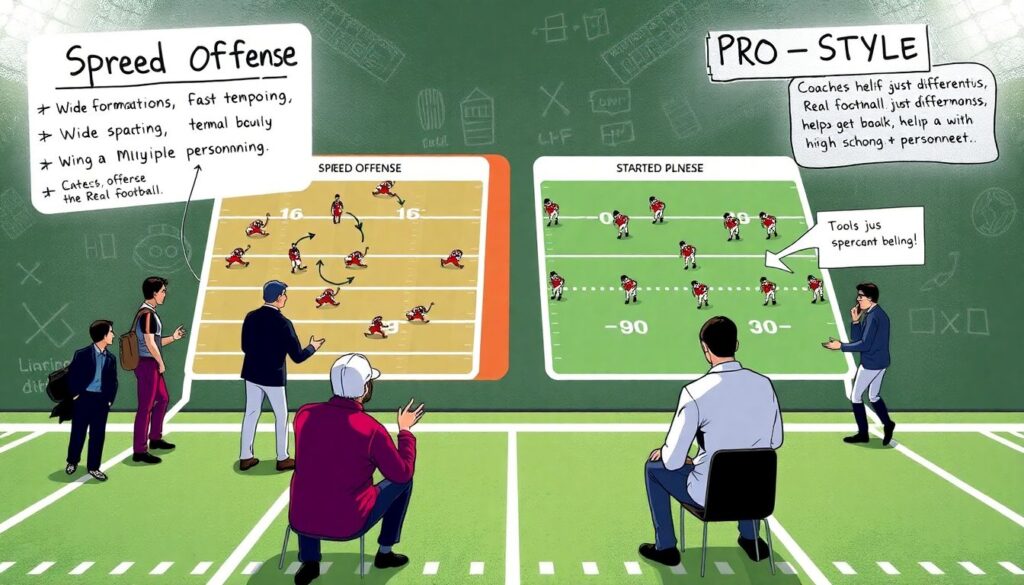
The conversation now often circles around spread offense vs pro style offense analysis: which is better, which is more “real football,” and which one gets your kids recruited. Truth is, that’s the wrong question. Spread is a set of tools (formations, tempo, spacing), pro-style is a set of tools (personnel groupings, under-center/under-control, full route trees). You can — and probably should — steal from both.
Longer view: Pure Air Raid took this to an extreme: minimal playbook, maximal reps, ruthless focus on spacing, option routes, and letting the QB be right. If you’ve ever watched an air raid offense coaching clinic online, you’ll notice they obsess over details like receiver splits, route stems, and QB eyes more than scheme size. That’s the real lesson: it’s not how much you know; it’s how well you execute a small set of answers.
—
Necessary Tools for a Modern Offensive Architect
1. Concept-Based Playbook (Not Just a List of Plays)
You need something more structured than random diagrams scribbled in a notebook, but less bloated than an NFL binder. When you design your own modern offensive football schemes playbook, focus on concepts that repeat:
1. Core runs (inside zone / outside zone / gap)
2. Core quick game (slant/flat, stick, spacing)
3. Core dropback (flood, dagger, drive)
4. Core screens (RB, WR, TE)
5. Core play-action / RPOs
Short note: If a play doesn’t tag off those cores, it probably doesn’t belong — or it needs a very specific reason to exist.
—
2. Film and Cut-Ups
You don’t need a fancy system to act like a pro. You *do* need consistent cut-ups:
– Your base runs and passes
– Situational football (3rd and medium, red zone, 2‑minute)
– Opponent fronts and coverages
The “evolution” shows up when you notice how teams are stopping you — too-high shells, simulated pressure, odd fronts — and you respond by borrowing smarter answers from other eras: more motion, compressed splits, bunch, or heavy sets.
—
3. Learning Resources (Books and Clinics)
If you want depth and context, look for the best books on evolution of football offensive schemes rather than just “cool new plays.” You’ll find that most cutting-edge ideas are old concepts with modern window dressing.
Short application: Combine that with an air raid offense coaching clinic online, and suddenly you’re not just copying plays; you’re understanding the ideas behind mesh, Y‑cross, or four-verts, and how they mesh (pun intended) with your existing system.
—
Step-by-Step: How to Build an Offense Using 100 Years of Ideas
Step 1: Start with Who You Are, Not What You Saw on TV
Before arguing spread vs “pro style,” ask:
– How smart is my QB as a decision-maker?
– How many linemen can actually move and reach block?
– How many kids can legitimately win 1‑on‑1 outside?
– What’s my practice and meeting time reality?
Short guideline: Your scheme should be the answer to “What can *these* kids do, at speed, under pressure?” Not “What do the college playoff teams run?”
—
Step 2: Choose Your Base Family (Run First, Then Pass)
Use the historical menu, but be ruthless:
1. Pick a primary run structure
– Zone-based (outside/inside zone, slice, split zone)
– Gap-based (power, counter, GT, trap)
2. Pick 1–2 secondary runs
– Best if they *look* the same to the defense (same formations, motions)
3. Pair passing concepts with those runs
– Ground-and-pound DNA? More under-center play-action, boots, deep crossers
– Spread/Air Raid DNA? More quick game, RPO, and vertical stems
Short takeaway: Don’t overcomplicate your run game; complexity belongs in presentation (formations, shifts, motions), not in your blocking rules.
—
Step 3: Steal from Pro Style and Spread Intelligently
This is where spread offense vs pro style offense analysis turns practical.
– From “pro style,” steal:
– Condensed formations for leverage in the run game
– Under-center play-action and movement passes
– Full-field progression reads
– From “spread,” steal:
– Tempo as a weapon
– Formations to force declarations from the defense
– Simplified read structures for the QB
Longer reflection: Your job is to decide *when* each tool serves you. Third-and-short in bad weather? That’s a great time to look like 1980s ground-and-pound. 2‑minute drill vs tired DBs? Go spread, go fast, and make them tackle in space.
—
Step 4: Build a Weekly Install Plan
Treat evolution as a phased install, not a giant dump of concepts:
1. Week 1–2: Core runs + screens; 1–2 quick game concepts
2. Week 3–4: Play-action off those runs; 1 dropback concept
3. Midseason: Tag variations (switch releases, motion, formation tweaks)
4. Late season: Situational wrinkles (red zone picks, 4th-down specials)
Short note: Modern offense is less about “new plays every week” and more about new *pictures* of the same base plays.
—
Step 5: Translate Ideas into Language Your Players Actually Use
Historical Xs and Os are useless if your kids are confused. Use simple, consistent language:
– Concepts named by what they *do* (e.g., “Flood,” “Bubble,” “Slice”)
– Tags that always mean the same thing (e.g., “Swap” always flips responsibilities; “Zip” always motions Z)
If you ever need to hand your staff or players a resource, you can download advanced football offensive playbook pdf examples from clinics and programs, then strip them down to match your vocabulary and your install tempo.
—
Practical Troubleshooting: Fixing Common Offensive Problems
Problem 1: You Can’t Run the Ball vs Modern Fronts
Longer breakdown: Defenses today fit the run with light boxes, creepers, and late safety rotation. This is where your ground-and-pound ancestry helps. If your zone schemes are getting muddy:
– Add a simple gap scheme (power/counter) to make your linemen more aggressive.
– Use condensed sets and TE wings to create extra gaps.
– Use motion to identify and manipulate the force player.
Short rule: When the run gets cloudy, *simplify* rules and tighten formations.
—
Problem 2: Your Passing Game Looks Pretty but Produces Nothing

History lesson applied: The high-flying passing teams you see have thousands of practice reps on just a few concepts. You probably don’t. So:
– Cut down the play menu.
– Emphasize spacing rules and timing.
– Build everything off 3–4 core concepts (mesh, flood, stick, four-verts).
Short reminder: Air attacks don’t work because they’re fancy; they work because they’re ruthlessly repetitive.
—
Problem 3: Your QB is Overwhelmed by Reads
When your QB stalls, it’s a sign your scheme is evolving faster than your teaching.
Try this:
1. Collapse your pre-snap checklist (one coverage ID, one safety count, one “hot” alert).
2. Limit post-snap reads to either a defender (RPO, glance, stick) or a side (half-field reads).
3. Use pure progression concepts (1–2–3–checkdown) in obvious passing situations.
Short fix: Tie your QB’s eyes to one defender or one side as often as you can.
—
Problem 4: Defenses Know What’s Coming
If you’re predictable, think like an evolutionary biologist: the defense has “adapted” to your environment.
Counter-adapt by:
– Using the same plays from multiple personnel groupings.
– Packaging runs and passes into RPOs or run-pass “families.”
– Borrowing one or two wrinkles a week from higher-level film.
Longer thought: You’re not reinventing your system every week; you’re changing how it *looks* so defenses can’t get comfortable.
—
Using History to Solve Modern Problems
Blend Eras, Don’t Worship Them
Your offense can:
– Run old-school iso from 11 personnel.
– Call West Coast quick game with spread formations.
– Use Air Raid spacing rules while still carrying a power run game.
That’s the real value in studying scheme evolution: you see that today’s “innovation” is usually a remix. That understanding makes you a calmer play-caller — you recognize patterns instead of chasing trends.
—
How to Keep Learning Without Drowning
You don’t need to become a full-time researcher, but you do need a simple learning rhythm:
1. In the offseason, pick one historical system to study in depth (e.g., classic West Coast, old-school wishbone, early Air Raid).
2. In-season, watch 1–2 games a week of offenses similar to yours.
3. Each month, steal exactly one idea and actually install it.
Using the best books on evolution of football offensive schemes as your foundation, plus targeted clinics and film study, keeps you evolving on purpose instead of randomly throwing in trick plays.
—
To Wrap Up
If you treat offense as a living thing, not a static play sheet, the “evolution of offensive schemes” stops being an abstract topic and starts being your daily edge.
You don’t have to be ground-and-pound, or pure spread, or full Air Raid. You can be a thoughtful mix: power in the run game, simple in the reads, aggressive in the formations, and deliberate in how you teach.
Use history as your toolbox, not your museum. Then tailor it ruthlessly to the kids in your huddle.