
Advanced analytics changes game performance work from gut-feel to repeatable experiments: instrument the game, track player behavior, build simple metrics, then use dashboards and models to decide what to tweak next. Start narrow: one goal, a few events, a baseline metric, a small A/B test, and a clear rollout rule.
Analytics-driven Game Performance Snapshot
- Define game performance in business and player terms: revenue, retention, win rates, fairness, latency, and satisfaction.
- Use game performance analytics software to centralize telemetry from client, server, and external services.
- Track player behavior with focused event schemas tied to specific design or monetization questions.
- Adopt real-time game analytics solutions only where fast in-game reactions matter, such as matchmaking or fraud detection.
- Use advanced game data analytics services for heavier workloads like churn prediction or balance modeling.
- Prioritize actionable KPIs over vanity metrics; every chart should connect to an experiment or decision.
From Metrics to Meaning: Core Concepts of Advanced Game Analytics
Advanced game analytics is the systematic collection, processing, and interpretation of in-game and surrounding data to improve performance, retention, and monetization. It turns scattered logs into structured signals that explain what players do, why they leave, and which changes actually move your KPIs.
Practically this means combining telemetry from your client, servers, and payments into a unified warehouse, then layering video game player behavior analytics tools, dashboards, and models on top. Good setups let designers, product managers, and analysts answer questions without digging through raw logs.
Scope-wise, it covers both competitive titles that resemble a sports performance analytics platform (win probability, strategy efficiency, stamina/fatigue proxies) and casual games focused on progression, session length, and monetization funnels. The core is the same: define clear metrics, test changes, and measure impact.
Instead of tracking everything, advanced analytics starts from decisions: what to buff or nerf, which onboarding to ship, which offer to show. Metrics and models are then designed backward from those decisions, making reports lean and immediately usable.
Data Pipelines and Instrumentation for Accurate Performance Insights
Under the hood, you move from raw events to queryable data in a few repeatable steps that any intermediate team can implement.
- Event design and schema
Define a compact event schema:session_start,level_start,level_complete,purchase_made,match_result. For each event, standardize properties: player ID, timestamp (UTC), platform, version, match/level ID, key numeric values (score, duration, spend). - Client and server logging
Instrument the game client to send events on clear triggers (button clicks, level transitions, match start/end). Mirror important events server-side (auth, matchmaking, economy) to avoid client-side cheating and data loss. Use batched sends rather than one HTTP call per event. - Ingestion and queueing
Push events into a message broker or streaming layer (e.g., Kafka, Kinesis, Pub/Sub). This decouples the game from downstream outages and lets you scale processing. Tag each stream by environment (dev/stage/prod) and game version so you can filter when debugging. - Storage for analytics
Load events into a warehouse (e.g., BigQuery, Snowflake, Redshift) in append-only tables. Partition and cluster by date and player ID. This is where your game performance analytics software, BI dashboards, and custom SQL queries will connect. - Transformations into metrics tables
Schedule SQL or dbt models to compute common aggregates: daily active users, retention cohorts, funnel steps, per-match stats, per-hero performance. Materialize these as separate tables so dashboards stay fast and non-technical stakeholders can explore safely. - Access via tools and APIs
Connect BI tools, internal dashboards, or custom APIs to the warehouse. Give designers canned queries like “win rate by hero and MMR bracket” instead of raw table access. For compute-heavy models, expose a batch output table or a small scoring API.
Well-instrumented pipelines let you choose between off‑the‑shelf analytics dashboards, custom video game player behavior analytics tools, or hybrid setups without changing the game code every time.
Concrete Application Scenarios Built on the Pipeline
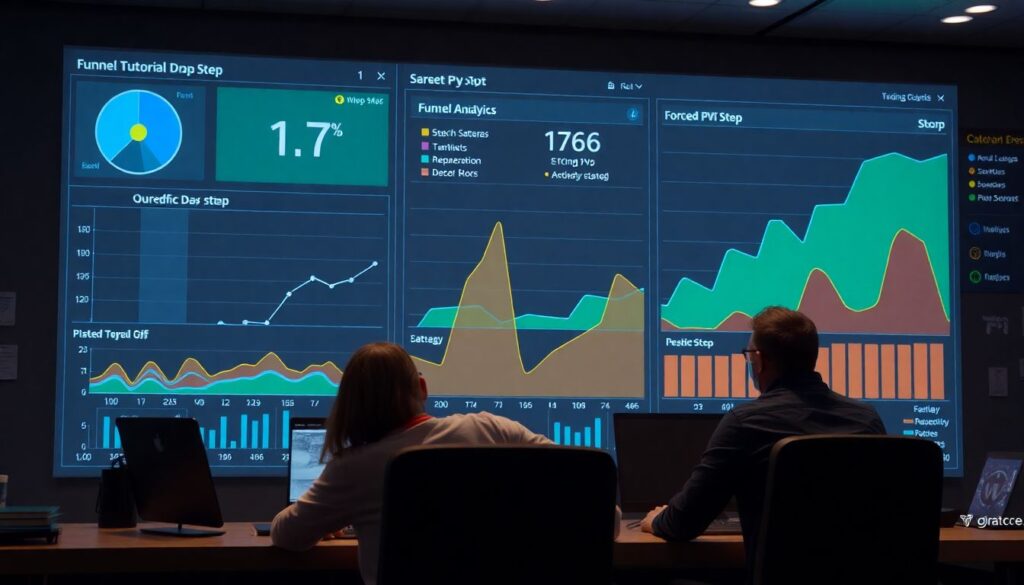
Once your pipeline is stable, a few focused scenarios show immediate value before you attempt anything complex.
- Onboarding drop-off analysis
Use funnel tables to see where players abandon the tutorial. If you see a steep drop at “step 3: forced PvP”, run an experiment with a PvE alternative and compare completion and day-1 retention. - Matchmaking quality tuning
Compute “fairness” as the share of matches that end within a target duration and score difference. Change matchmaking constraints (e.g., MMR range) and track fairness and queue times side by side to find a workable balance. - Economy sink and source balancing
Aggregate soft currency earned and spent per day, per player segment. If “sources” consistently exceed “sinks” for late‑game players, shortages never appear and upgrades feel trivial; introduce new sinks and monitor the slope. - Offer segmentation
Tag players by spend history and progression speed. Create two offer variants and push each to a defined segment. Compare conversion and long‑term retention to avoid short-sighted offers that hurt engagement.
These scenarios keep advanced analytics tied to specific, testable decisions rather than abstract data collection.
Player-centric Telemetry: Measuring Behavior and Experience
Player-centric telemetry focuses on what players actually experience, not only what the server sees. It connects in-game behavior to emotions and perceived fairness so you can adjust systems with confidence.
- Session and lifecycle tracking
Track each session start/end, session length, and time between sessions. Build views like “average sessions per day by level bracket” to detect grind walls or content deserts. - Progression and difficulty curves
Log level attempts, success, failure reasons, and time-to-complete. Plot success rates by attempt number and player power. If success jumps from 30% to 90% after one upgrade, your progression might be too spiky. - Combat and skill usage patterns
Capture ability usage, hit/miss, deaths, and survival time. For PvP-like games, this is where a sports performance analytics platform mindset helps: track positioning, rotations, and decision timing to refine maps and abilities. - Economy and store behavior
Log every currency source/sink, store view, and purchase, including offer ID and context (entry point, time since last purchase). Use these to build funnels and understand why a store page gets traffic but no conversions. - Technical and UX quality indicators
Collect FPS, ping, disconnects, and client errors. Correlate with churn: “players with average ping above threshold churn at higher rates.” Fix network issues in high-churn regions before changing gameplay. - Lightweight sentiment and survey hooks
Add in-game satisfaction prompts after key events (e.g., after ranked matches) and tie responses to telemetry. Even a simple 1-5 rating, linked to match stats, can reveal hidden frustration like perceived unfairness at certain skill tiers.
Combined, these signals let you move from “players are leaving” to “players with unstable FPS during late-game PvP are leaving after three bad matches,” which is specific enough to act on.
Modeling Performance: Predictive and Causal Approaches
Once telemetry is reliable, you can model performance to forecast outcomes and test what actually works. Start with simple models and controlled experiments before reaching for complex machine learning.
Advantages of Predictive and Causal Modeling
- Early warning for churn and revenue drops – Predictive churn models flag at‑risk players based on recent behavior so you can trigger save tactics (content nudges, softer difficulty, re-engagement rewards).
- Better targeting for live-ops content – Models rank which players are likely to respond to events or bundles, allowing you to limit aggressive offers and protect long‑term engagement.
- Quantified impact of changes – A/B tests and causal inference methods (e.g., difference-in-differences) estimate how much a patch actually changed win rates, retention, or spending versus background noise.
- Resource prioritization – Comparing the measured uplift from past experiments lets you prioritize future work on systems with the highest impact per developer week.
- Support for automated systems – As trust grows, outputs can feed simple automation, such as difficulty bands or daily personalized challenges.
Limitations and Practical Pitfalls
- Data quality and drift – Model quality collapses with missing events, inconsistent schemas, or silent tracking bugs. Every model pipeline needs monitoring and validation after each build.
- Overfitting to short-term KPIs – Optimizing purely for 7‑day revenue can damage long-term retention and brand. Always track a small set of health metrics alongside your primary goal.
- Complex models that no one trusts – Deep models without clear explanations are hard to accept. For many decisions, transparent logistic regression or simple trees are enough.
- Misinterpreting correlation as causation – High-spend players may engage with more systems, but changing any of those systems does not automatically increase revenue. Use experiments or causal methods before making big bets.
- Limited applicability to brand‑new content – Predictive models trained on old metas often misread player responses after large design shifts. Allow for manual guardrails during big updates.
Real-time Analytics and In-game Decisioning
Real-time systems take your metrics and models and apply them inside live matches or sessions. They are powerful but easy to misuse if you treat them as a magic fix.
- Myth: Everything should be real-time
Most questions (progression curves, economy balance) work fine with daily batches. Reserve real-time game analytics solutions for situations where seconds matter: live matchmaking, anti-cheat, live events, or dynamic difficulty. - Myth: Real-time personalization is always better
Over-personalized experiences can feel inconsistent or unfair. Start with simple, rule-based tiers (e.g., three difficulty bands) and only refine when you can clearly measure satisfaction and fairness. - Error: Ignoring latency and failure modes
Any real-time decision service must have timeouts and fallbacks. If your personalization API fails, the game should gracefully default to a safe mode, not block match start. - Error: No separation between experimentation and production
Keep experimentation flags and production decisions distinct. A/B allocations, model rollouts, and safety cutoffs should be managed in a controlled layer, not hard-coded per feature. - Myth: A vendor will solve design problems for you
Even the best advanced game data analytics services cannot fix unclear goals or bad game loops. Tools amplify good design and disciplined experimentation; they do not replace them. - Error: No guardrails around automated systems
Automated difficulty or reward tuning should operate within clear bounds, with human overrides and monitoring dashboards that surface anomalies quickly.
Interpreting Results: Visualizations, KPIs, and Actionable Reports
Interpreting analytics well means choosing a few stable KPIs, visualizing them clearly, and turning changes into concrete next steps instead of passive charts.
For a typical mid‑core game, baseline KPIs might include: day‑1/7/30 retention, average revenue per paying user, average matches per session, match fairness (score/length distribution), and technical health (crash rate, FPS/ping bands). Each feature team owns a subset linked directly to their roadmap.
Most teams start with a BI layer plugged into their warehouse or game performance analytics software. Prioritize:
- Daily health overview: retention, revenue, active users, crashes, and key experiment metrics.
- Per-feature dashboards: onboarding funnel, economy flow, ranked ladder health, store performance.
- Experiment dashboards: automatic A/B comparisons with clear confidence intervals and rollout rules.
A simple pseudo-reporting flow:
// 1. Define the question
"Did the new ranked matchmaking improve fairness without hurting queue time?"

// 2. Identify metrics
fairness_metric   = % matches ending within target duration and score diff
queue_time_metric = average time to match
retention_metric  = day-7 retention for ranked players

// 3. Compare old vs new
SELECT
  variant,
  AVG(fairness_metric)   AS fairness,
  AVG(queue_time_metric) AS queue_time,
  AVG(retention_metric)  AS d7_retention
FROM ranked_match_kpis
WHERE experiment_id = 'mmr_v2'
GROUP BY variant;

// 4. Decide based on pre-agreed rules
// e.g., roll out if fairness +2% or more, and queue_time +10% or less,
// and no drop in d7_retention.
Turn this into a recurring report: a short narrative (“fairness improved, queue times acceptable”), a few clear charts, and a decision (“roll out to 100%”). Over time, these loops are where real performance gains accumulate.
Whether you use an in-house stack or a commercial sports performance analytics platform repurposed for esports, stay focused on this loop: instrument, visualize, experiment, decide, and document.
Clarifying Common Practice and Implementation Concerns
How much tracking should a new game implement at launch?
Start with a minimal but reliable set: sessions, progression events, purchases, match results, crashes, and key technical stats. Make sure these are well-tested across platforms. Add more events only when a concrete question or experiment requires them.
When do I need custom tools versus off-the-shelf analytics?
Begin with off-the-shelf game performance analytics software for funnels, cohorts, and dashboards. Build custom tools when designers repeatedly need views your vendor cannot provide efficiently, or when you must integrate closely with in-game systems like matchmaking or dynamic pricing.
How do I combine esports-style analysis with casual game needs?
Use competitive, sports-style analysis (win probability, strategy efficiency, positional stats) for ranked or PvP modes, and classic progression/economy metrics for casual loops. Store all events in the same warehouse so you can compare how players move between modes.
How do I avoid over-optimizing for monetization?
Always track core health metrics (retention, satisfaction, fairness) alongside revenue metrics. Any experiment that boosts revenue but harms these health metrics should be treated with caution, especially if the negative impact appears in medium or long-term cohorts.
What team skills are necessary to run advanced analytics?
You need at least one person comfortable with data modeling and SQL, one engineer who can instrument events and maintain the pipeline, and product/design owners ready to define hypotheses and interpret results. External advanced game data analytics services can cover gaps temporarily but should not replace internal ownership.
How do I choose between batch and real-time analytics?
Use batch for most reporting, progression analysis, and economy tuning; it is cheaper and simpler. Choose real-time only where a delay would break the experience or system, such as live matchmaking, fraud detection, or limited-time interactive events.
Can analytics hurt creativity in game design?
Analytics can restrict creativity if you treat every idea as a small optimization. Use data to validate and refine big creative bets, not to avoid them. Set aside space for experiments whose value cannot be fully captured by short-term metrics.