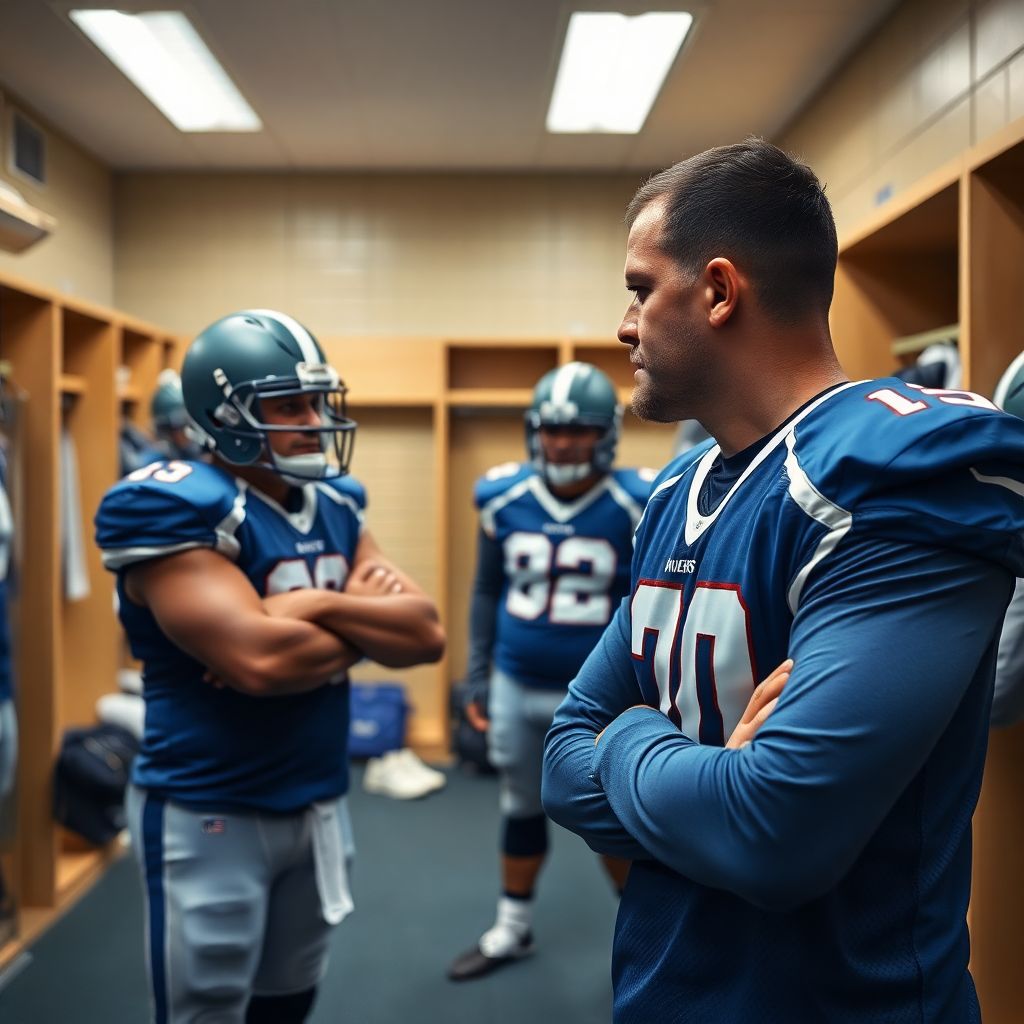
Sports psychology in modern American football explains why talented players underperform under pressure and how to fix it fast. By training attention, arousal control, communication, routines, decisions and recovery, you reduce mental errors, protect confidence and convert preparation into consistent execution on Friday nights, Saturdays and Sundays.
Core Psychological Principles for Football Performance
- Attention management: controlling what you notice pre-snap and post-snap to cut blown assignments.
- Arousal and anxiety regulation: keeping energy high but thinking clear in critical downs.
- Team communication and leadership: turning 11 individuals into one synchronized unit.
- Rituals and visualization: installing repeatable mental scripts for big-game consistency.
- Decision-making speed: simplifying reads so reactions are automatic, not hesitant.
- Resilience and recovery: bouncing back quickly from mistakes, hits and setbacks.
Attention, Focus and Situational Awareness
Attention in American football is the ability to place your mental spotlight on the right cues at the right time. Focus is staying with those cues long enough to execute. Situational awareness is knowing score, clock, down-and-distance, tendencies and field position, then adjusting accordingly.
Common mental errors here: staring at the wrong cue (eyes in the backfield for DBs), drifting between plays, or losing track of game situation. These breakdowns show up as busted coverages, false starts, missed hot routes and late timeouts, not as a lack of effort or toughness.
Quick prevention strategies sports psychology for football players uses:
- Pre-snap “one-cue” focus: Each position identifies a single key read (“guard’s near knee,” “safety rotation,” “snap count in helmet”). Players silently name that cue as they line up to block out noise.
- Between-play reset phrase: After each snap: short breath in, long breath out, then a consistent phrase like “Next play, new job.” This reduces emotional carryover from the last play.
- Situation checks every change of possession: Sideline habit: players verbally review “score-clock-down-field position-timeouts” before going back on. A position coach or leader prompts this in under 10 seconds.
With even brief mental performance coaching for athletes, these habits become automatic and dramatically cut “I just didn’t see it” mistakes without adding playbook volume.
Arousal, Anxiety and Performance Optimization
Arousal is your activation level: heart rate, muscle tension, “amped” feeling. Too low and you are flat; too high and you are tight or panicky. Anxiety adds worry and self-doubt on top of arousal, usually around outcomes, mistakes or judgment from coaches and fans.
How this system works on the field and how to control it fast:
- Individual optimal zone: Each player has a personal “sweet spot” of intensity. Linemen often need higher physical arousal; quarterbacks and kickers usually perform better slightly calmer. Identify this in practice by tracking when execution feels “fast but under control.”
- Breath as an in-game dial: To calm down: 3-5 slow breaths, exhale longer than inhale while looking at a fixed point (helmet decal, hash mark). To wake up: one strong inhale through the nose, short explosive exhale, quick body shake.
- Thought triggers: Under stress, brains go to threat (“don’t throw a pick”). Replace with task-only prompts (“eyes-feet-finish,” “low pad level, drive”). Practice these words in drills so they surface automatically in games.
- Pressure reframe: Treat big moments as “normal reps with bigger consequences,” not entirely different events. Same stance, same count, same read; only the stadium changed. Coaches reinforce this language all week.
- Sideline micro-resets: After a bad series, players take 30-60 seconds away from the huddle: sit, breathe, identify one controllable for the next drive, then rejoin. This prevents a single play from infecting the rest of the game.
Most “choking” is simply mismanaged arousal. Fast, practiced regulation tools beat generic advice like “just relax” or “get fired up.”
Team Dynamics, Communication and On-field Leadership
Modern American football demands coordinated decision-making across the entire unit. Team dynamics in sports psychology for football players focuses on trust, role clarity, communication under noise and the kind of leadership that stabilizes a group when things go wrong.
Typical situations where psychology shows up clearly:
- Hurry-up offense chaos: When tempo increases, communication shrinks. Common errors: receivers unsure of formation, linemen missing protection calls. Prevention: simple hand signals, one-word calls, and a pre-defined “base answer” when communication fails (for example, default to a safe protection).
- Defensive busts after big plays: After giving up a deep ball, DBs may start freelancing, trying to “make it back” with a hero play. Quick fix: leaders call out “11 together,” coaches re-state assignment rules, not emotion, on the sideline.
- Special teams breakdowns: These units often feel “secondary,” so focus drops. Normalize them as “momentum units,” give them a clear identity, and have a specific leader (player) responsible for last-second checks before each snap.
- Conflict between position groups: Offense blaming defense, vets blaming rookies. A sports psychologist for American football teams often facilitates short post-game debriefs focused on shared problems and shared solutions, not blame.
- Silent leadership from key players: Many best performers are quiet. Coaching mistake: trying to turn them into motivational speakers. Better: define “leadership jobs” like being first in drill, initiating huddle calls, or checking in with younger players individually.
Effective team psychology turns emotional spikes into communication, not chaos, and gives every player a clear mental job in tense moments.
Pre-game Rituals, Visualization and Mental Rehearsal
Pre-game mental routines create consistency in how players arrive at kickoff. Visualization and mental rehearsal mean running plays in your mind-seeing, feeling and hearing the rep-as if it were live. They are powerful, but misused routines can become crutches or superstitions.
Advantages of structured mental routines
- Reliable pre-game state: A short, repeatable sequence (music, stretch, visualization, breathing) helps players reach their optimal intensity instead of guessing how to “feel ready.”
- Error rehearsal without risk: Mental rehearsal lets QBs walk through reads, linemen see stunts and DBs visualize turns on deep balls without physical wear.
- Confidence through familiarity: When players have “played the game” in their minds multiple times, the real game feels less overwhelming.
- Rapid correction of recent mistakes: After a bad week, athletes can mentally replay the same situation, but correctly, to overwrite fear with a successful template.
- Scalability via online tools: Online sports psychology training programs often include guided audio visualizations players can use independently on phones or tablets.
Limitations and frequent mistakes to avoid
- Overcomplicated rituals: Long, rigid routines that cannot be done on a tight warmup schedule. Fix: keep the core routine under five minutes and portable.
- Superstitious thinking: Believing “if I do not do X, I will play badly.” Reframe routines as tools, not magic.
- Only visualizing perfection: Ignoring adversity. Better: include a few reps where you make a mistake, then calmly correct it on the next play.
- No sensory detail: Vague, movie-style images have less impact. Athletes should feel the turf, hear the crowd, and see specific landmarks on their home field.
- Not practicing in real time: Effective visualization respects tempo; rehearse at game speed, with realistic timing between snap and throw, break and catch, or snap and kick.
Split-second Decision Making and Cognitive Load Management
Football rewards fast, accurate decisions under intense pressure. Cognitive load is the amount of information the brain must process at once. When load is too high, reaction time slows and mental errors spike, especially in young quarterbacks, safeties and linebackers.
Frequent mistakes and myths, plus what to do instead:
- Myth: “Smarter players can handle any volume.” Reality: everyone has limits. Overloaded game plans make reads slower. Fix: trim calls on game day, group plays into simple families, and emphasize one clear decision rule per situation.
- Error: Coaching from the sideline in real time. Too many last-second instructions (“watch 3, but also the motion, and don’t forget the draw”) jam working memory. Fix: one cue only as the player runs on: “Eyes on 2,” “High and outside,” “Secure the ball.”
- Myth: “Reps alone build game intelligence.” Unstructured reps can repeat the same mistake. Use film plus “if-then” scripts: “If the safety rolls down, then I throw the glance.” Athletes verbalize these rules during walk-throughs to lock them in.
- Error: Ignoring decision fatigue late in games. Tired brains default to old habits. Fix: late-practice periods where players must make quick calls after conditioning, using the exact signals and language used on game day.
- Myth: “Mental toughness means never hesitating.” Smart hesitation in practice-stopping to correct a read-is valuable. The key is transferring that clarity into automatic execution in games through progressively faster decision drills.
Good mental toughness training for football players emphasizes simple, repeatable decision rules, not just “want to” or “grit.”
Recovery Strategies, Resilience and Mental Health Support
Recovery in sports psychology includes physical rest, emotional decompression and rebuilding confidence after mistakes or injuries. Resilience is the capacity to take a hit-on the scoreboard, in your role on the depth chart, or in life-and return to effective function quickly.
Mini-case example of a simple, effective system:
Scenario: A starting cornerback gets beaten for two touchdowns in the first half and begins playing scared, bailing too early and giving up easy underneath throws.
- Immediate sideline triage: Position coach avoids technical overload and sticks to one adjustment, plus a reset phrase: “You’re staying in phase; play the hands.” Short breathing drill, eyes on a fixed point, then back to the bench.
- Halftime micro-plan: Player and coach agree on a three-play focus to start the half: alignment depth, eyes on hip, finish through the catch point. No talk about stats or “making it back.”
- Post-game recovery: Within 24 hours, the athlete watches the two touchdowns with a sports psychologist or trusted coach: one pass to label facts, one pass to identify controllables, one pass to visualize doing it correctly.
- Ongoing mental health check-ins: For players with repeated setbacks or off-field stress, brief regular conversations with a qualified professional are normalized as performance tools, not signs of weakness.
Structured support systems like this are often built with help from mental performance coaching for athletes and can be reinforced through team education or online sports psychology training programs during the offseason.
Game-week self-checklist for the mental side
- Can I name my one pre-snap cue and between-play reset phrase for my position?
- Do I know how to quickly calm down or energize myself on the field without waiting for coaches?
- Have I walked through my assignments mentally at game speed, including at least one mistake-and-correct sequence?
- Do I know my simple “if-then” rules for key situations this week (red zone, third-and-long, two-minute)?
- Is there at least one person on staff I can speak with early if stress, anxiety or mood feels unmanageable?
Practical Performance Questions
How can a coach introduce sports psychology without pushback from players?
Present it as another performance tool, not therapy. Start with short, practical drills-breathing, pre-snap focus cues, simple visualization-built into existing periods instead of adding separate “classroom” time. When players see mental tools helping win reps, resistance usually drops.
What is the fastest way to help a player who gets too nervous before games?

Teach a brief pre-game routine: 3-5 slow breaths, a physical reset (stretch or band work), and a task-focused phrase about their first assignment. Have them practice this routine during high-pressure drills so it feels familiar on game day.
Do entire teams benefit from working with a sports psychologist?
Teams benefit when everyone shares common language for focus, arousal control and communication. A sports psychologist can train staff first, then help integrate simple mental skills into meetings, walkthroughs and practice, so it becomes part of culture, not an occasional lecture.
How often should mental skills be trained during the season?
Short, frequent integration works best. Use a few minutes in meetings or warmups several times per week instead of rare long sessions. Attach each mental skill to specific drills and situations so players immediately connect it to performance.
What if a player needs deeper mental health support beyond performance issues?
Coaches should have a clear referral path to licensed professionals and communicate that using support is a strength. Keep performance conversations focused on football, while ensuring the player has confidential access to appropriate clinical help when needed.
Can online programs replace in-person work with a psychologist?
Online programs can build basic skills and vocabulary, especially in the offseason. They usually work best as a supplement to in-person coaching or consulting, where content is tailored to your system, culture and individual player needs.
Is mental training different for youth, high school, college and pro players?
The core principles are similar, but language, complexity and delivery change. Younger athletes need simpler cues and games; older athletes benefit from more detailed decision scripts and self-directed routines. The earlier players learn basics, the more natural mental skills feel later.