Defensive coordinators game-plan for elite mobile QBs by building a clear film-based profile of when and how they run, then matching that profile with disciplined rush lanes, defined force/contain rules, selective spies, and situation-specific calls. The goal is controlled violence: squeeze explosive plays without surrendering easy throws or losing gap integrity.
Priority Tactical Insights for Game Preparation
- Build a mobility profile from film: scramble tendency, designed QB runs, and preferred escape lanes.
- Design rush lanes first, pressures second; never flip that order against a true dual-threat.
- Assign clear chase, force, and contain duties on every call, not just “spy” tags.
- Have conservative and aggressive answers ready for third down, red zone, and two-minute situations.
- Use in-game data (scramble direction, hit chart) to tighten the plan, not just pre-game assumptions.
- Drill communication so checks and QB-adjusted calls are simple, fast, and repeatable under stress.
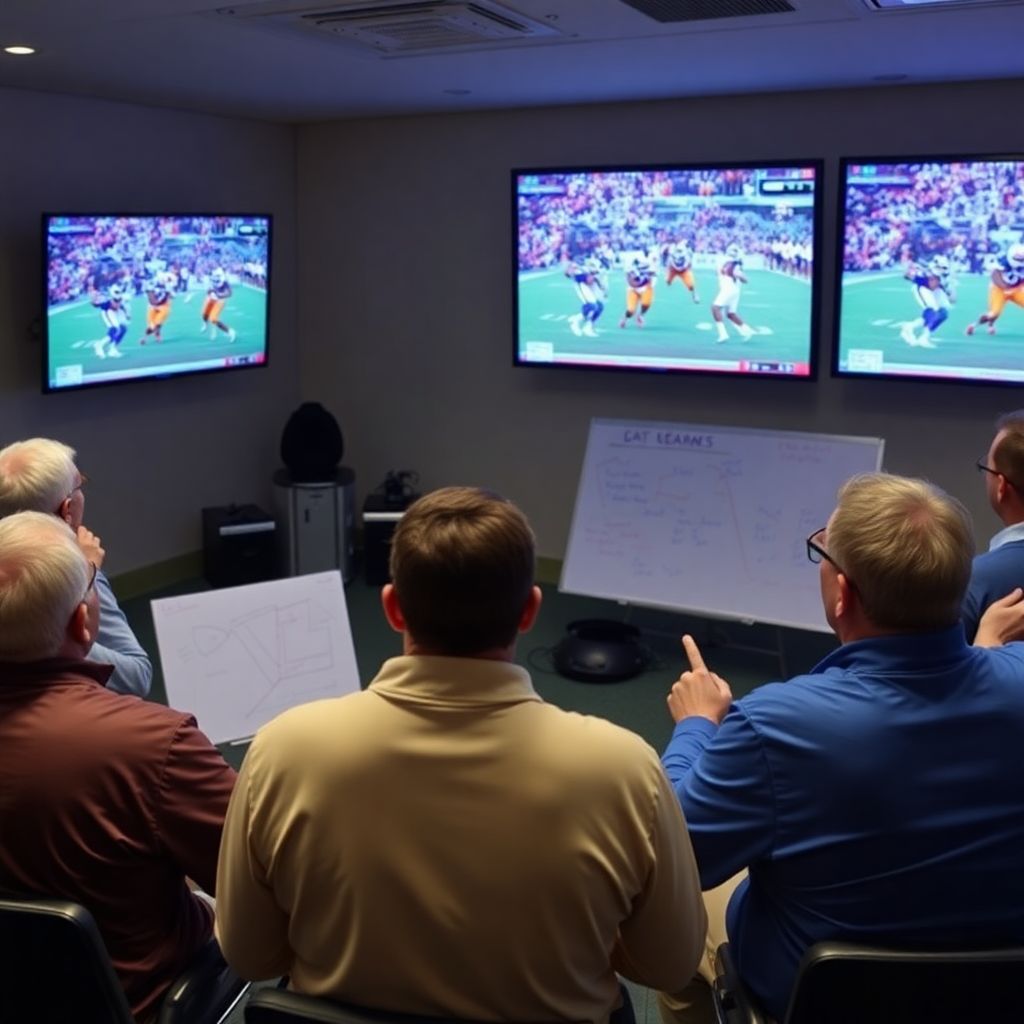
Pre-Game Film To-Do: Identifying Mobility Patterns and Constraints
This structure is best for defensive coordinators, position coaches, and analysts who already understand base fronts and coverages and want to specialize in how to defend mobile quarterbacks defensive schemes. It fits high school, college, and small-program pro levels where staff can devote focused film time.
Skip or simplify this depth if:
- Your opponent’s QB is clearly not a run threat and rarely leaves the pocket.
- Limited staff/time means you cannot realistically install more than minor adjustments.
- Your defense already struggles with core fits and tackling; chasing advanced tweaks will backfire.
Pre-game film objectives:
- Classify QB run type
- Is he a scrambler, a designed-run threat, or a true dual-threat QB used in the core run game?
- Tag clips as: scramble, QB draw, zone read, RPO pull, boot/naked, QB sneak/power.
- Note whether the coordinator is calling an advanced defensive playbook vs dual threat qb already, or mostly base concepts.
- Chart scramble direction and depth
- Left/right percentages and whether he climbs, bounces, or retreats deep.
- Note whether scrambles occur vs man or zone, 4-man or 5-man rush.
- Identify “panic” moves: spin out, reverse field, backpedal and drift.
- Identify constraint plays
- Which QB runs punish specific defensive answers (e.g., draw vs 2-man, zone read vs heavy edge crash)?
- Which formations/personnel predict QB run or movement (Y-off, 3×1, empty, pistol)?
- Tag formations where the OC clearly wants your edges in conflict.
- Study protection and pocket landmarks
- Where does the QB like to set up? Tight, spot-dropping, or drifting?
- Which protections struggle with twist/stunt or overload, forcing him off his spot?
- Note slide vs man-pro; know when rush games will move him into help.
- Contextualize with situation and field zone
- How does QB run usage change by down/distance, red zone, and two-minute?
- Does the OC get more conservative with QB runs after hits or turnovers?
- Note tendencies that shape red zone and third-down protocols later in the week.
Coaches can sharpen this process through defensive football coaching clinics, football defensive coordinator training courses, and even online football coaching certification defense modules that emphasize film breakdown workflows.
Structural Scheme Choices: Spying, Scrambling Lanes, and Defensive Rhythm
Before building a call sheet, inventory your tools and constraints. You need:
- Base fronts you trust versus both spread and heavier personnel (e.g., 4-2-5, 3-3-5, 4-3 with nickel).
- Coverage families you can play fast: a man tool, a quarters tool, and a spot-drop zone tool.
- A clear language for rush lanes, contain, and “green dog” rules that players already know.
Key structural choices and what they require:
- Spy-based structures
- Needs at least one second-level player who can run with the QB and tackle in space.
- Works best when you can spin the safety or bump the nickel to handle interior seams.
- Risk-aware note: Over-spying can pull a valuable zone-dropping defender out of windows.
- Lane-rush, no-spy structures
- Requires disciplined edges and interior rushers who understand level and width landmarks.
- Fits defenses with strong coverage units and DL who can win one-on-one without extra pressure.
- Risk-aware note: If a rusher loses his lane, there is no “extra” body to clean it up.
- Zone-match with squeeze-and-trap principles
- Needs back-seven comfort with pattern-matching and plaster rules on scrambles.
- Lets you keep eyes on the QB while still closing windows downfield.
- Risk-aware note: Poor communication turns match coverages into busted zones.
- Coverage-driven rhythm
- Decide when you want high-vision zone snaps to rally on scrambles versus tight man windows.
- Plan a sequence: e.g., early downs = zone eyes, passing downs = mixed man/zone with change-ups.
- Risk-aware note: Staying in predictable “QB vision” zone every snap invites cheap underneath throws.
- Pressure package selection
- Include at least one contain blitz, one edge-replace pressure, and one interior-squeeze pressure.
- Tag which pressures are “QB safe” (contain built in) versus “call only on long yardage.”
- Risk-aware note: Treat any free-run blitz vs mobile QBs as a calculated gamble, not a staple.
Personnel & Matchups: Assigning Chase, Force, and Containment Roles
Before the step-by-step assignment process, clarify practical risks and limits:
- Overloading one “QB stopper” with spy and force duties can fatigue him and slow the entire defense.
- Moving players into unfamiliar roles (e.g., safety as overhang backer) risks alignment errors and busts.
- Designing exotic roles that you cannot rep full-speed in practice often collapses under tempo or hurry-up.
- Misjudging a QB’s top speed leads to angles that are safe on film but unsafe on Friday or Saturday.
Use this sequence to assign chase, force, and containment roles safely and clearly.
- Identify your best space tacklers
Start with who tackles well in space, not who runs the fastest 40. You want clean finishers more than track stars.
- From film and practice, rank LBs, safeties, and nickels by open-field tackling reliability.
- Mark two “primary chase” defenders and one “emergency chase” backup.
- Define force and contain on your base edges
Set clear rules for DE/OLB/Nickel: who is primary force versus primary contain versus spill.
- Write these roles on the call sheet for each front: e.g., “4-2-5 Over vs Trips: Nickel = Force, DE = Contain.”
- Ensure run-fit rules and scramble rules match; players should not flip jobs post-snap.
- Assign a default QB chase player
Choose one defender whose default rule is “QB first once ball declares pass.” This is your chase, not always a true spy.
- Often a Will LB, nickel, or boundary safety in your best personnel grouping.
- Define his drop depth and trigger rules so he does not abandon intermediate windows too early.
- Add a tagged QB spy only where justified
Use spy tags sparingly in your advanced defensive playbook vs dual threat qb; they are powerful but resource-intensive.
- Reserve full-time spy calls for key downs (3rd/4th and medium, two-minute, red zone) or vs elite runners.
- Set a “yardstick”: if QB gains over a certain number of rush yards by halftime, increase spy usage.
- Match cover defenders to scramble zones
Decide who owns which scramble zones once the QB breaks the pocket.
- Example: Corner stays on top of vertical; nickel squeezes to intermediate; safety becomes “QB cutback” player.
- Practice plaster rules with receivers breaking deep, across, and back to the QB.
- Set personnel-based call families
Create mini-packages that align with your people: big nickel vs 12, speed nickel vs 10/11, etc.
- Label call families that emphasize squeeze/contain vs those that emphasize pressure.
- Include a “QB health” adjustment: if their QB is banged up, shift more toward standard pass calls.
- Script and rehearse communication
Teach short, unambiguous tags that travel with any front/coverage combination.
- Examples: “Mirror” = chase rules on, no true spy; “Lock QB” = designated spy; “Fence” = sideline leverage priority.
- Walk through how these tags are echoed on the field in loud, sudden-change situations.
Blitz Design and Rush Planes That Contain Without Overcommitting
Use this checklist to evaluate whether your pressures are safe and functional against mobile QBs.
- Every pressure call has clearly defined contain rushers on both sides, with names attached.
- Interior blitzers understand “do not cross the QB’s upfield shoulder” rules to avoid creating vertical seams.
- At least one pressure per package is a simulated or creeper look that preserves seven in coverage.
- You have a third-and-medium pressure where the spy replaces the vacated zone, not an extra rusher.
- Edge blitzes are paired with replacement rules (safety/nickel over) so the QB cannot escape into vacated space.
- Hot-throw locations are accounted for with trap or roll-down defenders, preventing easy answers vs all-out looks.
- Contain blitzes are tagged as “QB-safe” on your call sheet and prioritized over pure all-or-nothing calls.
- You have at least one bluff-to-drop pressure where a would-be rusher spies or baits a scramble into interior help.
- Twist/stunt games are practiced with lane responsibility first, win-the-1-on-1 second.
- Two-minute pressures are trimmed to a small menu that players can recall and execute at full tempo.
In-Game Adjustments: Reactive Calls, Clock Control, and Risk Management
Common mistakes when adjusting on the fly against elite mobile quarterbacks:
- Overreacting to one long scramble by living in soft, predictable zone and surrendering easy completions.
- Ignoring live data; failing to update the scramble direction chart or QB run tendency after halftime.
- Calling aggressive zero-pressure in two-minute without considering sideline access and clock stoppages.
- Abandoning the run-fit plan to chase sacks, which opens creases for QB draws and scrambles.
- Not simplifying the call sheet; using the full menu while players are tired and communication is breaking down.
- Leaving the same defender as spy all game, leading to fatigue and missed tackles late in the fourth quarter.
- Failing to coordinate with the offensive staff about clock, field position, and how your calls affect game flow.
- Panicking after a big play and stacking multiple new checks or tags that were never repped in practice.
- Forgetting red zone-specific answers and using midfield calls near the goal line where space and angles change.
- Not having a “get out of the drive” call – a conservative but safe call that forces the offense to earn every yard.
Red Zone and Third-Down Protocols Versus Pocket-to-Run Threats
Choose among these broad approaches depending on your personnel, QB type, and game context.
- Contain-first, coverage-heavy protocol
Best when your back-seven is stronger than your pass rush and the QB is a bigger threat to scramble than to beat tight coverage.
- Use high-vision zone or match coverage with defined QB chase and contain rules.
- Rush with four, occasionally five, prioritizing level, width, and escape-lane discipline.
- Ideal against dual-threats who hurt teams more with broken plays than with pure progression throws.
- Calculated pressure-and-hit protocol
Best when you have a dominant rusher or DB group that can hold up in man and you need negative plays on third down.
- Mix contain blitz, simulated pressure, and occasional zero with a clear “don’t let him out” plan.
- Tag hits on the QB within legal limits, aiming to speed up his clock and reduce his willingness to run.
- Appropriate when trailing late or facing an OC who leans heavily on long-developing concepts.
- Spy-and-funnel protocol
Best when the QB is the focal point of the red zone offense and your best athlete can mirror him.
- Use a true spy plus interior squeeze to funnel scrambles to your help and away from the goal-line pylon.
- Often paired with red-zone match or bracket coverages that handle crossers and back-line routes.
- Valuable against offenses that major in QB draw, sprint-out, and RPOs inside the 20.
- Field-position and game-state protocol
Adjust your risk level based on score and clock, not just down and distance.
- With a lead, favor contain-first calls that force field goals and long drives over high-variance pressure.
- When behind late, accept more risk with targeted pressures aimed at sacks, fumbles, or tipped-ball turnovers.
- Blend these protocols within the same game, anchored in the film study and rules you built all week.
Quick Answers to Tactical Doubts
When should I use a full-time spy versus a mobile quarterback?
Use a full-time spy mainly on critical downs, in the red zone, or when the QB is clearly the primary ball-carrier. For most of the game, rely on lane discipline and chase rules; a constant spy can weaken your coverage shell.
Is man or zone better against dual-threat QBs?
Both have roles. Man creates tight windows but invites scrambles if rush lanes fail. Zone and match coverages keep eyes on the QB and help close scramble lanes. Plan a mix, with more vision coverages on long yardage and two-minute.
How do I handle QB draws and designed runs on third and long?
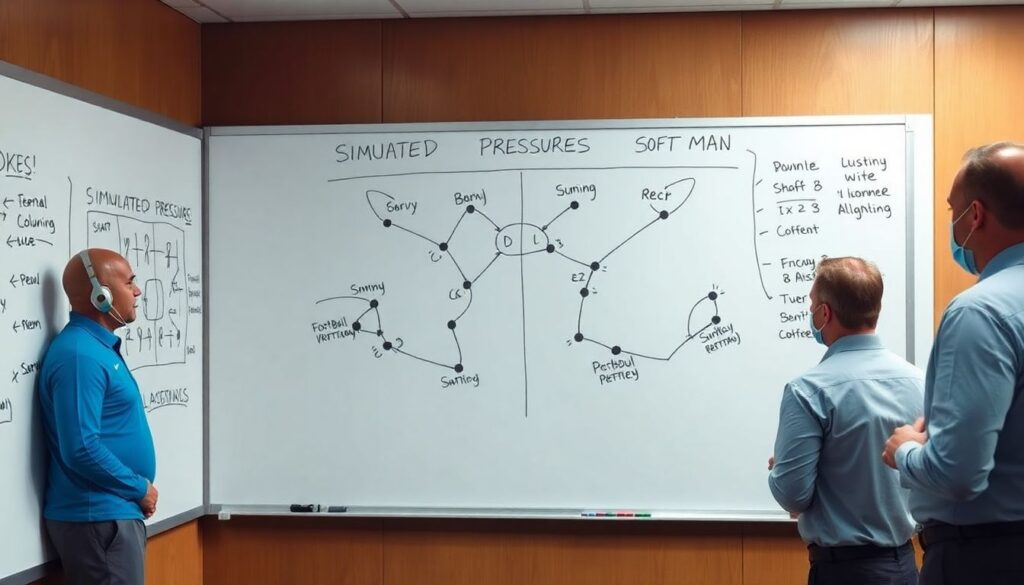
Tag one player as QB-first on passing downs and avoid turning your back in deep, soft man without a spy or chase rule. Use simulated pressures or creepers that show blitz but still keep enough second-level defenders in the box.
What is the safest blitz type versus a mobile quarterback?
Contain blitzes and simulated pressures are generally safest. They build in clear edge contain and preserve coverage numbers while still stressing protection. Avoid frequent all-out pressures with no deep help unless the game situation demands it.
How often should I change the spy or chase player during a game?
Rotate the role enough to manage fatigue and keep the QB guessing. Many coordinators shift the duty by quarter or by package, ensuring no single defender is in space every snap, especially against up-tempo offenses.
Can a small-school defense without elite athletes still slow a mobile QB?
Yes, by emphasizing angles, leverage, and tackling over exotic schemes. Prioritize disciplined rush lanes, clear contain rules, and high-vision coverages. Simple, well-repped calls often outperform complex packages your personnel cannot execute at full speed.
How do clinics and courses actually help with mobile QB game-planning?
Quality defensive football coaching clinics and football defensive coordinator training courses provide film libraries, scheme breakdowns, and practice scripts focused on modern QB run games. They shorten your learning curve and help you build repeatable weekly processes instead of reinventing your plan each game.