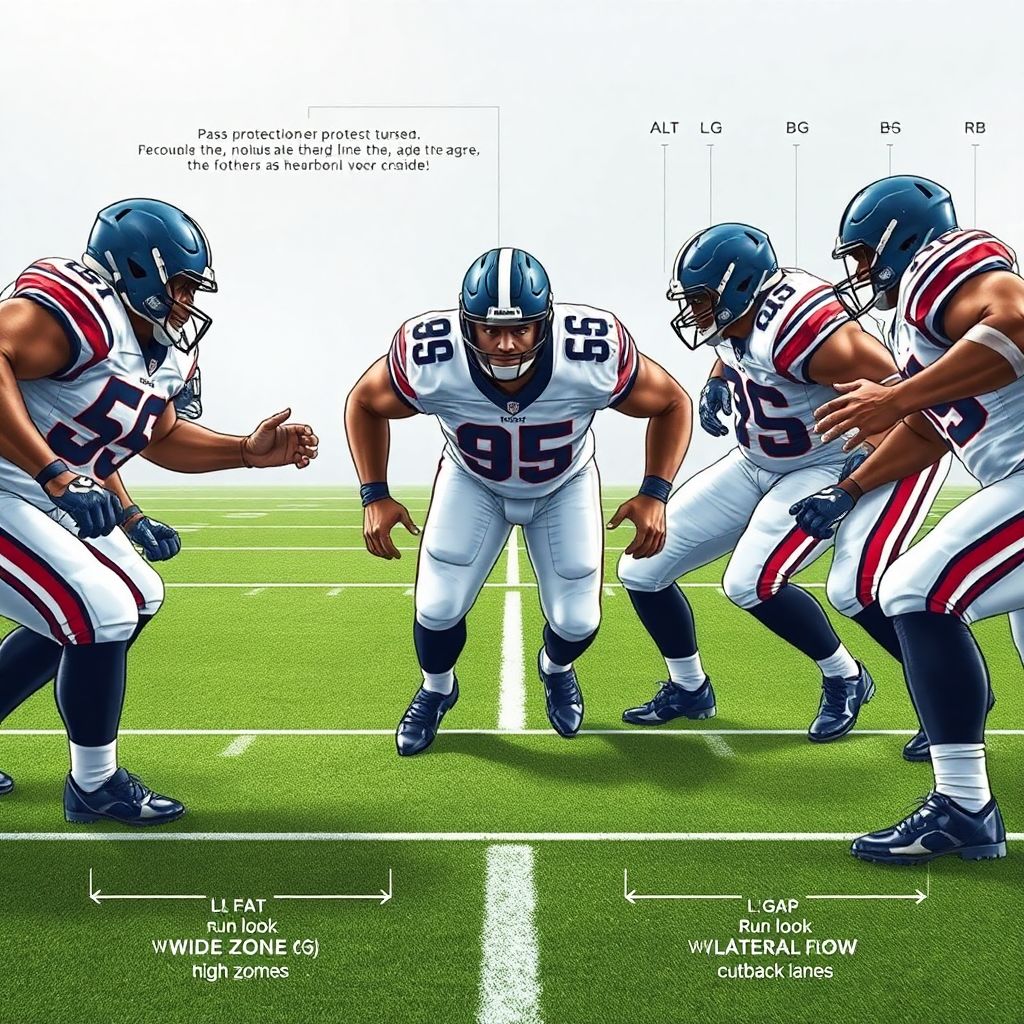
Offensive Line As a High‑Precision System
Definitions and Core Roles
In most broadcasts the camera chases the ball, так that viewers barely notice the five big guys who actually control the geometry of the play. Technically, the offensive line is a five‑man subsystem: left tackle (LT), left guard (LG), center (C), right guard (RG) and right tackle (RT). Their primary functions are pass protection (creating a stable “pocket” around the quarterback) and run blocking (creating displacement and angles for ball carriers). While commentators often collapse them into “the line,” each position has distinct protection rules, footwork patterns and leverage priorities. The LT typically handles the defense’s best edge rusher, the center manages pre‑snap identification and calls, and guards transmit horizontal power in inside zone and gap schemes. In high‑level championship teams this unit behaves like a synchronized mechanism, where individual movements are less important than collective timing, spacing and communication.
Unit Mechanics in Diagram Form
To understand offensive line play, it helps to view it as controlled space management rather than just “blocking your guy.” In pass protection, coaches describe the pocket as a deformable but non‑breakable cage around the quarterback. A simple text diagram looks like this:
[Diagram: D E T — LT LG C RG RT — QB]
Here “D E T” are defensive linemen and edges, and the offensive line forms a concave arc in front of the quarterback. The interior three create vertical depth; tackles build width. In wide zone run schemes, the picture shifts:
[Diagram: ←LT ←LG ←C ←RG ←RT →RB]
Arrows indicate a lateral step with coordinated hip alignment, trying to tilt defenders and generate horizontal flow. The running back then reads inside‑out, cutting off the first vertical crease. Expert line coaches emphasize that these diagrams are not just chalkboard art; they encode rules like “covered vs uncovered,” combo‑block progression and hand‑off points between linemen, which championship teams rehearse until they are essentially automatic.
Technical Value to Championship Teams
Pass Protection, Timing Windows and Risk Management
From a technical perspective, the offensive line’s job is to buy time measured in tenths of a second. Analytics departments in elite programs often map protection quality to “time to disruption”: how long until the quarterback must move off his spot. A reliable line stretches that window from, say, 2.3 seconds to 2.7 or more, which completely changes the available route tree and read progression. Expert offensive coordinators describe it as increasing the “decision bandwidth” of the quarterback. With stable interior protection, deep over routes, double moves and full‑field progressions become feasible; without it, the playbook shrinks to quick game and rollouts. Line play also directly affects turnover probability: hurried throws produce higher interception rates, and blind‑side hits correlate with fumbles and injury risk. That’s why teams with merely average skill talent can still contend for titles if they own a top‑tier protection unit that systematically reduces volatility and protects the franchise quarterback.
Run Game Efficiency and Structural Stress on a Defense
On the ground, offensive linemen function as force multipliers, converting individual strength and technique into repeatable yards after contact. In modern offenses, inside zone, duo and gap schemes are less about “blowing people off the ball” and more about distorting defensive fits by half‑gaps. [Diagram: Dgap Cgap Bgap Agap C Agap Bgap Cgap Dgap] can be overlaid under the formation, and linemen manipulate those gaps like switches. When they consistently create a numbers or leverage advantage in key gaps, the defense is forced to spin safeties down, widen overhangs or slant frequently, which in turn opens up play‑action explosives. Championship teams rarely rely on highlight‑reel runs; they aim for a high success rate—staying on schedule with 4–6 yard gains—which is almost entirely an offensive line metric. Coaches often compare their unit to a run‑game “processor”: the running back is only as efficient as the blocking architecture he’s running behind, no matter how flashy his open‑field skills look on film.
Development and Training Methodologies
Designing a High‑Level Training Program and Core Drills
When experts talk about the best offensive linemen training program, they emphasize specificity: building movement patterns and force vectors that match what happens on film, not just chasing weight room numbers. That’s why high‑level staffs integrate position‑specific strength (e.g., isometric holds in pass‑set angles), eccentric control for anchor, and mobility work for hip rotation and ankle flexion. On‑field, well‑designed football offensive line drills for championship teams follow a progression: first, isolated technique (stance, first step, hand carriage); then, partner work (strike timing, independent hands, leverage recovery); and finally, unit drills with full protection or run‑fit rules. [Diagram: 1v0 → 1v1 → 2v2 → 5v5] describes the typical build‑up. Expert line coaches recommend tracking technical KPIs—pad level consistency, win rate in one‑on‑ones, mental error percentage—rather than only bench or squat maxes. The goal is to hard‑wire repeatable, low‑variance movements that hold up under fatigue, noise and late‑game pressure rather than create weight‑room heroes who lose shape on third‑and‑long.
Coaching Clinics, Live Feedback and Learning Culture
Even players with elite tools stagnate without detailed instruction and feedback loops. That’s where the ecosystem around “offensive line coaching clinics near me” becomes a practical advantage, not just an advertisement. Quality clinics expose linemen and their position coaches to current best practices: updated pass‑protection slide rules versus modern simulated pressures, countermeasures to long‑arm rushers, and refinements in inside‑hand placement for wide zone. Experts consistently recommend that linemen become students of defense, not just their own technique: learning common front structures (over, under, mint, tite), pressure patterns and coverage tells helps them anticipate rather than react. In film sessions, good coaches move beyond vague criticism like “get lower” and instead provide frame‑by‑frame correction: foot spacing in inches, strike timing in relation to the defender’s second step, and exact aiming points on the breastplate. The most successful championship lines develop a peer‑coaching culture where veterans own the standard, run extra post‑practice sets and translate coaching points into position‑room language that younger players absorb quickly.
Recruiting, Gear and Long‑Term Pathways
Talent Identification, Metrics and College Recruiting
Because offensive line performance is deeply context‑dependent, projecting teenagers into future starters is famously difficult. That’s why many families lean on college recruiting services for offensive linemen, but experts caution that highlight reels alone are misleading. Savvy recruiters look for traits that scale: body proportions (arm length, hip and ankle mobility), movement quality in space, competitive temperament and the capacity to process complex protection rules. They also cross‑reference multi‑sport data; for example, wrestlers often showcase superior balance, hand fighting and leverage awareness. Top evaluators study full games, not just best plays, to see how a lineman responds to speed changes, stunts and fatigue. For prospects, the technical advice from college line coaches is consistent: master your stance, cadence discipline and base footwork; build honest strength while maintaining mobility; and accumulate full‑game film against credible competition. A lineman who can demonstrate scheme versatility—zone, gap, screens, tempo—is inherently more recruitable for modern spread and pro‑style systems.
Equipment, Customization and Biomechanics
At first glance, gear seems secondary to scheme and technique, yet at the highest levels small equipment choices significantly affect performance and durability. Programs that invest in custom offensive lineman gear and equipment treat it as a biomechanical tuning process. Cleat plate stiffness influences force transfer on drive blocks and the ability to anchor against bull rushes, while facemask configuration and vision lines affect how quickly a lineman can process second‑level movement. Shoulder pad cut and bulk change how easily a player can keep his hands inside the frame and rotate through contact. Expert strength and conditioning staffs increasingly collaborate with equipment managers and sports science departments to align gear with each player’s limb length, injury history and positional demands. For example, interior linemen may benefit from slightly different knee‑brace setups than tackles who play more in space. The overall objective is to reduce micro‑trauma over a long season, preserve joint integrity and keep the line’s starting five intact deep into the playoffs, where continuity often outweighs raw talent.
Putting It All Together: Expert Recommendations for Players and Coaches
Building a Championship‑Caliber Line Mindset
When offensive line gurus are asked what separates championship units from merely decent ones, their answers converge around process, not hype. First, treat the line as a system: individual stars matter far less than communication and trust across all five spots. That implies constant reps in full‑speed team periods, with the same personnel grouping whenever possible, so combo blocks and protection calls become almost subconscious. Second, make technique a daily non‑negotiable: 10–15 minutes of focused indy work on stance, get‑off and hand placement every practice does more over a season than occasional marathon drill sessions. Third, integrate film like a lab: linemen should watch their own cut‑ups and elite pro units, pausing to translate abstract coaching points into specific body positions they can feel. Finally, experts remind players that being an offensive lineman is a long‑arc job. Progress might not show up in highlight clips, but every snap of clean pocket or efficient run fit accumulates into wins. Teams that internalize that quiet, technical grind usually discover that their “unsung heroes” are actually the loudest reason they’re still playing in championship games in December and January.