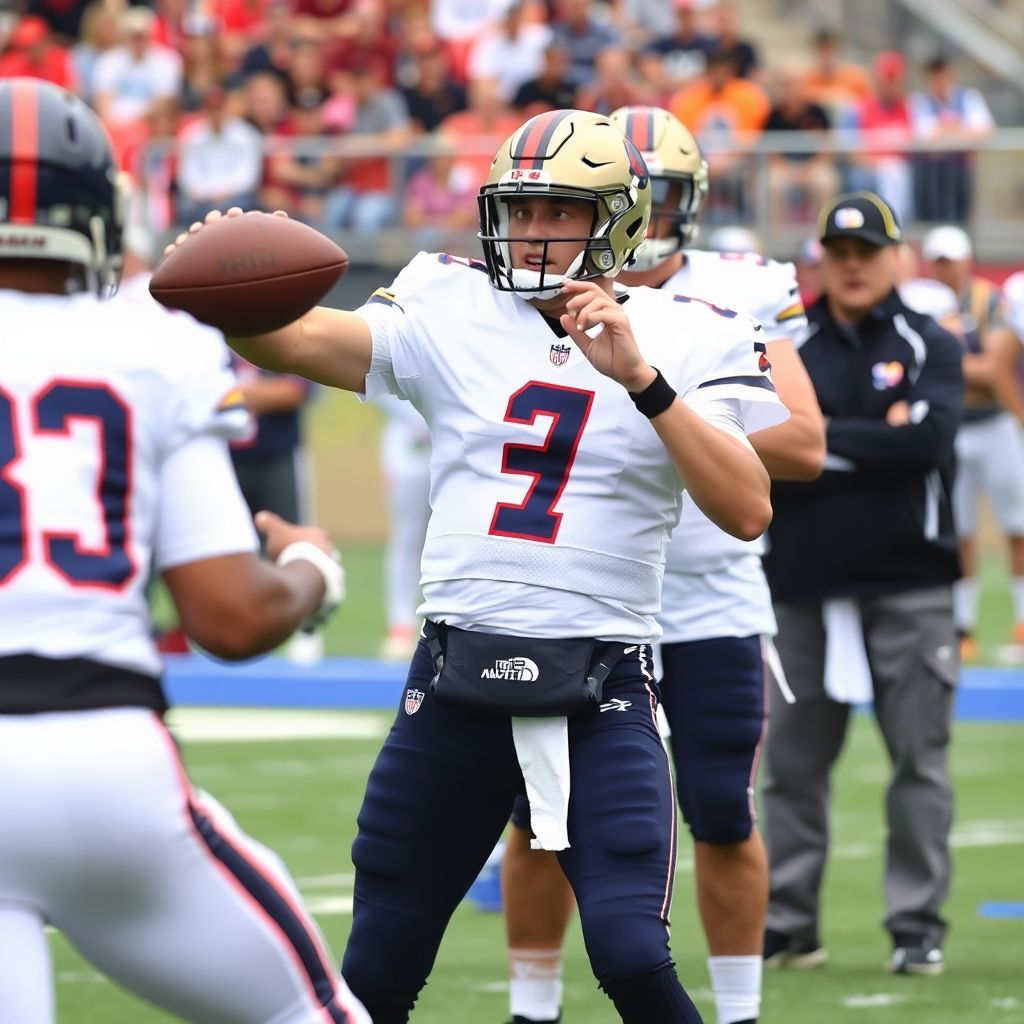
A perfect two-minute drill is a rehearsed, no‑huddle package combining clock control, fast communication, and high‑percentage passes. You script calls, assign clear signals, define clock rules by field zone, and rep it at game speed. Focus on tempo, protection, sidelines, and simple, repeatable concepts your quarterback fully trusts.
Pre-Game Checklist: Essentials to Confirm Before a Two-Minute Drill
- Define your primary two minute drill offense playbook (core 6-8 calls, 2-3 alerts, 2 tempo settings).
- Assign on-field roles: clock manager, signaler, “ball” runner, and who owns spike/kill calls.
- Confirm timeout plan for each half and who makes the final decision to use one.
- Rehearse one full field two-minute period in practice at least twice per week at true game speed.
- Walk through boundary/sideline awareness rules for every position group before each game.
- Script opening three calls for both “need a field goal” and “need a touchdown” scenarios.
Clock and Tempo Management Principles
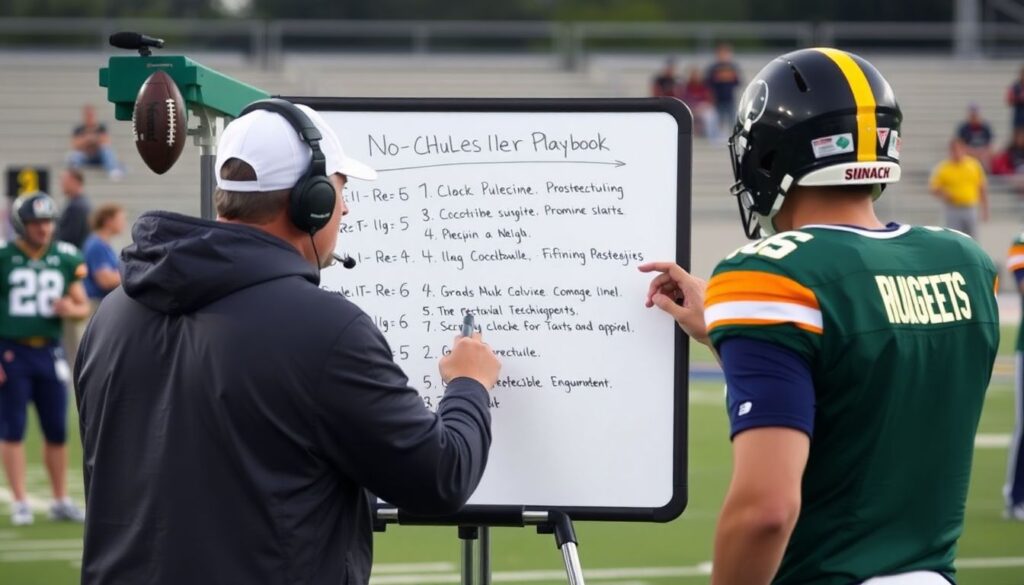
This section fits intermediate coaches, coordinators, and QBs who already run basic no‑huddle. Skip full two-minute tempo if your protection calls are still inconsistent, your QB cannot verbalize clock rules, or you lack a dependable snap/ball-handling operation under pressure.
Section prep-checklist (5-8 minutes)
- Explain clock rules by zone (own 25-40, midfield, fringe field goal, red zone).
- Walk through two base tempos: “urgent huddle” (~20 seconds) and “turbo” (~12-15 seconds).
- Run 3 reps of a scripted drive from your own 25 to midfield at urgent tempo.
- Run 3 reps from midfield into scoring range at turbo tempo.
Core clock and tempo principles:
- Know the math before the drive starts – Sideline calculates how many plays you realistically have. Communicate “we’re expecting 6-8 snaps, no sacks, no penalties” to the huddle or QB.
- Use the clock, do not chase it – Early in the drive, snap around 18-20 seconds. Shift to 12-15 seconds as you cross midfield. Protect timeouts for in‑bounds tackles in the last 30-40 seconds.
- Define “dead ball” behavior – After every incompletion, everyone sprints the ball to the official, then immediately looks to the sideline. No celebrations, no talking to opponents.
- Set automatic spike rules – For example: any completion in‑bounds inside 15 seconds with no timeout remaining is auto‑spike. QB announces “clock, clock” at the line.
Corrective cue: If the unit feels rushed and sloppy, slow the next snap to 18-20 seconds, call a simple concept, and reset the operation before returning to turbo tempo.
Personnel Packages, Substitutions and Matchups
Section prep-checklist (8-10 minutes)
- Choose one primary two-minute personnel group (e.g., 11 or 10) and one emergency group.
- Tag your top matchup players and preferred defenders to attack.
- Rehearse 3 quick substitution scenarios from the sideline, including a sudden injury.
- Run 2 drives where you stay in the same personnel the entire series.
Requirements and tools for clean personnel execution:
- One primary package – Select the group that best fits your football two minute drill strategies: usually your best spread passing look that still protects the QB. Everyone must know that “two-minute” equals this group by default.
- Clear substitution signals – Use one-word personnel tags and simple hand signals. The signaler must stand in the same spot every time so players can find them quickly.
- Designated matchup pieces – Identify who is your “must-target” receiver, your best check-down, and your trusted pass-protection back or tight end. Script 2-3 early calls to feature them.
- Emergency roles – Pre-assign backups who step in if a receiver, running back, or lineman comes off. In practice, simulate one player going down and sub the backup without stopping the drill.
- Specialist awareness – The kicker, holder, and long snapper monitor the drive and line up as soon as you cross your field goal line. Do not burn a timeout waiting for them.
Corrective cue: If substitutions delay the snap, lock into your primary personnel only and forbid mid‑drive changes until the unit shows consistent tempo.
High-Efficiency Route Concepts and Progressions
Section prep-checklist (10-15 minutes)
- Select 6-8 core pass concepts for your two minute drill offense playbook (quick game, outs, seams, screens).
- Define QB read side and outlet on each concept in three words or less.
- Walk through every concept on air, full formation, at least 3 times.
- Run 2 full drives using only these core concepts at controlled tempo.
Use this step-by-step structure to install your high-efficiency concepts so they fit any quarterback training two minute drill plan.
-
Pick concepts that beat the clock, not the coverage board
Favor routes that attack sidelines, shallow crossers with room to run, and simple seams. Avoid slow-developing double moves. Every call should have a built-in answer versus man and zone.
- Include at least one boundary out/stop concept to stop the clock safely.
- Include one middle-of-field “chunk” (e.g., dig or seam) for when the defense overprotects the sidelines.
-
Define QB progression in plain language
For each concept, script a short verbal like “Go, out, check-down” or “Seam to shallow to back.” The QB should be able to say the progression out loud before every rep.
- Limit to 3 reads: primary, secondary, outlet.
- Set a firm hitch count (e.g., “throw on second hitch or get it out underneath”).
-
Tag clock-friendly variants
Create “clock” tags that turn middle routes into outs or stop routes near the sideline. Teach receivers that any clock tag means “fight to the boundary, then get vertical later.”
- Run 3 reps of each concept with and without a clock tag.
- Coach receivers to plant and turn upfield with the outside foot toward the sideline.
-
Install built-in hot answers
Defenses often bring pressure in two-minute. Add quick slants, speed outs, or now screens as hot answers that the QB can throw immediately when the line slides or identifies pressure.
- Drill 5 rapid-fire reps where the center calls “pressure” and QB immediately throws the hot.
- Keep hot answers on the same side as the primary progression when possible.
-
Script field-position-based calls
Group your concepts into “coming out,” “midfield,” and “fringe/red zone.” This mirrors how the best football coaching book two minute drill chapters organize their examples.
- Use safer, horizontal concepts coming out; more vertical options as you reach midfield.
- Inside the 20, prioritize space-creating rubs and quick outs over deep fades unless you have a clear mismatch.
-
Run a blended drive at game speed
Finish by calling a scripted eight-play drive on air or versus scout, mixing all concepts. Track completion rate, boundary usage, and time remaining.
- Goal: 70% or better completions in practice with no sacks and no penalties.
- Repeat the same script until the offense finishes inside your scoring range with consistent time left.
Corrective cue: If the QB holds the ball, cut the menu in half for the next drive and emphasize quick-game and screens only until the operation speeds up.
Snap-to-Throw Mechanics and Timing Drills
Section prep-checklist (10-12 minutes)
- Assign one coach to watch the center-QB exchange and one to watch QB lower body.
- Run 10 rapid-fire snaps under center or from gun, no routes, focusing on operation only.
- Run 3 “30-second” end-of-game periods focusing solely on snap, drop, and ball out.
Use this checklist to verify that your snap-to-throw execution can survive real two-minute pressure:
- QB consistently secures the snap, no drops or bobbles across 20+ consecutive reps.
- Ball is snapped within the planned tempo window (e.g., 12-18 seconds on the play clock in practice).
- QB hits the back of the drop on balance, with base slightly wider than shoulder width.
- Throw is released on time: no extra hitches beyond the scripted progression count.
- Receivers reach their landmarks at the same time the QB finishes his drop on at least 8 of 10 reps.
- Sack rate in team two-minute periods is near zero; QB either throws away or hits outlet on time.
- Running backs consistently identify and fit their protection assignments before releasing.
- Ball security is clean: no fumbles on exchanges, scrambles, or pump fakes during the period.
- Sideline throws travel outside the numbers and arrive before the receiver steps out of bounds.
- Communication of motion and shifts is clear and does not cause false starts or illegal formations.
Corrective cue: If routes and drops are not matching up, shorten all routes by one step and demand the QB throw on the scheduled hitch; add depth later after timing syncs.
Timeouts, Field Position and Risk Management
Section prep-checklist (8-10 minutes)
- Review timeout ownership and verbal cues with QB and sideline staff.
- Walk the field and mark your realistic field goal line with your kicker.
- Script 2 drives: one with 2 timeouts, one with none, ending near your field goal line.
Common mistakes that break two-minute drives:
- Burning early timeouts on routine alignment or personnel issues instead of saving them for in-bounds tackles late.
- Calling low-percentage, deep isolation shots when you only need a field goal and already sit near your range.
- Forgetting to adjust risk based on who is kicking: trying to force extra yards when the current range is already comfortable.
- Allowing the QB to scramble in-bounds with no remaining timeouts and under 20 seconds left.
- Taking a sack in fringe field goal range by not immediately throwing the ball away when protection breaks down.
- Failing to coach defenders about avoiding penalties (roughing, DPI) that can extend the opponent’s own two-minute drives.
- Snapping the ball too early when ahead on the scoreboard, instead of bleeding safe time before each snap.
- Not having a specific “last safe play” call before sending on the field goal unit.
- Running the ball in short-yardage without a clear “no gain equals immediate timeout” rule.
Corrective cue: If risk decisions are poor in practice, restrict the QB to “field goal first” rules on the next drive: no sacks, no throws inside that risk turnovers, ball out or throwaway only.
Sideline Communication, Signals and Game-Ready Scripts
Section prep-checklist (8-12 minutes)
- Define your main signaler, backup signaler, and their exact locations.
- Install a 6-10 play two-minute script for “need a field goal” and one for “need a touchdown.”
- Walk through both scripts on the sideline, then on the field, at least twice.
Alternative approaches to two-minute communication and scripting, and when to use them:
-
Fully signaled no-huddle
All plays and tempos are sent via hand signals and boards. This fits teams with strong practice time and consistent staff, and is often featured in an online course mastering two minute drill systems.
-
QB-led wristband huddle
Coach calls a number, QB reads the play from his wristband, then huddles or uses a quick “mini-huddle.” Use this if your roster changes often or if communication noise is high on the road.
-
Hybrid: first calls scripted, then free call
Begin with 3-4 pre-scripted plays to stabilize the drive, then let the coordinator adjust based on coverage. This is useful for intermediate QBs who handle structure well but still need help versus unexpected looks.
-
Silent “menu” system
Coordinator gives the QB a small menu of 2-3 plays at a time; QB chooses at the line based on leverage. Use this when your QB excels at quick recognition and you want to attack specific matchups.
Corrective cue: If calls are frequently confused on the field, simplify to one communication system (e.g., wristband only) for the next week and rebuild complexity after clean execution returns.
Troubleshooting: Common Execution Failures and Quick Fixes
Our two-minute drill looks good in walkthroughs but falls apart at full speed. What should we change?
Rep it at true game tempo with a running clock and coaches off the field. Cut your call sheet to your six best concepts, then track operation errors (substitution, formation, clock) and fix those before adding more plays.
My quarterback freezes when the defense changes coverage late. How do I help him?
Reduce his reads to one side with a clear outlet and build in simple hot answers. In practice, rotate coverages late on purpose and reward him for throwing the check-down on time instead of forcing deep throws.
We cannot get out of bounds consistently. What should we teach the receivers?
Drill sideline catches every practice: catch, tight turn outside, two quick steps, then step out. Emphasize aiming for the bottom of the numbers to the boundary and never cutting back inside with under 40 seconds left.
Our linemen jump early when we go turbo tempo. How do we stabilize the snap count?
Use one primary cadence in two-minute and rehearse 20-30 consecutive snaps on air. If issues continue, remove all hard counts during the drill and only reintroduce them after several clean practices.
We keep wasting time on spotting and ball-handling after plays. How can we speed that up safely?
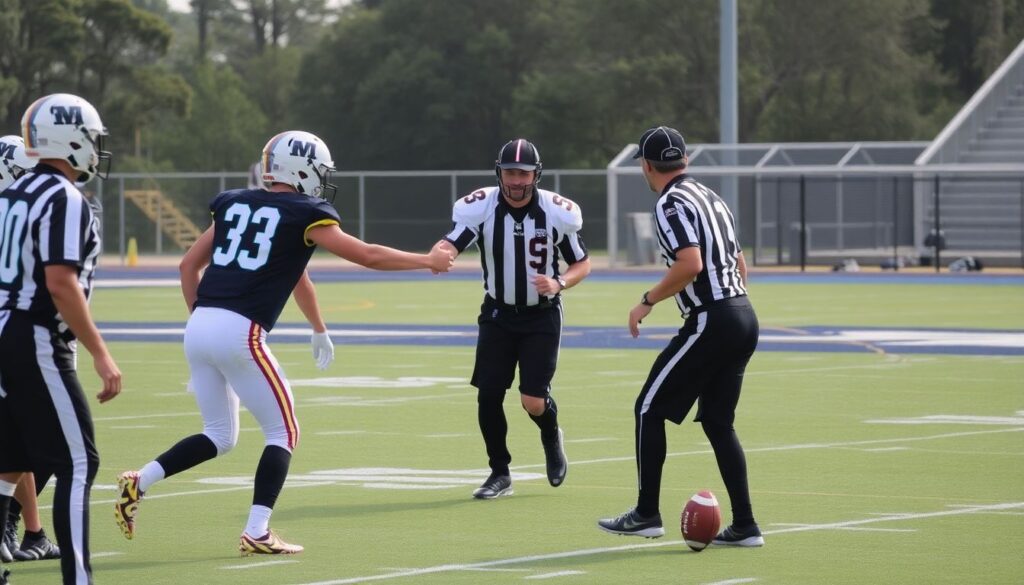
Assign one player each side of the ball to grab it and hand it directly to the official. Practice “finish and find the ref” in every team period so players treat it as part of the rep, not an afterthought.
Our players struggle to remember the full call menu. Should we keep it complex anyway?
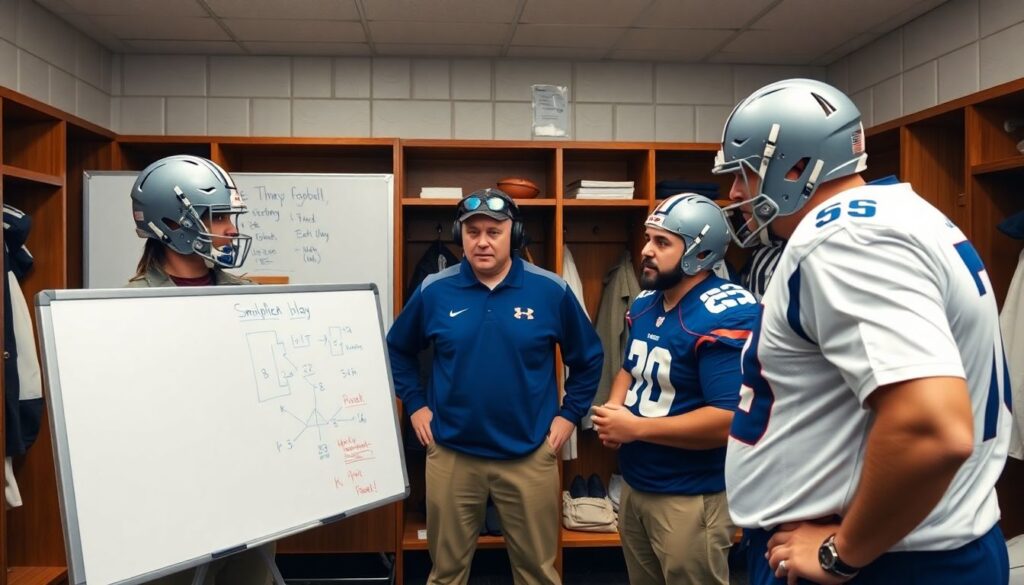
No. Trim the menu until every player can recite the core calls in order without a script. A smaller, well-executed package is more effective than a large, poorly remembered one in a two-minute situation.
How often should we practice a full two-minute drive during the season?
Run at least one full-drive two-minute period in each main practice, varying scenarios and field position. Shorten the script if needed, but keep the clock live so players feel the same pressure they will see in games.