
The Dual-Threat Quarterback: What It Really Means Now
If you watched football even 15–20 years ago, “dual-threat quarterback” basically meant “guy who can run fast and sort of throw.” In 2026, that definition is outdated. Today, a dual-threat quarterback is expected to process like Peyton Manning, move like a slot receiver, and understand protections like an offensive line coach.
In other words, we’re not just talking about a passer who can scramble. We’re talking about a primary decision-maker who stresses a defense with both his arm and his legs on *every* snap, even if he never actually crosses the line of scrimmage.
—
Clear Definitions: Dual-Threat vs Pure Pocket vs Running QB
Let’s lock down some terms before we go further.
Pocket passer (traditional)
A QB who does almost all of his damage from inside the pocket, with limited designed runs. Think prime Tom Brady: elite pre-snap reads, surgical accuracy, almost no called QB runs.
Running quarterback
A QB who is dangerous with the ball but doesn’t consistently win as a passer from structure. A lot of early 2000s “athlete QBs” fell in this bucket—deadly in the open field, but coordinators didn’t trust them on full-field reads.
Modern dual-threat quarterback
A QB who:
1. Runs the *entire* passing menu (progressions, full-field reads, timing routes), and
2. Adds a legitimate, schemed run element (zone read, QB power, RPO keepers, scramble threats) that the defense must respect on each down.
So the dual-threat isn’t just “can run and can throw.” It’s “can run the full NFL-style passing game and is a featured ball-carrier when needed.”
—
Text Diagram: How Defenses See a Dual-Threat QB
Imagine how a defensive coordinator looks at the offense. Here’s a crude text diagram of a typical shotgun set with a dual-threat QB:
“`
WR LT LG C RG RT WR
TE QB(R) RB
Key:
QB(R) – Dual-threat QB (run + pass)
RB – Running back
WR/TE – Receivers
“`
With a statue QB, the defense usually treats the QB as a non-runner unless it’s a sneak. With a dual-threat, the math changes:
– The QB is a live ball-carrier on zone read, power read, speed option, and designed draws.
– The defense now has to allocate a body to the QB on run plays, *in addition* to the RB.
That extra gap the defense has to account for is the foundation for the entire dual-threat revolution.
—
From Option QBs to Complete Offensive Engines
The evolution didn’t happen overnight. It came in rough stages, with key archetypes along the way.
Early Stage: College Option Wizards
In the 1990s and early 2000s, a lot of college coaches realized something simple: it’s easier to teach a fast, dynamic athlete just enough passing to keep defenses honest than it is to turn a pure pocket guy into a 4.4 sprinter.
So we got:
– Triple-option QBs in service academies and option-heavy programs
– Spread-option QBs running read-option and QB power out of shotgun
Many of these players were labeled “system QBs” and weren’t considered NFL-ready. They were closer to running backs who could throw a bit.
They pushed the game forward, but the passing concepts were often limited: half-field reads, simple high-low concepts, heavy reliance on first read.
—
Middle Stage: Spread Masters Who Could Actually Sling It
The next wave were college QBs who could:
– Operate tempo spread systems,
– Throw with timing and accuracy, and
– Be a significant designed run threat.
These guys blurred the old categories. They were still from spread-heavy systems, but they had real passing polish. This era forced pro scouts to rethink what “NFL offense” meant and opened the door for modern quarterback coaching for dual-threat QBs. Coaches had to learn how to refine mechanics, reads, and protection calls for athletes who previously would have been moved to receiver or DB.
—
Current Stage: Pro-Level Processors Who Just Happen To Be Elite Athletes
By the mid-2020s, the cutting edge looks different. The most dangerous dual-threat QBs:
– Command pre-snap and post-snap reads like veteran pocket passers.
– Adjust protections, change route concepts, and identify mismatches.
– Still have an entire run package built around them.
They are not “athletes playing QB.” They are quarterbacks with elite athletic upside.
Defenses are facing QBs who understand coverage rotations, manipulate safeties with their eyes, and then, if everything breaks down, turn a busted play into a 20-yard gain with their legs.
—
Why Defenses Hate Seeing Dual-Threat QBs
A modern defensive coordinator facing a dual-threat QB has three unsolved problems: numbers, space, and time.
Problem 1: Numbers – You Can’t Be Right Everywhere
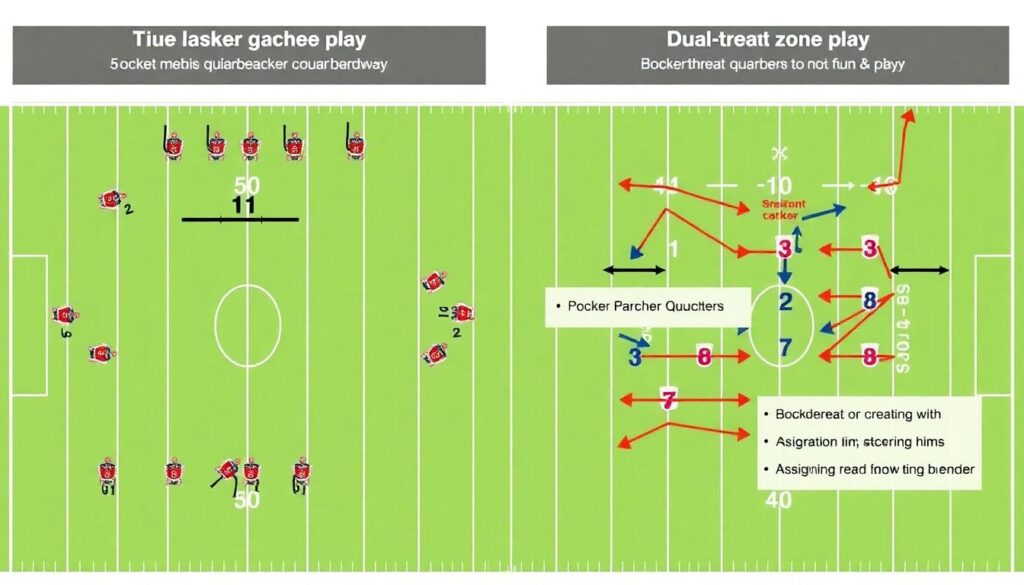
On a standard run play with a pocket passer, the offense has:
– 5 OL + TE + RB = 7 blockers max,
– Defense can fit the run with 7 or 8 in the box,
– The QB is essentially a spectator.
With a dual-threat QB on zone read, the offense “blocks” an extra defender by reading him instead of assigning a blocker:
1. OL and TE block their usual guys.
2. The QB reads the unblocked end or OLB.
3. If he crashes on the RB, QB keeps.
4. If he sits on the QB, hand off to RB.
So the offense gets:
– 5 OL + TE + RB ball-carrier + QB as a run threat = 8 effective participants vs 7 defenders in the box.
That math is brutal for defenses.
—
Problem 2: Space – You Can’t Cover Grass and Spy the QB
When you spread the field with 3–4 wideouts and a dynamic QB, the defense has to choose:
– Drop more defenders into coverage to handle the pass concepts,
– Or keep an extra body near the box to account for QB runs and scrambles.
If they drop everyone back, the QB can:
– Take cheap underneath throws, or
– Take off on scrambles into vacated zones.
If they crowd the box, vertical shots become easier. The best college dual-threat quarterbacks ranking every year is basically a list of guys who force DCs into these no-win tradeoffs.
—
Problem 3: Time – Play Doesn’t End When the Route Does
The last piece is time. In the old world, if the QB hit the back of his drop and the rush got home, the play was almost over.
With a dual-threat:
– He can escape the first wave,
– Reset outside the pocket,
– Turn the play into a backyard scramble drill.
Defenders are being asked to cover for 4–5 seconds instead of 2.5–3. That’s where explosive plays happen and where broken coverage meets a QB who can throw 40 yards on the move.
—
How Offenses Are Built Around Dual-Threat QBs in 2026
Offensive coordinators in both college and the pros are no longer “accommodating” QB mobility. They’re building entire systems around it.
Core Building Blocks of a Dual-Threat Offense
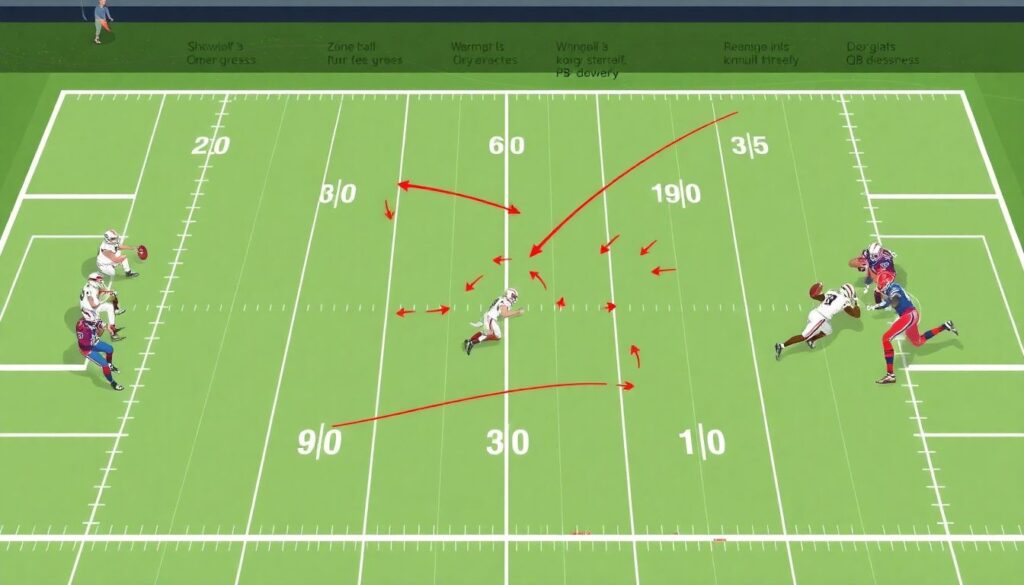
Here are the main tools modern play-callers use with dual-threat quarterbacks:
1. Zone read / RPO packages
The QB reads a defender post-snap and chooses between handoff, keeper, or quick pass. The defense is wrong if they guess; they’re still wrong if they react slowly.
2. QB-designed runs (power, counter, draw)
Instead of just scrambles, they call real run plays for the QB: QB power behind pulling guards, QB counter, QB draw from empty. These are structured runs with blocking schemes, not freelancing.
3. Bootlegs and movement throws
Rollouts and nakeds stress flat defenders: do they chase the QB or cover the route in the flat? With a dual-threat QB, there’s no good answer.
4. Scramble rules for receivers
Receivers are coached: “When the QB breaks contain, you break your route *this* way.” This takes improvised chaos and turns it into engineered explosives.
5. Tempo and formation variety
Hurry-up tempo with a run-capable QB is hell on tired front sevens. Move fast, change formations, and make the defense declare its intentions while it’s still catching its breath.
—
Text Diagram: RPO With a Dual-Threat QB
Here’s a simplified text diagram of a basic RPO with a dual-threat QB:
“`
WR WR
LT LG C RG RT TE
QB(R) RB
Post-snap:
1. QB reads LB:
– LB steps toward RB → QB throws glance route to WR.
– LB drops into passing lane → QB hands to RB.
– Edge crashes hard and LB slow → QB keeps and runs outside.
“`
This single play threatens:
– Inside run
– Quick pass
– QB perimeter run
…all from one look, one call, and one read. That’s the modern dual-threat DNA.
—
College vs NFL: Same Concept, Different Constraints
The dual-threat idea lives in both college and pro football, but the practical realities aren’t identical.
College Football: Laboratory for Dual-Threat Innovation
College coaches can:
– Recruit to a scheme (find a QB specifically to run their offense),
– Face wider talent gaps (mismatch-heavy environments),
– Run heavier QB-run volume (shorter careers, fewer games, and more roster depth).
So you see:
– More pure QB run game (20+ carries some weeks),
– Extreme spread sets to isolate slow linebackers,
– Option-heavy packages that would be risky in the NFL.
The constant wave of athletic high school QBs, plus the growth of every kind of dual-threat quarterback training program, has turned college ball into a testing ground for ideas that may or may not filter up to Sundays.
—
NFL: Same Athletes, But With Paychecks and Long Careers
In the NFL, it’s different:
– Defenses are faster across the board.
– The QB is a massive financial investment.
– A lost season to injury can erase playoff windows.
So pro coordinators:
– Use QB runs selectively, usually in high-leverage situations (red zone, third-and-short, playoff games).
– Lean harder on RPOs, bootlegs, and controlled QB movement instead of constant power runs.
– Emphasize slide rules and “get down” coaching—hit avoidance is a coached skill now.
The balancing act: squeeze every advantage out of QB mobility without sending your franchise player into a linebacker every other drive.
—
Modern Training: How Dual-Threat QBs Are Built, Not Born
The current wave of dual-threat stars didn’t just appear by accident. They’re the product of targeted development from middle school on.
Offseason Culture: Camps, QB Coaches, and Year-Round Work
In the 2020s, a serious high school QB’s calendar often includes:
– Private QB coach sessions
Footwork, throwing mechanics, coverage recognition. This is where quarterback coaching for dual-threat QBs really shines: taking natural runners and turning them into polished passers, and vice versa.
– Specialized dual-threat camps
Players search “dual-threat quarterback camps near me” and end up at events that blend passing drills with movement, off-platform throws, and designed-run reads. They’re not just running 40-yard dashes; they’re working pocket escapes, rollout accuracy, and RPO decisions.
– 7-on-7 leagues
Passing-only leagues force them to read coverages and make fast decisions. Even the most athletic QBs have to learn to win from the pocket because they can’t run here.
– Film and cognitive training
More young QBs are doing remote film sessions and mental-rep software: coverage ID quizzes, “if/then” decision trees, and VR-style looks at defenses.
This year-round environment feeds a growing industry of dual-threat quarterback recruiting services that help match prospects to schemes where their specific skill sets can thrive.
—
Inside a Dual-Threat QB Training Program
A well-run dual-threat quarterback training program in the mid-2020s doesn’t separate “passing day” and “running day” like they’re different sports. It integrates both.
A typical mini-block might look like this:
1. Footwork + base
Under-center, gun, and pistol footwork; quick reset drills; base-width work so accuracy holds up when moving.
2. Movement throws
Sprint outs, rollout flood concepts, off-platform throws after simulated pressure, throwing on the run to both sides.
3. Run-read integration
Mesh drills for zone read and RPO: QB and RB practice reading a coach acting as the conflict defender. QB makes keep/give/throw decisions on the fly.
4. Protection and pre-snap ID
Identifying the Mike, spotting blitz tells, checking from bad runs into better calls. Even the most athletic QB can’t outrun a free rusher every snap.
5. Hit management and sliding
Late, but crucial: how to get down safely, how to get out of bounds, how to turn a square hit into a glancing blow. This is career-length training.
The goal is a single integrated player, not “runner plus passer glued together.”
—
Key Modern Trends in 2026
Let’s zoom in on what’s specifically different about the dual-threat landscape as we sit in 2026.
Trend 1: Pocket Skills Are Non-Negotiable
The days of “he’ll just outrun everyone” are fading. Defenses have too much tape, too much speed, and too many simulated pressures.
Current high-level dual-threats:
– Win inside the structure of the offense *first*.
– Use their legs as a forcing function: to stress coverage, extend plays, and punish man coverage when DBs turn their backs.
– Are coached relentlessly on boring stuff—checkdowns, hots, boundary throws—because the highlight runs only show up if the day-to-day passing work is rock solid.
If you want to be taken seriously by top programs or the NFL, mobility is now a bonus multiplier, not a substitute for throwing.
—
Trend 2: Hybrid Schemes – College Concepts on NFL Sundays
The wall between “college offense” and “NFL offense” has crumbled. Pro playbooks now include:
– RPO families straight out of college spread systems.
– QB run packages that appear in the red zone or must-have-downs.
– Fast-motion and bunch looks designed to create college-like leverage even against pro defenses.
The evolution runs both ways: college coordinators steal pro passing concepts (option routes, full-field progression reads), and NFL guys steal college backfield and formation tricks. Dual-threat QBs are the bridge between these worlds.
—
Trend 3: Analytics-Driven Risk Management
Modern analytics departments help decide:
– How often to call designed QB runs,
– In which game states to unleash scramble-heavy looks,
– Which formations create the best explosive-run probabilities without spiking injury risk.
Instead of old-school “we don’t run our QB” vs “we run him 20 times,” teams are asking:
– “What’s the expected value of adding three QB runs a game?”
– “Does the marginal gain in red-zone efficiency justify the contact?”
So you see:
– Fewer meaningless early-down QB hits between the 20s,
– More carefully-selected high-leverage QB run calls where one first down can flip win probability.
—
Trend 4: Recruiting and Development Are Scheme-Driven
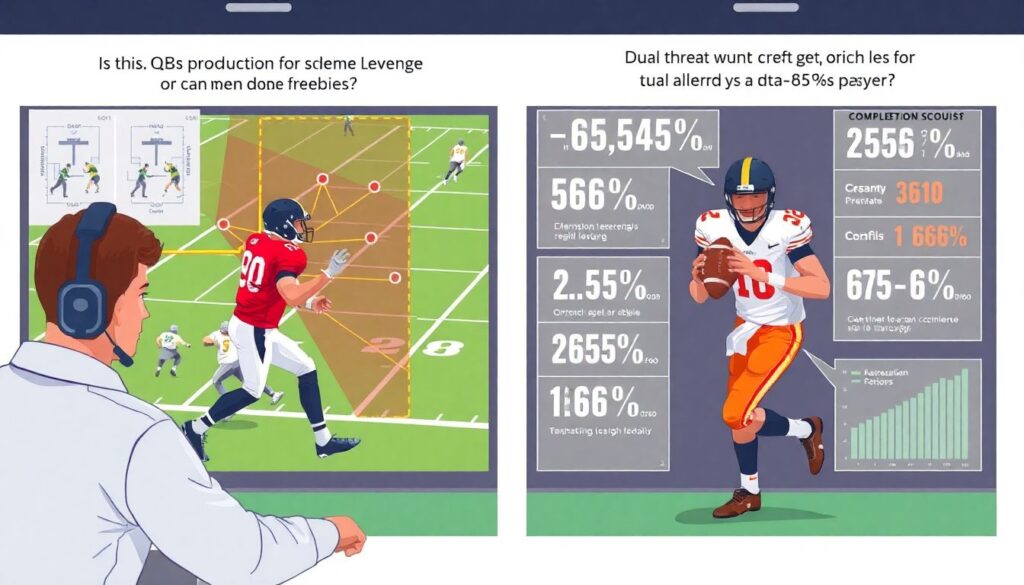
Because of the explosion of data and film, high school prospects are being evaluated with far more context:
– “Is this QB’s production coming from scheme freebies, or can he actually read leverage?”
– “Is he a runner who can get to 60% completion with the right coaching, or is he already a 65–68% passer who just happens to run 4.5?”
This is where modern dual-threat quarterback recruiting services pitch their value: they don’t just blast out highlight reels; they frame players for the right schemes. A QB who is lethal in a heavy RPO, quick-game system might not be ideal for a vertical, play-action-heavy offense—and that’s okay, as long as everybody’s honest about it.
—
How to Think Like a Coach About Dual-Threat QBs
If you’re a player, parent, or coach trying to navigate this landscape, it helps to adopt a coordinator’s mindset.
Five Practical Guidelines for Developing a Modern Dual-Threat QB
1. Build the arm and the eyes first.
Work mechanics, accuracy, and coverage ID constantly. Speed helps, but processing wins.
2. Treat mobility as a tool, not an identity.
Being fast doesn’t mean you should run every snap. Use legs to buy time, stress coverages, and convert must-have downs.
3. Learn protection like an OL.
The quickest way to kill a dual-threat QB is letting him get hit by free rushers. Teach him how to set protections and recognize blitz cues.
4. Practice controlled chaos.
Design drills that mimic broken plays: escape, keep eyes downfield, throw on the run, slide when nothing is there.
5. Think career, not highlight reel.
Every extra hit at 18 has a small but real impact on how fresh you’ll be at 28. Slide early, win from the pocket whenever you can, and pick your spots.
—
Short-Term Gimmick or Long-Term Future?
At this point, it’s clear: dual-threat quarterbacks aren’t a phase. The game at every level is faster, wider, and more space-oriented than it was a generation ago, and QBs who can both diagnose and punish defenses physically fit that environment perfectly.
What *is* changing is the bar. In the early days, being a dynamic runner was enough to get you on the field. In 2026, it’s just the price of admission. The truly elite dual-threats are winning games with their minds and arms, then breaking defenses’ backs with their legs when the structure fails.
If you’re building an offense today—college, high school, or pro—the question isn’t “Should we go dual-threat?” It’s “How can we design our system so that a smart, accurate, mobile QB can use every part of his toolkit without shortening his career?”
Answer that correctly, and you’re not just following the evolution of the dual-threat quarterback. You’re driving the next stage.