
From Pocket Passers to Playmakers: Why Dual-Threat QBs Took Over
Ten years ago, most coaches still treated rushing yards from a quarterback as a bonus. Now, if your starter can’t extend plays or win in the designed QB run game, you’re playing catch‑up. Across FBS since 2015, offenses with a quarterback over 500 rushing yards average roughly a full yard more per play and 4–6 extra points per game. The NFL mirrors that trend: in 2023, four of the top six scoring offenses featured QBs who created at least 600 yards with their legs, either on scrambles or option concepts.
Case Studies: How Dual-Threat QBs Reshaped the Modern Offense
Lamar Jackson is the clearest example. In his 2019 MVP season, Baltimore built a run‑first, pistol‑heavy system that leveraged his zone‑read and QB power skills. He generated over 1,200 rushing yards while still posting elite passing efficiency, and the Ravens posted a top‑three EPA per play offense. That year forced defensive coordinators to re‑write third‑down packages and pushed front offices to openly value mobility as a primary quarterback trait, not a secondary bonus.
From College Tape to Pro Systems: Jalen Hurts and Josh Allen
Jalen Hurts’ path shows how dual-threat QBs can scale from college to the pros with the right ecosystem. In Philadelphia, the staff married RPOs, designed QB runs and vertical shot plays, echoing his Oklahoma tape. Once the Eagles leaned fully into his skill set, red zone efficiency spiked and short‑yardage success became almost automatic. Josh Allen offers another blueprint: his early career was built around QB power, bootlegs and scramble drills, buying time for mechanical and processing improvements without stalling the offense.
Next Wave: Prospects and the 2025 Draft Class
Looking at the best college dual threat quarterbacks 2025 draft analysts already highlight, a pattern appears: coordinators are recruiting and designing around mobility first. Players projected near the top of the board are regularly hitting thresholds of 3,500+ passing yards and 600–800 rushing yards in a season. That dual production forces college defenses into lighter boxes and simulated pressures, which in turn makes NFL evaluators comfortable projecting these schemes forward into Sunday systems without assuming a complete stylistic overhaul.
Inside the Numbers: What the Data Actually Shows
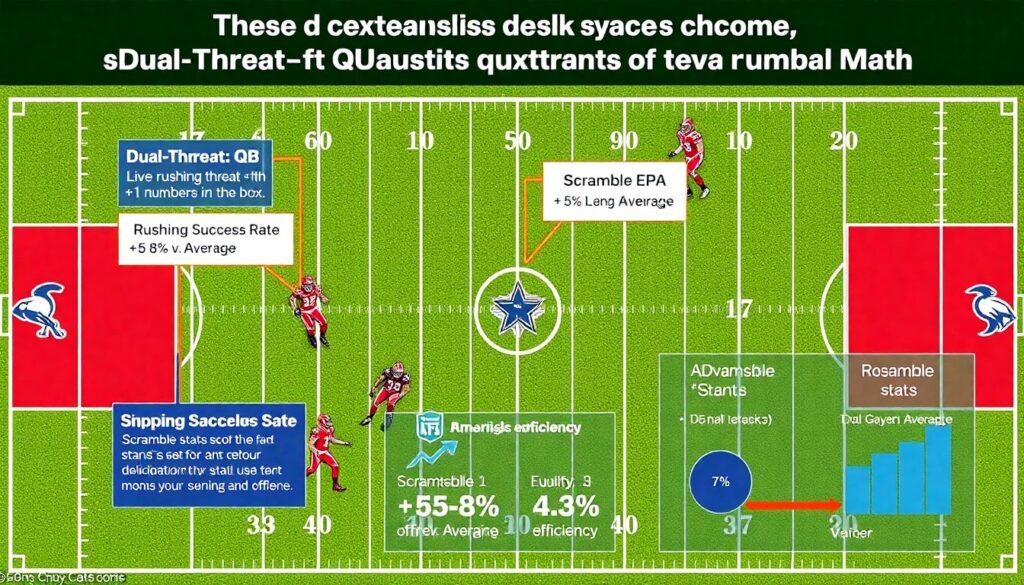
Statistically, dual-threat quarterbacks change run game math. With the QB as a live carry, the offense gains a plus‑one advantage in the box, which explains why teams with top‑tier runners at the position regularly post rushing success rates 5–8 percentage points higher than average. Scramble EPA is another differentiator: even “controlled” scramblers add hidden yardage by turning broken pass plays into efficient gains. Over a full season, that can be worth two to three additional wins in close‑game situations where one extended drive flips win probability.
Recruiting Rankings and the Talent Pipeline
On the college side, dual threat quarterback recruiting rankings now heavily weight verified speed, change‑of‑direction metrics and off‑schedule play creation on film. A decade ago, many ranking services listed such prospects as “athletes” and projected position changes. Today, that same profile is often graded as a premium QB candidate. As a result, Power Five rosters feature more true dual‑threat starters than ever, and mid‑majors are building entire identities around high‑volume QB run packages and spread option concepts.
Training: How Development Models Have Evolved
Traditional QB training obsessed over footwork on five‑ and seven‑step drops, board drills and static pocket reads. A modern dual threat quarterback training program looks very different. Sessions combine full‑field progression work with sprint‑out concepts, off‑platform throws, reaction‑based scramble drills and load‑management conditioning similar to skill receivers. Trainers also script “chaos periods”: live rush simulations where the QB must reset passing lanes or transition into a designed run read, mirroring game‑speed processing.
Role of Private Coaches and Specialist Support
The private coaching ecosystem adjusted quickly. Parents searching for a “quarterback coach for dual threat QBs near me” now encounter specialists who integrate track‑style speed training, lower‑body power work and cognitive processing tools like VR coverage reps. These coaches aren’t just teaching mesh mechanics; they’re building decision‑making frameworks so athletes know when to protect themselves, when to slide and when an aggressive cutback is worth the collision cost over a 12‑ or 17‑game season.
- Mechanical work: off‑platform throwing, arm‑slot variability, base stability under movement.
- Run integration: read‑option footwork, ball security, contact balance and slide technique.
- Cognitive training: coverage ID, pressure recognition, scramble rules and hot adjustments.
Economics: Why Dual-Threat QBs Are Changing the Money Flow
On the financial side, dual‑threat stars are becoming economic engines. In the NFL, mobile franchise quarterbacks command contract structures that assume they are the system, not just operating within one. Their presence boosts offensive metrics, which inflates valuations for offensive tackles, receiving tight ends and multipurpose backs. In college, NIL deals for high‑profile dual threats routinely hit seven figures, driven by their highlight‑friendly play style and the way their rushing volume keeps them on screen every snap.
Market for Training, Camps and Showcases
Off the field, an entire niche market emerged around dual threat quarterback camps and showcases. These events emphasize live 7‑on‑7 with integrated QB run rules, movement throws and red‑zone option periods. Organizers monetize through streaming rights, recruiting subscriptions and brand partnerships. For athletes, strong camp performances can directly influence scholarship offers and transfer‑portal leverage; for trainers, they create recurring revenue and a clear funnel into private coaching and remote film‑analysis services.
- Camp fees and premium “VIP” sessions with ex‑NFL coordinators and QB coaches.
- Sponsorship from apparel and wearable‑tech brands focused on performance tracking.
- Media rights via live streams, highlight packages and recruiting‑focused platforms.
Impact on Schemes, Rosters and the Broader Industry
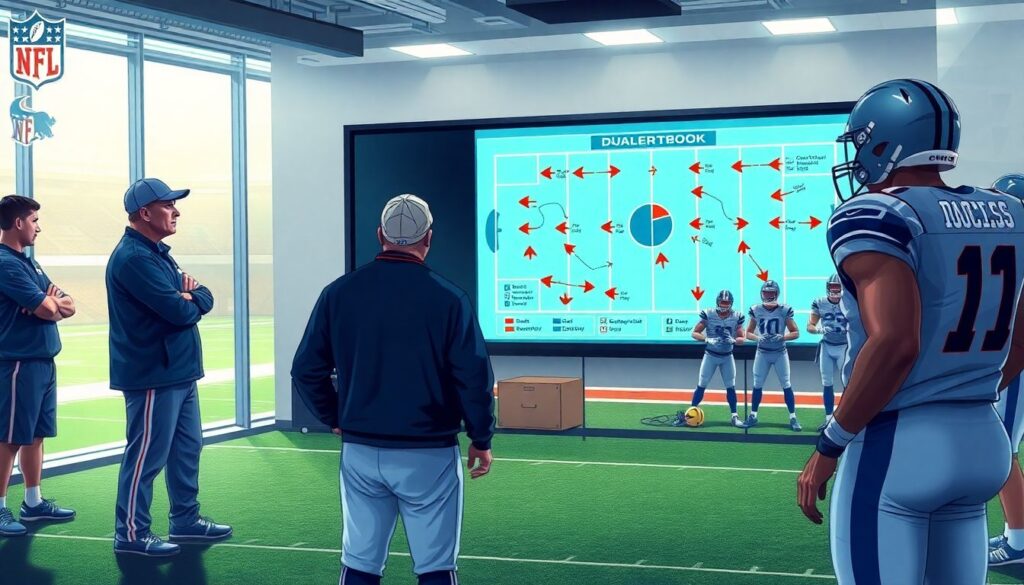
NFL and college coordinators are retrofitting playbooks to keep dual-threat QBs healthy while preserving their value on the ground. That means more RPOs, quick‑game concepts and structured scramble rules, with fewer unnecessary designed hits. Offensive line recruiting now favors movers who can execute wide‑zone and pull on QB counter. Receiver rooms prioritize scramble‑drill awareness and perimeter blocking. Even defensive rosters respond, investing more in hybrid safeties and off‑ball linebackers who can both cover space and fill against QB‑centric run games.
Forecasts: Where Dual-Threat Quarterbacks Go Next
Looking ahead, there’s little evidence this is a passing trend. High school offenses are essentially laboratories for spread and option concepts, so the next decade’s prospects will arrive with thousands of live RPO and QB run snaps already banked. Expect dual threat quarterback recruiting rankings to incorporate more advanced metrics, like GPS‑tracked acceleration and throw velocity under pressure. At the pro level, rule emphasis on quarterback protection should extend career arcs, making mobile QBs sustainable long‑term assets rather than short‑window gambles.
Strategic Takeaways for Players, Coaches and Recruiters
For young athletes, the key is balance: mobility opens doors, but front offices still pay a premium for processing, accuracy and late‑down passing. Coaches who can blend a robust dropback menu with curated QB runs will squeeze maximum value without exposing their starter to constant hits. Recruiters should evaluate how a prospect’s dual‑threat traits translate when the game speeds up and windows shrink. In that context, targeted use of a dual threat quarterback training program becomes less about gimmicks and more about building a complete, sustainable modern field general.