
The modern business of football: why money strategy wins games
In the NFL, the salary cap turned roster building into a math puzzle as important as play design. Since 2021 the cap jumped from $182.5M to $208.2M in 2022 and $224.8M in 2023, then spiked to $255.4M for 2024, roughly +40% in four seasons. That growth rewards teams that planned ahead with flexible deals and punishes those that kicked money into the future. We’ll break down how front offices think, how contracts really work, and why analytics and legal support now matter as much as scouting.
Salary cap basics and why they’re misunderstood
What the cap actually limits
The salary cap is a yearly upper limit on cap charges, not on cash paid. Signing bonuses can be paid today but spread on the cap over up to five seasons, which is how contenders keep stars while staying “under the number.” From 2021–2023, over half of playoff teams each year ranked in the top ten for prorated bonus spending, proving creative accounting is standard practice, not an exception. The key constraint isn’t raw cap space, but how much future flexibility you’re burning.
Diagram: cap space as a pipeline
[Diagram: Imagine a horizontal pipeline labeled “2024–2028 cap.” Each year is a segment. When a team restructures a contract, you insert a valve in 2024 and push water forward into 2025–2028 segments. The 2024 segment empties (more cap room now), but downstream segments fill up (less room later).] This mental model is how serious NFL salary cap management services explain restructures and void years to coaches and even owners who don’t live in spreadsheets every day.
Front-office structure: who actually decides?
Roles in the decision chain
A modern front office usually has four strong voices: the general manager (roster architect), the cap/contract lead (the “numbers” expert), the head coach (scheme and culture), and the analytics director (probability and value). Since 2021, more than half of playoff teams have publicly acknowledged using some form of football analytics consulting for front office decisions, from 4th-down calls to multi‑year roster planning. The winning pattern: coach sets on‑field needs, GM and cap lead translate them into financially sustainable moves.
Scouting vs. spreadsheets
Traditional scouts focus on traits and tape; analytics staff model outcomes like WAR (wins above replacement) and aging curves. Between 2021 and 2023, teams that ranked in the league’s top eight by PFF team coverage grade and also invested in analytics staff made the conference championships in all three seasons. That doesn’t “prove” analytics alone win, but it shows a clear correlation: balancing film and data tends to produce more efficient cap spending, especially at volatile positions like DB and WR.
Inside an NFL contract: structure beats sticker price
Key definitions you need fluently
Cap nerd vocabulary is smaller than it looks: base salary (yearly pay), signing bonus (up‑front cash, spread on the cap), roster bonus (paid if on roster by a date), workout bonus, guarantees (injury, skill, and cap), and incentives, split into Likely To Be Earned (LTBE) and Not Likely To Be Earned (NLTBE). Since 2021, elite QB deals have averaged over $50M per year in new money, but only about 55–65% of that is fully guaranteed at signing. The rest is “practical” guarantees that depend on survival through certain seasons.
Diagram: how a bonus hits the cap
[Diagram: Column of five boxes labeled 2024–2028. At the top, a circle labeled “$20M signing bonus.” From the circle, five equal arrows ($4M each) flow into each year box, showing prorated cap hits. Next to 2024, add a separate box “$10M base salary.” Final 2024 cap hit = $4M (bonus) + $10M (base) = $14M.] This is why a “5‑year, $100M” headline often hides a smaller 1‑ or 2‑year fully guaranteed window the team can truly count on.
Negotiation tactics: finding leverage and value
Where leverage really comes from
Players gain leverage from performance, scarcity at their position, health, and timing. Teams gain it from draft depth, tag options, and their own cap flexibility. In 2022–2023, top QB extensions (Rodgers, Murray, Hurts, Jackson, Herbert, Burrow) shifted the APY market from the mid‑40s to the mid‑50s. Yet several deals were structured to allow an out after year three, showing teams still protect long‑term downside. A good sports contract negotiation agency will obsess over those exit ramps more than headline numbers.
Non‑QB positions and market tiers
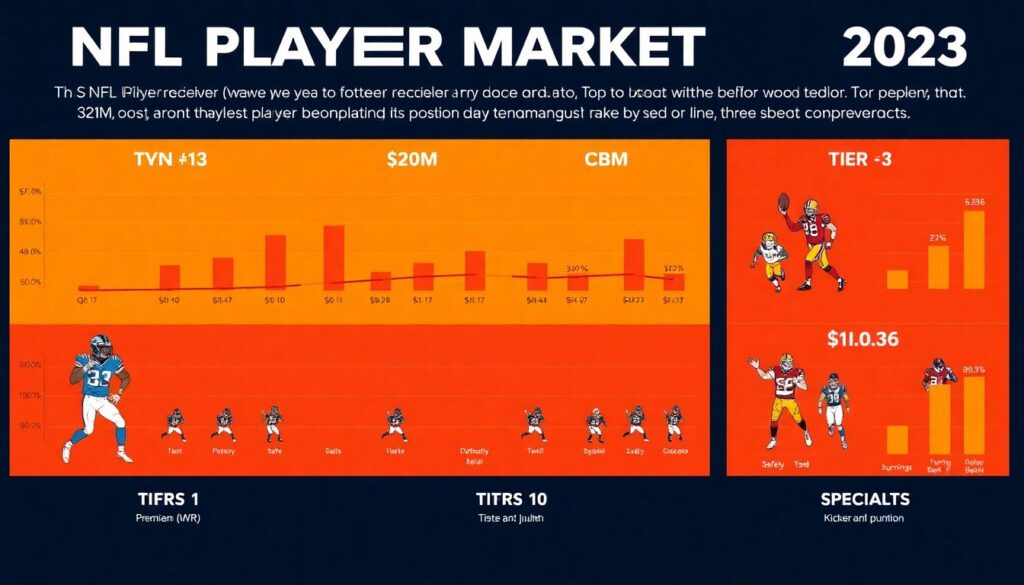
From 2021 to 2023, wide receiver and cornerback markets exploded: top WR APY jumped from around $20M to $28M+, while CBs pushed past $21M. Front offices now tier positions: Tier 1 “premium” (QB, WR, EDGE, OT, CB), Tier 2 (DT, S, TE, LB), Tier 3 (RB, specialists). Premium positions get length and guaranteed money; others see shorter deals with lower guarantees. Smart teams avoid paying Tier‑2 or Tier‑3 positions like Tier 1 starters unless they’re truly elite and scheme‑critical.
Cap strategy in practice: win now vs. sustain
Two core philosophies
Most teams lean toward one of two cap philosophies. “All‑in” contenders front‑load talent, use restructures, and accept future dead money to maximize a 2–3 year Super Bowl window. “Rolling window” teams maintain flexible space, stagger extensions, and rarely max‑restructure deals. Between 2021 and 2023, every Super Bowl winner used at least two major restructures on veteran stars, but they also paired that with strong rookie classes to keep average cost per starter manageable. Aggression works only if you can refill with cheap talent.
Diagram: all‑in vs. rolling window
[Diagram: Two timelines, 2024–2028. For the all‑in team, 2024–2025 bars are tall (high spending, low flexibility), then shorten sharply with notes “dead money” and “aging core.” For the rolling‑window team, all bars are medium height, labeled “steady cap health,” with small peaks labeled “targeted splurge years.”] Your front‑office strategy should pick a lane and commit; mixing both usually leads to an expensive but mediocre roster around year three.
Risk management: dead money and injuries
Dead cap as the cost of changing your mind
Dead cap is the charge for players no longer on the roster, usually from remaining prorated bonuses. From 2021 to 2023, several franchises carried over $40M in dead cap at least once, effectively playing with $5–10M less usable space than rivals. That’s often the hangover from earlier “all‑in” pushes. Good cap managers treat dead cap like credit card interest: acceptable in small, controlled doses, dangerous when it becomes a regular line item for aging starters with little remaining on‑field value.
Injury, guarantees, and insurance
Injury rates haven’t improved much; roughly 15–20% of a roster will hit injured reserve in a typical season. That reality drives teams to push for injury‑only guarantees and per‑game roster bonuses, especially for running backs and older players. The best sports law firms for player contracts navigate the trade‑off: more security via guarantees versus team protection through offsets, void years, and split salaries. For front offices, the lesson is simple: assume injuries will hit expensive vets and bake that risk into structure, not hope.
Analytics and external expertise
Why front offices outsource some brainwork
Not every club wants a huge in‑house analytics or cap department. That’s where external NFL salary cap management services come in—boutique firms modeling multi‑year scenarios, restructure options, and tag strategies. Similarly, several franchises quietly lean on football analytics consulting for front office planning around draft capital, extension timing, and positional value. Outsourcing doesn’t replace your GM; it gives them better “what‑if” maps, especially when ownership wants to see the cost of aggressive spending versus patient builds.
Legal and education ecosystem

Around the league, agents and lawyers have also specialized. A modern sports contract negotiation agency will often employ former team cap analysts or law grads who studied CBA minutiae. Parallel to that, more executives and agents enroll in an online course football front office management to get comfortable with cap math, CBA rules, and negotiation tactics. The knowledge gap between “old‑school” and modern operators has narrowed, raising the overall baseline of sophistication in how deals are structured and disputed.
Practical playbook for aspiring front‑office minds
Step‑by‑step way to think like a cap strategist
1. Map your core: identify 8–10 players you’d be comfortable guaranteeing real money to over the next three seasons.
2. Align with scheme: ensure spending matches how your coaches win; don’t pay a power run line for a pass‑heavy system.
3. Protect your future: cap every restructure with a clear “exit year” and acceptable dead‑money limit.
4. Exploit rookie deals: concentrate expensive vets at the most impact‑efficient positions while your QB or stars are cheap.
Where to focus your learning
If you want to work in this space, prioritize three skill sets. First, CBA literacy: read the current agreement and understand tags, tenders, guarantees, and grievances. Second, spreadsheet fluency: be able to model multiple contract structures and their cap impact quickly. Third, communication: explain complex mechanisms to non‑technical coaches and owners with simple diagrams and analogies. Those who combine football insight with financial clarity are exactly who teams hire when they retool their front‑office strategy.