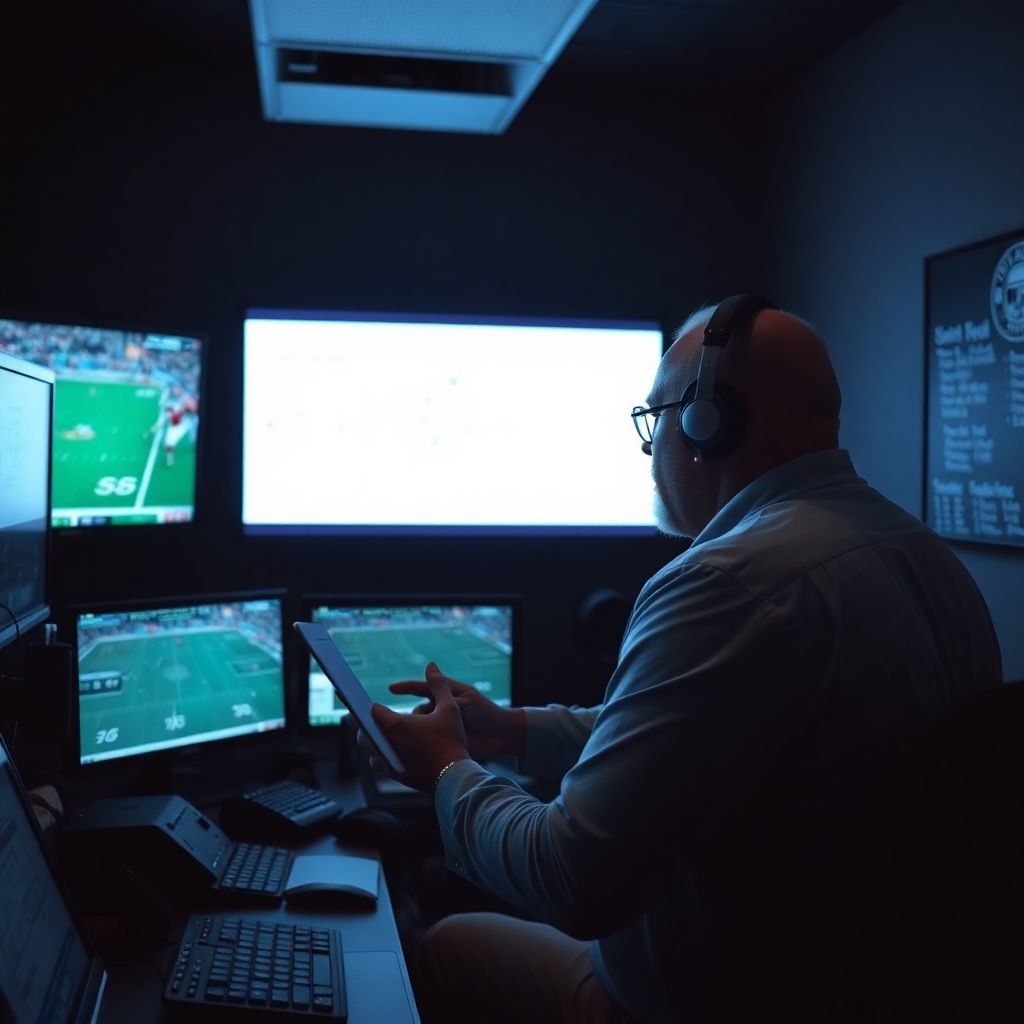
To analyze game tape like an NFL coach, standardize your setup, watch from wide then end-zone angles, tag every play the same way, and focus on structure first, details second. Start with personnel, formation, and situation, then move into concepts, protection, coverage, and tendencies that translate directly into practice and play-calling.
Core Principles of Film-Study Workflows
- Always tag down-and-distance, field position, and personnel before judging results.
- Study from wide angle first to understand structure, then end-zone for line play and backfield detail.
- Separate “what happened” (facts) from “why it happened” (coaching points and corrections).
- Batch your viewing: formations in one pass, concepts in another, tendencies in a third.
- Turn notes into simple, repeatable rules players can execute at full speed.
- Use consistent language so your cut-ups, grading, and scouting reports all align.
Preparing Your Viewing Environment and Tools
This workflow suits high school, college, and semi-pro staffs, and ambitious fans who want more than highlight watching. It is less useful if you cannot access all-22 style angles or if you only have time for quick recaps, because details of spacing and leverage matter.
Set up your film room like a workplace, not entertainment. At minimum, you need:
- A screen large enough to see spacing and numbers clearly (no tiny phone screens).
- Reliable pause, rewind, frame-by-frame, and playback speed controls.
- A note-taking system (digital document, spreadsheet, or dedicated film platform).
- Clear role division if you work as a staff: who tags, who draws, who writes reports.
If you are choosing the best software for football game film analysis, prioritize:
- Easy cut-up creation by formation, personnel, situation, and result.
- Flexible tagging and filters (e.g., “Trips into the boundary on 3rd and medium”).
- Simple export of reports and clips to share with players and staff.
For learners without access to team systems, an online training to analyze football game tape or an nfl game film analysis course can provide sample cut-ups, terminology, and templates you can copy into your own workflow.
Micro-example – Simple setup for a high school OC: one laptop with film software, an external monitor, headphones, a shared spreadsheet on a cloud drive, and a weekly routine (Sunday: tag formations and personnel, Monday: concepts and protections, Tuesday: tendencies and game-plan notes).
Breaking Down Play Structure: Personnel, Formations, Motion
Before you can analyze concepts or protection, you must reliably identify how the offense lines up and shifts. This is where most nfl coaching film study tools start: standardized tags for every clip.
You will need:
- Access to full-game video with, ideally, wide and end-zone angles.
- A clear personnel grouping system (e.g., 11, 12, 21, or your own labels).
- A formation naming system your staff actually uses on the field.
- A consistent way to record motion, shifts, and backfield alignments.
If you do not have software, a simple spreadsheet works. Columns might include:
- Play #, Quarter, Clock, Down & Distance, Field Position.
- Offensive Personnel, Formation, Strength call (e.g., to TE or passing strength).
- Motion/Shift description and direction.
- Play Type (Run/Pass/RPO), Result (yards, first down, explosive, turnover).
Some staffs outsource initial tagging to a football game tape breakdown service, then refine the data themselves. This is effective if your time is limited, but you still want detailed scouting.
Micro-example – Tagging one play: 2nd & 7 on own 35. Offense in 11 personnel, shotgun, 3×1 Trips Right. RB offset to QB’s left. WR to the boundary tight to the formation. Z WR comes in fast jet motion left-to-right. You would tag: “11 – Gun Trips Rt, Jet Mot Z Lt->Rt, Field strength: Trips.”
Assessing Route Concepts, Blocking Schemes, and Timing
Analyzing concepts and timing is where you shift from “what they lined up in” to “what they’re trying to accomplish.” Follow these practical, safe, and repeatable steps. Avoid jumping to conclusions based on one clip; look for patterns and protect player privacy when sharing examples.
- Do not share identifiable clips of amateur players publicly without permission.
- Respect platform terms of service when downloading or clipping video.
- Avoid using film to embarrass individual players on social media.
- Be careful not to disclose opponent signals or calls in public materials.
- Remember that tendencies change; do not gamble or make high-risk decisions based solely on old tape.
-
Label the down, distance, and situational context first
Before worrying about routes or blocking, note down-and-distance, field position, hash, score, and time. This frames why the call was made and what the offense and defense likely expected from each other. -
Start from the quarterback and backfield action
Watch QB footwork and the RB path. Identify: pure run, pure pass, play-action, RPO, or screen. QB drops (quick, three-step, five-step, play-action depth) reveal timing and the menu of likely concepts.- Quick game (no hitch or one-step) usually ties to short, timing-based concepts.
- Deeper drops often support intermediate or shot concepts needing more protection.
-
Trace the route concept from inside-out
Focus on #2 receivers and tight ends first, then work to #1s outside. Look for common families: slant/flat, curl/flat, smash, four-verticals, mesh, flood, dagger, etc. Identify which receiver is “primary” based on concept and QB eyes.- Pause just after the QB’s back foot hits on his drop and note which route is breaking.
- Compare route depth to the sticks on critical downs (3rd and medium, red zone).
-
Diagnose protection and blocking schemes
From the end-zone copy, watch the offensive line and backs. For the pass game, look for slide vs man protection, where help is going, and if the back is releasing or staying in. For the run game, identify zone vs gap, double teams, and pullers.- Check if protection matches the depth of routes (e.g., long-developing concepts need solid edges).
- Note communication: are linemen pointing and talking pre-snap, or do they look unsure?
-
Sync timing between QB, routes, and protection
Play the clip through a few times focusing only on timing. Ask: does the QB hit his back foot as routes are breaking and protection is still solid, or is someone consistently early/late? Timing often explains incomplete passes more than accuracy alone. -
Tag coaching points and issues, not just results
In your notes, separate the outcome from the underlying detail. A completed pass with bad spacing still needs correction; a well-timed throw dropped by a WR might be graded positively for the QB and protection.- Create simple tags like “WR under depth,” “QB late trigger,” “OL uncovered rules busted.”
- Save short clips of clean examples to use in meetings and a separate list for corrections.
Micro-example – One third-down pass: 3rd & 5. Offense runs a rub concept: inside pick with an out by the #2 WR. QB is one step late on the throw, allowing the DB to undercut. Your note: “Good call vs man, QB trigger late, rep timing drill this week.”
Identifying Tendencies, Game Plans and In-Game Adjustments
Once individual plays are tagged, step back and test whether your conclusions hold across the whole game or multiple games. Use this checklist to validate your tendency study.
- Have you filtered by personnel groupings and checked run/pass percentages within each, instead of overall only?
- Did you analyze tendencies by down-and-distance bands (short, medium, long), not just “all third downs” lumped together?
- Have you looked at field position zones (coming out, midfield, red zone) for specific favorite calls?
- Did you account for hash and formation into/away from the boundary when assessing strength calls?
- Have you compared the first 15-20 offensive calls to previous weeks to infer scripted game-plan ideas?
- Did you track how the offense or defense adjusted after halftime, or after a big play broke down their original plan?
- Have you checked for “answer” plays: what they call the next time they face the same look or situation?
- Did you verify that your perceived tendencies have enough sample size and are not based on one or two outliers?
- Have you converted tendencies into simple rules players can understand (“On 3rd & long, expect trips into the boundary flood”)?
Micro-example – Tendency insight: Over three games, the opponent in 12 personnel on 1st & 10 called outside zone weak or play-action flood to the strong side. You now game-plan a force player and flat defender drilled to handle that exact combination.
Grading Plays and Producing Actionable Scouting Reports
Grading and reporting are where film work often goes wrong. Avoid these frequent mistakes that make film study less useful for players and staff.
- Grading only on result, not assignment and technique (e.g., giving a “plus” for a bad play that lucked into yards).
- Using inconsistent or unclear grading scales that change from week to week or between position coaches.
- Writing reports that are too long, too vague, or full of jargon players cannot apply on the field.
- Failing to separate “must fix now” issues from minor corrections, overwhelming players with low-priority notes.
- Not aligning scouting language with practice scripts and play-call terminology, causing confusion.
- Ignoring special teams and situational football in your grading and reports.
- Leaving no space in reports for opponent strengths, only weaknesses, which underestimates their key players and best concepts.
- Sharing reports late in the week so there is not enough practice time to address findings.
- Copying templates from an nfl game film analysis course or online training to analyze football game tape without adapting them to your system and level.
Micro-example – Simple grading template: For each player: Assignment (plus/zero/minus), Technique (plus/zero/minus), Effort (plus/zero/minus), and one coaching point. For each opponent unit: Top three concepts, top three players, and three “must answer” situations.
Turning Tape Insights into Practice Plans and Play-Calls
Film has value only if it changes how you practice and call plays. There are several ways to move from analysis into weekly preparation, and some alternatives if you cannot run full NFL-style workflows.
-
Full staff-run install from team film
Ideal for organized high school and college programs. Position coaches own their cut-ups and present top opponent concepts to players early in the week, then build practice periods around those looks. -
Hybrid model with outsourced tagging
Use a football game tape breakdown service for initial data (personnel, formations, basic play type). The staff focuses on higher-level tendencies, adjustments, and practice design. Helpful if staff time is limited but you still want detail. -
Self-education with structured courses
For smaller programs or aspiring coaches, an nfl game film analysis course or other curated online training to analyze football game tape can provide frameworks, sample reports, and drills to copy until you build your own system. -
Lightweight weekly review for amateur teams or fan analysts
When practice time or player access is minimal, run a short weekly session using simple cut-ups: “What they do best,” “Where they are vulnerable,” and “Situations we must win.” Use clips mainly to reinforce 2-3 clear points, not an exhaustive breakdown.
Micro-example – Turning an insight into a call: Your film shows the opponent auto-checks to Cover 0 versus bunch on 3rd & 3-5. You build a bunch fade-wheel concept and script it for your first 3rd & 3 in plus territory, practicing the exact timing all week.
Practical Clarifications for Game-Video Analysis
How many times should I watch each play to analyze it like an NFL coach?
Start with two passes: wide copy for structure, end-zone for line play. For key plays or concepts, expect three to five viewings focusing on different details each time. Avoid obsessing over one clip; prioritize patterns across multiple snaps.
Can I do serious film analysis without all-22 angle access?
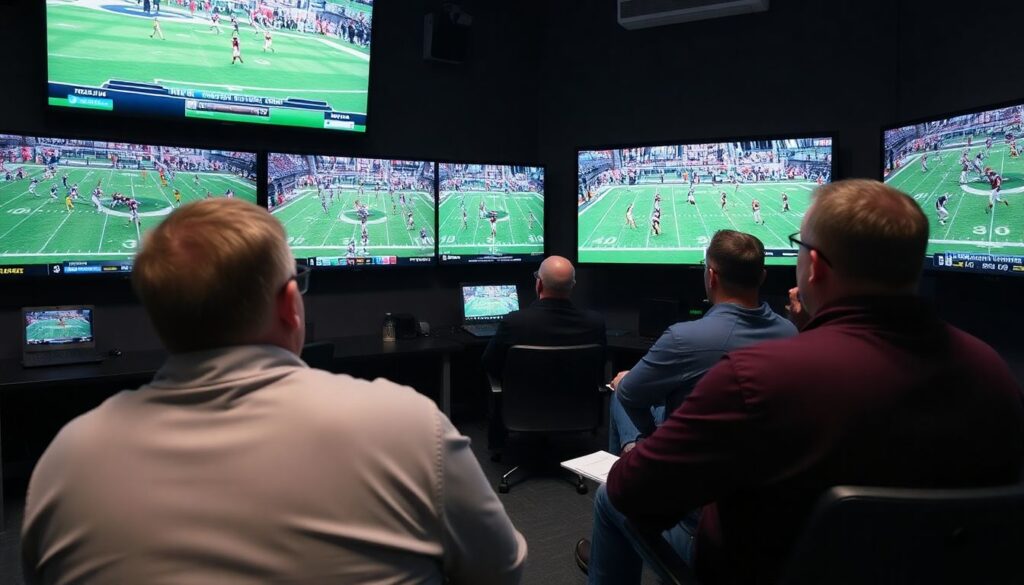
You can still learn tendencies and concepts from broadcast copies, but you will miss some spacing and coverage detail. Focus on formations, motions, and obvious route concepts from the TV angle, and use end-zone-like views when available to study line play.
What is the minimum tech setup to start structured game-tape study?
A laptop or tablet with reliable playback controls, a way to pause and rewind precisely, and a basic note-taking or spreadsheet tool are enough. Advanced platforms and nfl coaching film study tools help, but consistency in tagging and terminology matters more.
How do I avoid overwhelming players with too much film information?
Limit each position group to a few core rules and examples. Use film to show “this is our rule in action” rather than every tiny tendency. Prioritize opponent strengths and the top situations you expect to see, and share only what changes how they play.
Is it worth paying for a professional breakdown service or software?
If your staff is small and time is tight, outsourcing basic tagging to a football game tape breakdown service or using the best software for football game film analysis can free you to focus on game-planning. For smaller amateur teams, a disciplined manual system is usually enough.
How can an aspiring coach learn these skills without being on a team staff?
Study freely available games, build your own tagging sheet, and compare your notes with coaching resources. Structured options like an nfl game film analysis course or other online training to analyze football game tape can accelerate your learning by providing tested frameworks.
How often should I update my tendency reports during a season?
Revisit them weekly, but adjust their weight over time. Early in the season, one or two games heavily influence your view; later, emphasize recent games to capture in-season adjustments while still recognizing the offense or defense’s core identity.