
Major NFL trades and contracts are business decisions driven by salary cap rules, cash flow, risk management, and roster value, not just talent. Front offices balance guarantees, bonuses, and trade timing against cap flexibility and downside risk, constantly comparing alternative structures to find the most efficient, least risky way to acquire or keep players.
Executive Summary: Financial Drivers Behind Major NFL Moves
- The salary cap and its timing windows often decide when big trades happen more than on-field needs or NFL trade rumors 2024 storylines.
- Modern NFL player contracts and salaries use signing bonuses and guarantees to trade short-term cap relief for long-term commitment and risk.
- Restructures, cuts, and trades solve similar cap problems but differ sharply in ease of implementation, locker-room impact, and dead money risk.
- Valuation blends data, film, market comps, and opportunity cost; overpaying one star can quietly weaken three positions.
- Compensatory pick rules and draft capital costs turn similar trades into very different long-term investments.
- Teams that routinely model multiple contract and trade paths make fewer emotional decisions and gain reliable edges for betting markets and roster building.
How the Salary Cap Shapes Trade Timing and Contract Design
The salary cap is a hard annual limit on how much a team can spend on its 53-man roster, practice squad, and certain bonuses. Cap charges, not cash, are what matter for compliance. Every major trade or extension is built around the current cap, projected future caps, and existing commitments.
Trade timing often follows cap inflection points: the start of the league year, roster bonus dates, and the trade deadline. A player can be affordable in pure cash terms but impossible to keep under the cap without a restructure or trade. That is why front offices watch an NFL salary cap tracker as closely as they watch film.
Mini cap math example: If a player has a $10M base salary and $5M remaining prorated bonus, his current cap hit is $15M. Trading him before a key date could accelerate that $5M immediately, while trading after June 1 might split it into $2.5M this year and $2.5M next year under standard CBA rules on proration.
Practical comparison of timing approaches:
- Pre-league year trade: Easiest for planning; more partners available; higher cap hit this year but clears future years quickly; lower long-term risk.
- Post-June 1 trade: More complex; splits dead money to reduce current-year pain; increases future-year risk and cap clutter.
- Deadline trade: Maximizes information about team performance; least flexible; minimal current-year cap impact due to partial-season salary, but offers limited time to integrate the player.
In practice, when you read about NFL trade rumors 2024 involving a high-salary veteran, the real front-office question is rarely just talent. It is whether absorbing or accelerating that player’s cap charges now versus later creates less risk than extending him, restructuring, or simply moving on after the season.
Anatomy of Modern NFL Contracts: Signing Bonuses, Guarantees, and Offset Language
Modern NFL player contracts and salaries are built from a small toolkit of levers that change who takes which kind of risk: the team or the player. The core components interact with cap rules to create either flexibility or rigidity over the life of a deal.
- Signing bonus and proration
Teams convert salary into a signing bonus paid up front but spread over up to five years for cap purposes. Example: a $20M signing bonus on a four-year deal results in $5M of prorated cap charge per year. This is easy to sell to players, but it creates back-end dead money risk. - Base salary and guarantees
Base salary is the yearly cash; guarantees can be skill, cap, injury, or combinations. Fully guaranteed salary is simple but inflexible. Partial guarantees are easier to negotiate but create more future decision points and potential friction if a player underperforms. - Roster and workout bonuses
These are date-specific triggers that push decisions earlier. A $5M roster bonus due on the third day of the league year forces a team to either pay, cut, restructure, or trade. They are straightforward to administer but increase calendar-based pressure on front offices. - Escalators and incentives
These tie extra pay to performance thresholds or playtime. They allow a team to protect against downside while rewarding upside. However, poorly designed incentives can unexpectedly eat cap room in later years if a player exceeds expectations. - Offset language
Offset language determines whether a released player can effectively double dip by collecting his guarantee and a new salary elsewhere. Strong offsets shift financial risk to the player; weak offsets are more player-friendly and are often a negotiating focus for the best NFL contract negotiation agencies. - Void years
Extra dummy years used only for proration. A two-year deal with three void years can spread a bonus over five years. This makes cap math look friendly today but pushes dead money into the future, increasing long-term risk.
Simple numeric illustration: A two-year, $24M deal could be built as $4M signing bonus (prorated $2M + $2M), plus $10M base per year. Year 1 cap hit: $12M. If instead you use an $8M bonus prorated over four years with voids, Year 1 cap hit might fall to $8M but create $4M of future dead money if you cut the player early.
Implementation vs. risk comparison:
- High signing bonus, lower base: Easy to close and attractive to players; riskier for teams due to large dead money if performance dips.
- Higher base, lower guarantees: Harder for agents to sell; much safer for teams; easier to move on from the player via cut or trade.
- Heavy incentives and escalators: Moderate ease; cap-friendly if thresholds are realistic; risk lies in mis-forecasting the player’s actual usage and health.
Cap Management Tactics: Restructures, Dead Money, and Future Flexibility
Cap management tactics are ways to realign when and how you recognize cost, without necessarily changing how much a player ultimately earns. The main tools are restructures, extensions, cuts, and trades, all of which shift cash flow and dead money into different years.
- Simple restructure
A team converts part of a base salary into a new signing bonus to lower the current-year cap hit. Example: Convert $10M of a $14M base into bonus on a four-year remaining term. New annual proration is $2.5M instead of $0, lowering this year’s hit by $7.5M but adding $2.5M to each of the next three years. - Extension with restructure
This adds years while converting money into bonus. It is easier politically (player gets security) but riskier structurally if performance declines. It is best used for younger core players, not aging veterans with durability red flags. - Post-June 1 designation
A team can cut or trade a player and choose to split dead money across two seasons. This is a relief valve but can lead to a “ghost roster” of dead charges limiting future flexibility. - In-season restructures
Used to create emergency space for signings or to handle incentives that hit the cap. Operationally simple but can stack small future problems that compound over multiple seasons.
Numeric snapshot: If cutting a player outright creates $20M of dead money this year, a post-June 1 treatment might reduce that to $8M this year and $12M next year. You gain short-term breathing room but accept future constraints.
Scenario comparison by ease and risk:
- Restructure only: Easiest to implement; minimal relationship damage; increases future dead money risk and can trap you in the deal.
- Restructure plus extension: Moderate difficulty; locks in a core player; higher long-term risk if your evaluation is wrong.
- Cut or trade with dead money hit: Hardest politically; immediate pain on the cap; often healthiest long-term if performance no longer justifies the contract.
When front offices debate a move, they quickly sketch these scenarios, frequently using internal tools or a public-style NFL salary cap tracker to visualize three to five years of cap effects before deciding which tactic presents the least total risk.
Valuing Players: Metrics, Market Comparables, and Opportunity Cost
Player valuation underpins every major contract and trade. Teams blend film, tracking data, traditional stats, and market comparables to decide what a player is worth over time, not just today. The challenge is less about measuring production and more about pricing uncertainty and opportunity cost.
Simple valuation illustration: Suppose your internal model values a starter at $12M per year based on production, age, and durability. The market for similar players is paying $14M. If you pay $16M to win the bidding, you are essentially taking on $4M per year of downside risk relative to your model and $2M relative to the market.
Core valuation tools and their strengths
- Metrics and film grades
Combine advanced tracking data and coaching grades. Strong at isolating individual contribution; weaker at predicting how well performance will age. - Market comparables
Compare your target to recent contracts at the same position and tier. Easy to communicate and justify; risk is overfitting to outlier deals. - Role and scheme fit
Measures how much value you can extract in your specific system. Low implementation cost; the risk is coordinator or scheme changes. - Health and age curves
Estimate how many high-level years remain. Easy to model; uncertain at the individual level, especially for unique body types or work habits.
Key limitations and hidden risks
- Sample size issues: One great season or a playoff run can overweight short-term performance and bias decisions.
- Role inflation: Paying a player for usage he only gets on a weaker roster assumes the same volume on your deeper roster.
- Opportunity cost: Overpaying by $5M per year for one player might mean losing two solid depth pieces, which is rarely visible in highlight packages but shows up in injuries and special teams.
- Market timing: Free-agency spikes and unique cap jumps can make normal-looking deals turn into bargains or burdens a year later.
For bettors learning how to analyze NFL trades and contracts for betting, understanding these strengths and weaknesses clarifies why some “overpays” actually reflect hidden scheme value and why other splashy signings tend to underperform expectations.
Trade Economics: Compensatory Picks, Draft Capital and Long-Term Roster Strategy
Trades sit at the intersection of contract math, player value, and draft economics. A trade is rarely just Player X for Pick Y; it is a choice among multiple paths for turning present-day cap room and picks into future wins.
Basic numeric trade frame: Imagine you can trade a veteran with a $15M cap hit for a second-round pick. If you move him, your cap hit becomes $8M in dead money, creating $7M in immediate space plus the pick. Keeping him keeps the full $15M hit but preserves continuity and proven production.
Common misconceptions and their risks
- “A first-round pick is always worth an established starter”
Ease: emotionally appealing and simple to argue. Risk: ignores variance; a mid-first pick still has a meaningful bust rate and delayed impact relative to a proven player who fits your system. - “Cap space today is always better than later”
Ease: easy to implement by dumping salary. Risk: some future years may be more valuable because you expect to be closer to contention; using every lever now can leave you capped out when your roster peaks. - “Compensatory picks are free assets”
Ease: simple narrative; you let a player walk and receive a pick. Risk: you lose a known contributor and must replace his snaps, leadership, and scheme knowledge, often at hidden cost. - “You must win every trade on public perception”
Ease: aligns with media and fan sentiment. Risk: the true goal is portfolio health over multiple years, not a single headline; a short-term PR win can be a long-term roster loss. - “More picks automatically mean better outcomes”
Ease: more darts sounds inherently better. Risk: rosters can only absorb so many young players; without snaps and development, excess late picks can be wasted opportunities and churn.
Smart front offices compare options side by side: extend, tag, trade, or play out the contract and let the player walk for a potential compensatory pick. They model three to four years of draft and cap impact, rather than reacting to a single-season narrative.
Real-World Case Studies: Dissecting Three High-Profile Trades and Their Business Logic
While many specifics are confidential, front offices tend to follow similar decision patterns on big trades. Below are simplified, illustrative scenarios that mirror the logic behind real deals, without relying on proprietary numbers.
Case 1: Trading a star receiver one year early
- Player wants a top-of-market extension that would add $8M per year over his current projected value.
- Team trades him for a first-round pick and saves $10M in cap space by avoiding the extension and bonus proration.
- Business logic: Lower implementation risk (no monster extension), but higher short-term on-field risk. Team chooses flexibility and draft capital over a potentially rigid contract.
Mini math: Keeping the player: $24M cap hit per year for three years. Trading him: $12M dead money this year, $0 future commitment, plus rookie on a cheap deal around $4M per year. Over three years, the trade path might save roughly $40M in cap compared with the extension path.
Case 2: Acquiring an expensive edge rusher for mid-round picks
- Player has two years left at $18M and $20M cap hits with modest guarantees remaining.
- Acquiring team restructures, turning $12M into bonus spread over three years and adding one void year, cutting Year 1 hit to around $10M.
- Business logic: Higher structural risk due to added dead money; easy short-term integration because you only give up mid-round picks and keep your top selections.
Mini math: Before trade, cap hits: $18M, $20M. After restructure: $10M, $22M, plus $4M dead in a void year if he is not extended. Implementation is straightforward, but you accept the risk of carrying “ghost” charges if performance drops.
Case 3: Moving a veteran quarterback for a package of picks
- Quarterback carries a $40M cap hit with $25M in remaining prorated bonus.
- Trade creates $25M dead money this year but clears $15M of salary and all future years. Team receives multiple picks, including a future first.
- Business logic: Difficult to sell to fans; financially painful in Year 1; but it dramatically reduces future risk and rebalances the roster’s financial structure.
Mini math: Keeping him two more years would consume $80M of cap. Trading now creates a one-time $25M dead charge and removes $55M of future cap plus the injury and performance risk. From a business perspective, the trade is a concentrated hit that buys long-term flexibility and draft equity.
In each case, the approach chosen balances ease of implementation (how hard the deal is to close and explain) with risk (dead money, performance decline, and roster imbalance). This framing is the same lens sharp observers and betting analysts use when they review NFL salary cap tracker data or assess the work of the best NFL contract negotiation agencies behind headline deals.
Practical Clarifications for Front-Office Decision-Makers
How much should cap considerations drive whether we trade or extend a player?
Cap should be a constraint, not the sole driver. If you are trading a clearly elite, scheme-perfect player primarily to solve a near-term cap crunch, it is usually a sign of earlier planning mistakes. Use trades to reshape your long-term cap structure, not just to patch a single year.
When is a restructure preferable to an outright release?
A restructure is preferable when you still like the player’s role and health, and you are confident he will remain on the roster for most of the remaining term. If you are already questioning his medium-term future, a restructure simply delays an inevitable, more painful exit.
How do we weigh compensatory picks against tagging or extending a player?
Start by estimating your likely compensatory pick value, then compare it to the tag or extension cost and your contention window. If you are in a clear competitive window, keeping a valuable starter on a slightly inefficient tag can easily outweigh the future value of a mid-round compensatory pick.
What is the safest way to use void years in contracts?
Limit void years to younger core players you are likely to extend again and to smaller deals where dead money will not materially restrict future flexibility. Avoid stacking multiple large void-heavy contracts in the same expiration window, which can create a sudden dead-money cliff.
How should betting or public models interpret big trades?
Models should adjust not only for player talent but also for the team’s cap and roster trajectory. A move that looks like a short-term downgrade can signal a longer-term pivot, affecting future-season win totals more than immediate game lines.
Are fully guaranteed deals always too risky for teams?
No. Fully guaranteed deals can be appropriate for uniquely durable, scheme-critical players at premium positions. The risk becomes problematic when guarantees extend well past the years you reasonably expect peak performance or when they prevent you from paying a second or third core player.
How do we communicate complex cap moves to ownership and fans?
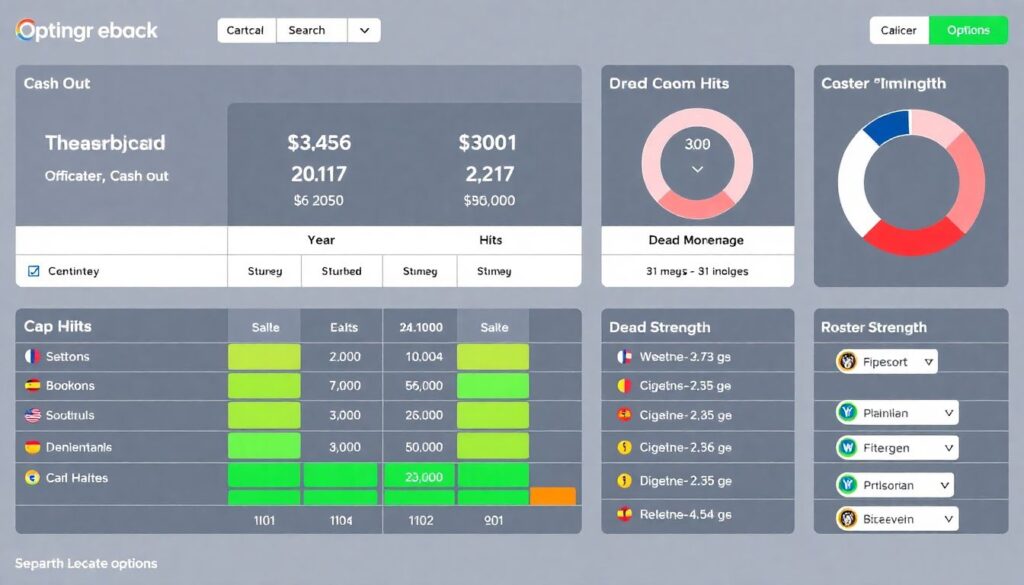
Use simple comparisons over three-year windows: show cash out, cap hits, dead money, and likely roster quality under two or three options. Visualizing the trade-offs, rather than debating isolated numbers, makes it easier to explain why a painful decision might still be correct.