
Evaluating quarterback performance beyond touchdowns and interceptions means focusing on efficiency, decision‑making, and context. Prioritize metrics like Expected Points Added (EPA), Completion Percentage Over Expected (CPOE), and net yards per attempt, then layer in film-based insights on reads, accuracy, and pressure handling. Use numbers to narrow questions; use tape to finalize conclusions.
Foundational Metrics and Concepts for Quarterback Evaluation
- Start with drive-level impact: use EPA per play to see how often the quarterback moves the offense closer to scoring, not just how many touchdowns he finishes.
- Use CPOE to separate scheme and supporting cast from the quarterback’s own accuracy and ball placement on difficult throws.
- Track net yards per attempt (NY/A) to blend passing volume, efficiency, sacks, and explosives into one stability-oriented metric.
- Always interpret stats through down, distance, score, and opponent; the same box score can mean very different things depending on game script.
- Combine charting data (separation, drops, yards after catch) with efficiency to avoid blaming or crediting the quarterback for receiver and scheme outcomes.
- Leverage a football data platform for quarterback analysis or a dedicated quarterback performance analytics software tool to standardize charting and avoid manual errors.
- Make every metric coachable: translate numeric trends into specific practice drills, playcalling adjustments, or protection changes rather than treating stats as labels.
Advanced Passing Efficiency: EPA, CPOE, and Net Yards per Attempt Explained
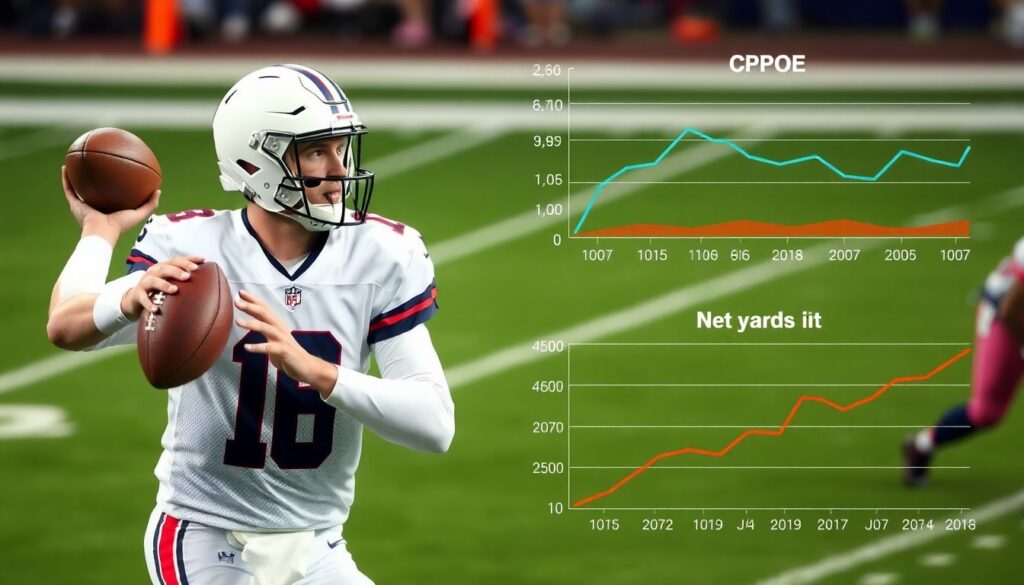
Advanced passing efficiency metrics focus on how much value a quarterback adds on each play rather than just total yardage or touchdowns. The three most useful building blocks are EPA, CPOE, and net yards per attempt, each answering a slightly different question about performance.
Expected Points Added (EPA) measures the change in expected points for the offense from the start to the end of a play, based on field position, down, and distance. Passing EPA per dropback tells you whether the quarterback is consistently making plays that move the scoring needle, not just compiling stats late in games.
Completion Percentage Over Expected (CPOE) compares actual completions to an expected baseline, where each throw has a modeled probability of being caught (based on depth, sideline vs. middle, pressure, separation, and more). Positive CPOE suggests the quarterback outperforms the difficulty of his throws; negative CPOE implies missed opportunities or poor ball placement.
Net yards per attempt (NY/A) extends simple yards per attempt by deducting sack yardage and including sacks in the attempt count. Conceptually, NY/A = (passing yards – sack yards) divided by (pass attempts + sacks). This treats sacks as failed pass plays and stabilizes efficiency evaluation over time.
For practical work, many coaches and analysts rely on an advanced quarterback stats ranking tool that surfaces EPA, CPOE, and NY/A together. An nfl quarterback efficiency metrics subscription from a data vendor typically includes these metrics, letting you filter by situation (play-action vs. dropback, pressure vs. clean pocket) instead of calculating everything by hand.
Reading Context: How Down, Distance, Game Script and Play Volume Shape Numbers
Raw efficiency numbers can be misleading without understanding the situational levers behind them. Context tells you whether a quarterback is thriving in high-leverage moments or just accumulating easy yardage when the outcome is mostly decided.
- Down and distance: Third-and-long conversions and red-zone throws carry far more weight than second-and-short checkdowns near midfield. Evaluate EPA, CPOE, and NY/A separately on third down and in the red zone to see if production holds when defenses tighten.
- Game script (leading vs. trailing): When trailing by multiple scores, defenses often invite short passes and guard deep shots, inflating completion rate but reducing explosive value. Split metrics by score differential to see whether efficiency comes in neutral game states or only in catch-up mode.
- Play volume and tempo: High-volume passing offenses can boost counting stats while hiding poor per-play efficiency. Compare total passing yards or touchdowns against per-dropback EPA and NY/A to determine whether production comes from quality or quantity.
- Field position and starting spot: Short fields created by defense or special teams can make touchdown totals look better than the underlying process. Use EPA to adjust for whether drives start near midfield or deep in your own territory.
- Opponent strength and scheme: Elite defensive opponents, complex coverage rotations, and heavy pressure packages affect both results and decision-making. Benchmark your quarterback against league performance versus that same defense when using any advanced quarterback stats ranking tool.
- Personnel groupings and protection: Efficiency metrics change with different receiver sets and offensive line combinations. Track EPA and CPOE by personnel and protection schemes to avoid over- or under-reacting to games with backup linemen or missing receivers.
Probabilistic Models: Completion Probability, Expected Points Added and Their Uses
Probabilistic models estimate what should happen on a play before it occurs, then compare the outcome to that expectation. They are central to modern quarterback evaluation because they adjust for throw difficulty and game situation instead of treating every completion or yard as equal.
- Completion probability on each throw: A model assigns a completion likelihood to every pass (based on depth, sideline vs. middle, pressure, separation, etc.). Aggregating these yields expected completions, and the difference between actual and expected is CPOE. Use this to see whether a quarterback consistently hits tight-window or downfield throws.
- Expected Points Added per play: Before the snap, a drive has a baseline expected points based on down, distance, and field position. After the play, the new state has its own expected points. EPA quantifies the difference. Tracking EPA per dropback shows how much each pass play changes win probability in a compressed form.
- Risk-return decisions: By pairing completion probability with EPA, you can evaluate whether a quarterback is turning down valuable but risky throws (high EPA, low completion probability) for safer but low-impact options (low EPA, high completion probability). This helps separate conservative game management from smart situational football.
- Route and concept evaluation: When you chart routes and concepts with completion probability and EPA, you can see which designs create high-value opportunities for your quarterback. This is where a football data platform for quarterback analysis can automate the heavy lifting and highlight underused concepts.
- Defensive game-planning: Defensive coaches can identify where the quarterback’s EPA collapses (certain coverages, pressure looks, or field zones) and design plans to force him into those low-return situations. Offensive staff then counter with plays that simplify reads or create built-in answers.
- Long-term trend tracking: Probabilistic outputs smooth out random bounces like tipped balls or circus catches. Over larger samples, they reveal whether a quarterback’s underlying process is improving, even if touchdowns and interceptions bounce around week to week.
Scenario-Based Use of Probabilistic Insights
Imagine a quarterback with average raw completion percentage but strong positive CPOE and stable EPA per dropback. The data suggests he attempts difficult, downfield throws yet still beats expectation; the coaching response is to keep aggressive concepts while working on protection and turnover minimization rather than forcing more short passes.
Conversely, a quarterback may post a high completion rate with negative or neutral CPOE and low EPA. This indicates a tendency to check the ball down into low-value throws. Here, you would script more intermediate, play-action concepts that create high-probability, higher-EPA shots and reinforce progression rules that prioritize in-breaking routes over outlet throws when leverage is favorable.
Cognitive and Pressure Indicators: Decision Quality, Time-to-Throw and Pressure Outcomes
Cognitive and pressure indicators aim to quantify how quickly and accurately a quarterback processes information, especially under duress. They include measures like time-to-throw, pressure-to-sack rate, turnover-worthy play rate, and outcomes when blitzed versus when pressured by four-man rushes.
- Advantages of cognitive and pressure metrics
- Reveal decision quality beyond the stat line by capturing throwaways, missed reads, and late decisions that do not always show up as interceptions.
- Help distinguish protection problems from quarterback-caused pressure, since extended time-to-throw and drifting in the pocket often inflate pressure rates.
- Identify specific coaching opportunities, such as simplifying reads versus blitz, adding hot routes, or drilling pocket movement to cut down on sacks.
- Support scouting by comparing how prospects handle college pressure to NFL-like pressure tendencies, especially when using the best quarterback scouting and grading system you have access to.
- Limitations and cautions
- Time-to-throw is heavily influenced by scheme; quick-game offenses will look safer even if the quarterback struggles on deeper, full-field concepts.
- Pressure and sack metrics depend on offensive line quality and receiver separation; a poor supporting cast can make good processors look hesitant.
- Charting of turnover-worthy plays and pressure responsibility can be subjective, varying across analysts and quarterback performance analytics software providers.
- These indicators must always be validated on film; numbers can indicate that something is wrong under pressure, but tape is needed to see whether it is mental, technical, or schematic.
Supporting Film-Based Inputs: Separation, Throw Location, Drops and Yac Potential
Film-based inputs explain why plays succeed or fail in a way that spreadsheets alone cannot. Receiver separation, throw location, drops, and yards-after-catch (YAC) potential show how much of the outcome belongs to the quarterback versus his teammates and play design.
- Myth: Every incompletion is a quarterback error. Chart receiver separation, route depth, and defensive leverage. If CPOE is near expectation but incompletions come from tight coverage or misaligned routes, the main issue may be receiver talent or route detail, not the passer.
- Myth: All accurate passes are the same. Throw location (high vs. low, inside vs. outside) determines whether receivers can protect the ball and maximize YAC. Film plus charting shows whether a quarterback consistently puts the ball on the front shoulder in stride or simply achieves a catchable ball.
- Myth: Drops fully excuse poor stat lines. Some drops come from late ball placement, excessive velocity, or forcing receivers to adjust into traffic. Tag drops as “on-target” or “off-frame” during charting to separate clean receiver mistakes from quarterback-driven difficulty.
- Myth: YAC is only about receiver talent. Anticipation, timing, and leading throws into open grass massively affect YAC potential. A quarterback who hits receivers a step early, with eyes moving defenders away, is actively creating YAC rather than just enjoying it.
- Myth: Manually charted film is enough for modern analysis. Manual charting is powerful but time-consuming and inconsistent. Pair it with an nfl quarterback efficiency metrics subscription or a broader football data platform for quarterback analysis to validate trends over larger samples and across the league.
- Myth: Advanced data replaces coaching judgment. Metrics narrow where you look; they do not tell you how to coach. Use film to interpret why a quarterback’s EPA, CPOE, or YAC trends move, then design drills and gameplans that directly address those underlying causes.
From Analytics to Action: Translating Metrics into Coaching Adjustments and Playcalling
Turning analytics into on-field improvement requires mapping each metric to a concrete coaching or playcalling lever. The goal is to move from “what” (EPA, CPOE, NY/A values) to “how” (specific adjustments in practice and game plans).
Consider a mid-season review where your quarterback shows strong CPOE on early downs but declining EPA and NY/A on third-and-medium, with elevated time-to-throw and a spike in turnover-worthy plays versus blitz. Film confirms he is holding the ball, waiting for deep routes to uncover, and missing hot options underneath.
A practical adjustment flow might look like this:
- Refine third-down menu: Add more quick-game and option routes to your third-and-medium calls, giving defined answers versus common blitz looks you see on film.
- Drill pressure rules: In practice, run blitz pickup and hot-route periods where the quarterback must immediately replace blitzers with the ball, reinforcing the rule-based answers you want him to use.
- Monitor metrics post-adjustment: Over the next few games, track third-down EPA per dropback, pressure-to-sack rate, and turnover-worthy plays with help from a quarterback performance analytics software tool or the best quarterback scouting and grading system you have available.
- Iterate with film: Re-check tape to ensure improved stats come from better decisions and timing, not just more conservative throws that sacrifice explosives. Adjust your balance of shots versus quick-game accordingly.
By consistently cycling between metrics, film, and specific coaching responses, you build a repeatable framework for quarterback development rather than reacting emotionally to touchdowns and interceptions alone.
Practitioner Clarifications and Short Answers
Why are touchdowns and interceptions not enough to evaluate a quarterback?
Touchdowns and interceptions ignore down, distance, field position, and throw difficulty. Efficiency metrics like EPA, CPOE, and NY/A show how often the quarterback improves scoring chances and makes the right throws, even on drives that do not end in touchdowns.
How many games of data do I need before trusting advanced quarterback stats?
Per-play metrics stabilize faster than box-score stats, but you still need multiple games to reduce noise. Look for trends over several weeks, and always cross-check major swings in EPA, CPOE, or NY/A with film before changing your evaluation.
Do I need special software to use these quarterback metrics effectively?
You can calculate some metrics manually, but a dedicated football data platform for quarterback analysis or an nfl quarterback efficiency metrics subscription simplifies filtering by situation and opponent. This frees you to spend more time on interpretation and coaching adjustments.
How should I balance analytics with film study for quarterback evaluation?
Use analytics to focus your film work on specific situations, such as poor EPA on third down or negative CPOE under pressure. Then rely on film to identify whether the root cause is reads, mechanics, protection, or route design, and build coaching plans from there.
What is the simplest metric to start with if I am new to advanced stats?
Begin with EPA per dropback and net yards per attempt. Together they capture drive value and efficiency while staying relatively easy to understand, especially compared to more complex models. Once comfortable, add CPOE to separate accuracy from throw selection.
Can a quarterback with average arm talent still grade well in advanced metrics?
Yes. Efficient decision-making, timing, anticipation, and understanding of coverage often drive strong EPA and CPOE even without elite arm strength. Film will show whether the quarterback compensates with processing, ball placement, and pre-snap recognition.
How can high school or college coaches apply these ideas without big budgets?

Track basic splits like third-down efficiency, red-zone EPA, and simple charting for drops and pressure manually. Even a lightweight spreadsheet, supported by consistent film tagging, can mimic features of a professional advanced quarterback stats ranking tool on a smaller scale.