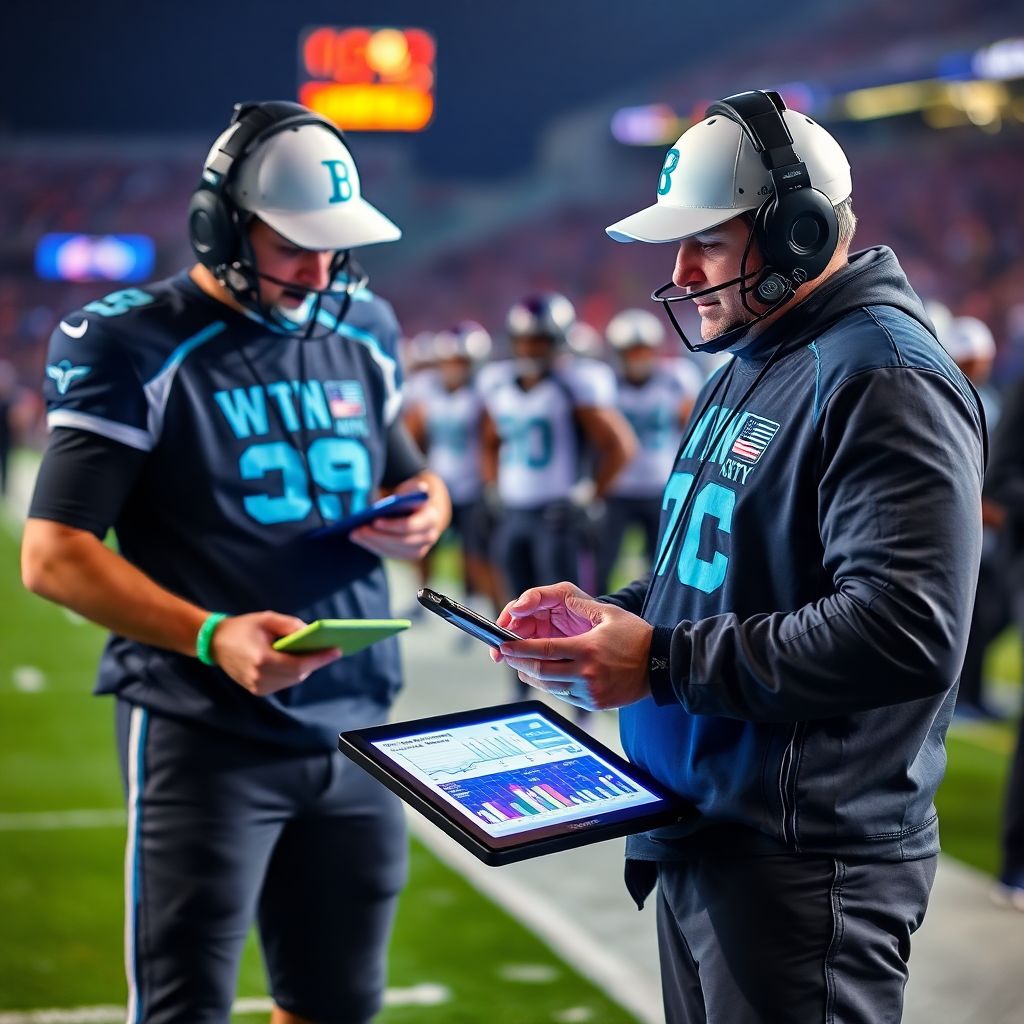
Analytics transform fourth-down and two-point decisions by replacing gut feel with precomputed win-probability and expected-points tables tailored to your roster and opponents. You integrate historical play data, player tracking, and game-state models into simple sideline charts or tablets, then follow clear thresholds that dictate go, kick, or two-point calls in real time.
Executive analytic summary for fourth‑down and two‑point choices
- Build decisions around win probability, not field position optics or crowd expectations.
- Use pregame custom charts derived from team-specific offensive, defensive, and special-teams baselines.
- Define go/kick/2-point thresholds before kickoff and treat them as default rules.
- Override the model only for concrete, pre-agreed constraints (injuries, weather, clock, depth).
- Operational success depends more on communication, signals, and tempo than on model complexity.
- Start with a lightweight fourth-down and 2-point chart, then iterate as data and staff capacity grow.
Foundations: how fourth‑down analytics redefine conventional wisdom
Analytics reframe fourth-down and two-point choices as portfolio problems: maximize win probability across the full game, not comfort on a single snap. That is why many modern models recommend going for it on fourth-and-short and being more aggressive with two-point attempts than traditional charts suggest.
This approach suits:
- Teams with at least basic data staff or access to sports analytics software for football teams.
- Coaches willing to pre-commit to aggressive rules and defend them publicly.
- Programs that record play-by-play and can export data from their scouting or video systems.
- Organizations already using nfl fourth down decision analytics tools or considering them.
It is not a good fit when:
- The head coach refuses to follow pregame rules or often overrides analytics from emotion.
- No one on staff can maintain simple spreadsheets or validate input data each week.
- The league structure (forfeits, tiebreakers, point differential rules) makes risk profiles unusual.
- There is no consistent way to communicate decisions to the sideline with enough time on the play clock.
Model mechanics: expected points, win probability, and micromodels
To operationalize analytics, you combine EP and WP models with small micromodels that estimate your conversion, kick, and defensive stop probabilities in specific situations. Most of the complexity can live off the field; what reaches the coach is a small set of thresholds and a call on each down.
Core requirements and tools:
- Data backbone
- At least two to three seasons of play-by-play with down, distance, yard line, time, score, and play result.
- Ideally, player-level tags (QB, RB, WR, TE, OL combinations) and defensive fronts/coverages.
- Export capability from video systems or best football data analytics platforms for coaches.
- Modeling environment
- Spreadsheet (Excel/Sheets) for small programs; code (R/Python) for larger staffs.
- Optional integration with nfl fourth down decision analytics tools or two point conversion analytics software for american football.
- Sideline delivery
- Laminated charts sorted by yard line, distance, time band, and score differential.
- Tablet app from sports analytics software for football teams, or internal web dashboard.
- Clear color coding: go (green), kick (blue), 2-point (orange), indifference (gray).
- Governance and overrides
- Policy for when the coach can override analytics (e.g., QB injury, blown protection, extreme wind).
- Postgame review cadence to log overrides and track their impact on WP.
Compact comparison of basic options:
| Choice | Primary metric | Key inputs | When it tends to dominate |
|---|---|---|---|
| Go for it (4th) | WP gain vs. punt/FG | Conversion rate, field position, clock, score | Short yardage, midfield or plus territory, moderate clock left |
| Punt / FG | WP relative to failed conversion | Kicker range, coverage, opponent offense strength | Long yardage, own territory, poor conversion unit quality |
| Two-point attempt | WP vs. PAT baseline | 2-pt success %, kicker reliability, future drive expectations | Late game, specific score states where 1 vs 2 points flips leverage |
Critical inputs: player tracking, game state, and roster-specific modifiers
This section describes a safe, practical workflow from raw data to a usable decision tool. Adjust the level of automation to your staff capacity; the steps remain the same whether you use in-house spreadsheets or a commercial playcalling engine.
- Define the decision grid and situations
Decide which situations your chart will cover first (e.g., 4th-and-1 to 4th-and-5 between your 35 and their 35, all game states).- List combinations of yard line bands (e.g., own red zone, backed up, midfield, fringe, red zone).
- Define distance buckets: 1, 2-3, 4-6, 7-10, >10 yards.
- Separate time bands: <2 minutes, 2-8, 8-15, 15-30, >30 minutes remaining (game clock and half clock as relevant).
- Estimate base EP and WP from historical data
Using league or competition-wide data, compute EP and WP for each down, distance, and yard line combination as your neutral baseline.- If you lack coding resources, start with public or vendor tables and import them into a spreadsheet.
- Where sample sizes are thin, smooth with neighboring yard line and distance bands.
- Layer on team-specific conversion and stop rates
From your own games plus opponent scouting, estimate:- Fourth-down conversion probabilities by distance and concept family (sneak, inside zone, quick game, RPO).
- Field-goal make probability by distance and hash.
- Punt net yardage distribution and opponent drive EP after punts and failed conversions.
- Build micromodels for each decision branch
For each grid cell (yard line, distance, time, score), compute WP for:- Go-for-it: combine conversion chance, ensuing WP if successful, and WP if failed.
- Kick (FG or punt): combine make/miss and field position outcomes.
- Special cases (onside kick, intentional safety) if you want advanced branches.
Example: if go-for-it WP is 0.54 and punt WP is 0.50, the go decision yields +0.04 WP and should be coded as preferred.
- Encode decisions into a simple chart
Convert the micromodel outputs into a coach-friendly grid:- For each situation, mark the option with highest WP as default.
- Flag razor-thin edges (e.g., <0.01 WP difference) as staff discretion areas.
- Use consistent colors or symbols and avoid small fonts for night and weather conditions.
- Incorporate player tracking and roster modifiers
Use tracking data and depth chart context to adjust probabilities by game:- Increase or decrease conversion odds based on trench advantages, QB run threat, and recent injuries.
- Downgrade kicks in wind/rain or with backup specialists; upgrade when facing poor return units.
- Set pregame notes: for example, “with backup LT, avoid long-developing 4th-and-medium passes.”
- Deploy via software or laminated sheets
Choose a delivery mode:- Use nfl fourth down decision analytics tools or two point conversion analytics software for american football if you want live recalculation.
- Otherwise, print the final grid as 1-2 laminated pages for the head coach and coordinator.
- If you purchase playcalling analytics solution for sports teams, mirror its recommendations with your internal chart to build trust.
Fast-track fourth-down installation checklist
- Start with league-average EP/WP tables and plug in your simple fourth-down and FG success rates.
- Limit the first chart to 4th-and-1 to 4th-and-3 from your 40 to their 40 in neutral score states.
- Print a one-page grid with color-coding and use it for three games without exceptions.
- After each game, log overrides and major misses, then only adjust thresholds with evidence.
Two‑point conversions: probabilistic thresholds and situational recipes
Two-point analytics are narrower: you mostly care about late-game score states where 1 vs 2 points fundamentally changes the shape of remaining drives. The model answer often clashes with intuition, so coaches need a small, trusted recipe list rather than dense tables.
Two-point decision verification checklist:
- Confirm your 2-point success rate and PAT make rate before the season and refresh mid-season.
- Use quick WP comparisons for the standard dilemmas (down 14, 11, 8, 5, 2, up 1, 2, 4, 5 late).
- Check time remaining and number of likely possessions left for both teams.
- Account for offensive fatigue, trench health, and best short-yardage packages (QB run, option, sprint-out).
- Apply a simple rule of thumb: if the model shows a meaningful WP gain and you have a rehearsed 2-point menu, go.
- Ensure your playbook has at least three independently schemed 2-point concepts versus common red-zone coverages.
- Pre-brief the staff on rare but critical cases (e.g., when to chase 2 early in the fourth compared with waiting).
- Track postgame: every 2-point decision must be logged with the recommended option, actual choice, and outcome.
Operationalizing decisions: coaching checklists, signals, and in‑game tools
Even elite models fail if the sideline procedure is messy. You need crisp roles, a short communication chain, and realistic timing within the play clock. Technology helps, but simplicity and rehearsal matter more than having the flashiest tablet views.
Common operational mistakes to avoid:
- Waiting until 4th down to start the conversation instead of thinking one down ahead.
- Letting “feel” on the previous play override pregame thresholds without concrete new information.
- Having multiple voices in the headset debating analytics while the play clock runs down.
- Designing ultra-detailed charts that are unreadable in rain, cold, or night games.
- Failing to train substitutes and assistants on the chart logic, so confusion spikes after injuries.
- Ignoring special-teams context: poor protection, snap issues, or kick coverage leaks.
- Not integrating your external or vendor recommendations from best football data analytics platforms for coaches into weekly practice periods.
- Treating the tool as untouchable doctrine instead of logging exceptions and refining off-season.
Evidence in practice: condensed NFL and college case studies with outcomes
Teams have multiple paths to analytics-enabled decisions, depending on budget and staffing. You can start lightweight and grow toward more sophisticated systems as you demonstrate value to leadership and players.
- Spreadsheet-first in-house model – Analysts build EP/WP models and charts in Excel or R, then export laminated sheets. Suitable for high schools, smaller colleges, or cost-conscious programs that are not ready to purchase playcalling analytics solution for sports teams.
- Vendor software with custom tuning – Use commercial sports analytics software for football teams that offers nfl fourth down decision analytics tools and two point conversion analytics software for american football. Great for organizations wanting live updates, cloud sync, and support while still adding their own tendencies.
- Video-platform integration – Some programs integrate analytics directly into their video scouting and tagging workflows, so fourth-down and 2-point suggestions appear alongside cutups and opponent reports.
- Hybrid “coach plus consultant” model – External analysts provide weekly reports and recommendation grids, while internal coaches handle sideline communication and override policies, gradually building up in-house capability.
Implementation concerns and concise clarifications
How accurate do fourth-down models need to be before I can trust them?
They must clearly separate strong edges from coin flips. If the model consistently identifies big WP gains on certain 4th-and-short spots and those holds up in review, you can start using it, even if fine-grained probabilities are imperfect.
Can smaller programs benefit without hiring a full-time analytics staff?

Yes. A single technically inclined coach can build and maintain a basic chart using open data and spreadsheets, then iterate during the off-season. Vendor tools can offload heavy modeling and let staff focus on operational discipline.
How often should I update conversion and kick probabilities?
Refresh at least once mid-season and once in the off-season. Update early if a key player is injured, a new kicker arrives, or major scheme changes alter your short-yardage identity.
What if my head coach occasionally wants to override the chart?

Define explicit override conditions in advance (injuries, extreme weather, surprise opponent strategy) and log every override. During review, compare outcomes versus model recommendations and adjust thresholds only when evidence accumulates.
How do I prevent disagreements on the headset in critical moments?
Assign a single decision captain, usually the head coach, and one analytics voice. Everyone else can contribute during series breaks and halftime, not during live countdown. Rehearse the exact communication flow in practice.
Do players need to understand the analytics behind these decisions?
They need clarity on the philosophy, not formulas. Explain that aggression is intentional and backed by data, then translate it into consistent rules of thumb so players are mentally ready for more frequent 4th-down and 2-point attempts.
How do I start testing a vendor tool without disrupting current processes?
Run the vendor’s recommendations in parallel on the sideline for a few games without changing calls. Compare their outputs to your existing decisions, then phase in changes only where the tool shows clear, consistent advantages.