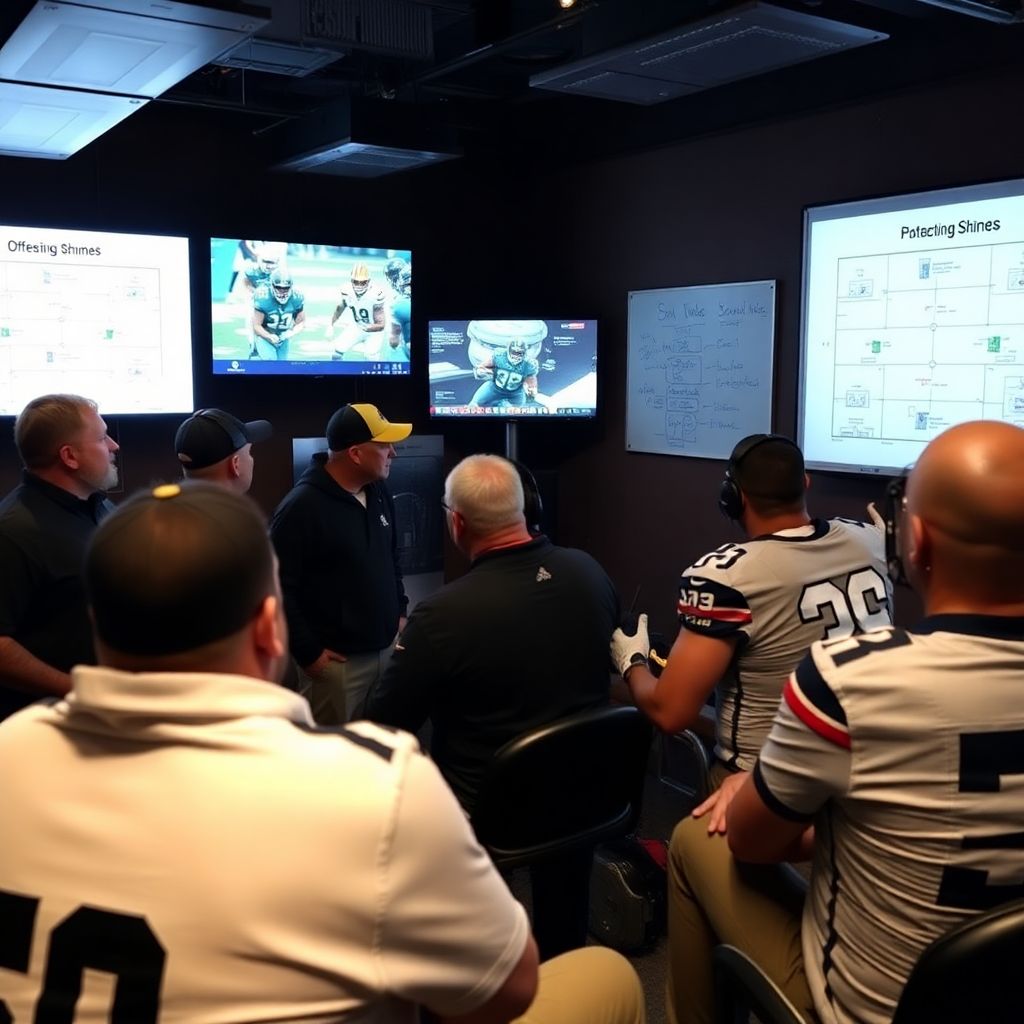
To neutralize elite pass rushers, combine targeted film study, protection adjustments, and disciplined individual technique. Build your plan around alignment and first-step tells, then layer pass protection schemes against edge rushers that fit your personnel and quarterback. Rehearse rules, not just plays, so linemen and backs can adapt on the fly to movement and pressure.
Pre-Game Tactical Summary
- Identify the rusher’s top two moves, preferred side, and get-off based on film, not reputation.
- Pair your best pass protector with a helper (chip, slide, or TE) to that edge on key downs.
- Design fast-game and movement throws away from the rusher’s dominant side.
- Build simple, repeatable football coaching clinic pass protection strategies into your weekly script.
- Drill specific countermeasures every day: anchor, inside-out leverage, and recovery vs counters.
- Track in-game: pressure rate, hits on QB, and success of each protection call vs their packages.
Scouting the Rusher: Film Markers, Alignment, and Personal Tendencies
This approach fits intermediate-level coaches and players who already know base protections and want to learn how to neutralize elite pass rushers through detailed preparation. It is less useful if your league does not allow blitz or if you lack any video access; in that case, prioritize live-practice evaluation instead.
- Start with front structure: Note when the defense features the elite rusher in four-down, odd fronts, or special packages.
- Alignment checklist:
- Wide-9 vs tight-5 vs ghost alignment (no tight end).
- Depth off the ball: tight to LOS (power) vs deeper (speed/loop).
- Shade: inside eye (threat to B gap) vs outside eye (upfield edge).
- First two steps on film:
- Flat upfield with outside foot = speed/outside rip or dip.
- Vertical then hard inside = inside spin, jab-swipe, or B-gap spike.
- Short, choppy, square = power move (bull or long-arm).
- Game-state tendencies:
- Down-and-distance where he changes sides or moves inside.
- Two-minute, third-and-long, and red-zone packages.
- When he switches to a “green light” rush (no screen or draw awareness).
- Protection beaters on tape:
- Which protections he wins against most: slide, half-slide, or full man.
- Favorite stunts and games with the adjacent tackle or backer.
- Whether chips or tight splits have slowed him down for other teams.
- Summarize in a one-sheet: Write a concise scouting card with “If wide-9 + deep, expect speed; if tight 5 + square, expect power,” plus top counters and your planned answers.
Protection Architecture: Choosing Fronts, Slide Schemes, and Hot Routes
You need a clear menu of pass protection schemes against edge rushers and the ability to teach simple rules to your QB, OL, and backs. At minimum, have your playbook, cut-ups for film study techniques for blocking elite pass rushers, and a weekly script for protection walkthroughs and blitz pickup.
- Staff tools:
- Cut-up software or a simple playlist system grouped by front, down-distance, and pressure.
- A protection installation sheet: rules for each scheme, plus notes vs this week’s rusher.
- On-field resources:
- At least one solid chip-capable back or tight end who can delay and release.
- Clear QB rules for mike-ID and hot throws when the defense overloads the protection.
| Protection Type | Best Use vs Elite Edge | Main Coaching Emphasis |
|---|---|---|
| Full Slide (zone) | When rusher moves a lot or you expect games/stunts. | Protect inside first; FB/TE chip from the backside edge. |
| Half-Slide (BOB) | Balanced looks; one elite side, one non-elite. | Slide to the elite; backside man rules ironed out for overloads. |
| 6-Man with RB Chip | Obvious passing downs vs speed rushers. | RB alignment and chip target on hip/rib; do not whiff and drift. |
| Max Protect (7-Man) | Shot plays; when edge wins even against help. | Two releases only; QB reads deep to checkdown, throw away if capped. |
- Pair every scheme with a fast answer: built-in hot or quick game where the QB can beat the rush with timing.
- Integrate at least one movement concept (boot, sprint out) away from the elite rusher each quarter.
- Teach your QB that part of how to neutralize elite pass rushers is cadence, pocket depth, and decisive triggers, not hero-ball scrambles.
Individual Blocking: Hands, Footwork, Leverage, and Exit Strategies
Before drilling technique, verify basic readiness and safety so players can execute consistently without risky positions.
- Confirm players understand base stance, aiming points, and where their help is coming from.
- Walk through the elite rusher’s top moves at half-speed before going full speed.
- Use shells or sleds first to pattern footwork and hands without excessive collisions.
- Coach “never bend at the waist, always at the hips” to protect neck and lower back.
- Win pre-snap with stance, split, and set point
Define the tackle’s or tight end’s horizontal set point based on the rusher’s alignment and speed. Slightly widen the split and deepen the stance vs pure speed; tighten the split vs power or heavy inside moves.- Drill: Half-line sets vs a wide-9 rusher, working to a landmark five yards deep and outside.
- Drill: Mirror drill with cones marking inside and outside set points, no contact.
- Maintain inside-out leverage and vertical posture
Teach “inside half man” as the default rule: your midline on his inside number. Keep chest up, eyes through the sternum, and do not overset past the midpoint of the rusher’s body.- Drill: Inside-out leverage walk-through, coach tapping which number to cover on command.
- Drill: Post-kick footwork on boards, emphasizing no crossover and low pad level.
- Use independent hands, not two-hand lunges
Coach the post hand (inside) as the anchor and the kick hand (outside) as the steering wheel. Strike with the inside hand to stop charge, then fit the outside hand under the armpit or on the shoulder, avoiding grabbing the collar or facemask.- Drill: Hand-pop progression on a heavy bag, alternating single-hand strikes.
- Drill: One-hand mirror vs rusher; outside hand behind back to train strong inside hand.
- Build an anchor vs bull and long-arm
When the rusher converts speed to power, sink hips, widen base, and drop the anchor without ducking the head. Cue “hips down, hands up, feet under you” while re-fitting inside hands to the chest plate.- Drill: Bull-rush anchor with a partner using pads, working short recoil steps.
- Drill: Long-arm recovery, practicing chop of the outside arm and re-fit of hands.
- Train recovery vs counters and spin
Expect a second move after the blocker stops the first surge. Coach “do not stop your feet” and “eyes to the near hip” to stay square through club-rip, spin, or inside counter.- Drill: Two-move rush sequence where the defender must execute a counter after first contact.
- Drill: Spin recognition; on the call “spin,” blocker replaces inside foot and re-centers.
- Escape and replace when beaten
If the blocker is clearly edged, coach safe recovery: run the rusher past the spot, avoid grabbing the back of the shoulder pads, and do not trip or dive at the legs. The QB must understand when to climb or escape based on this action.- Drill: Lose-on-purpose drill where lineman intentionally gets edged then runs defender past the launch point.
- Drill: QB climb and reset drill paired with edge rush to train shared pocket awareness.
Macro Adjustments: Stunts, Game-Within-a-Game Calls, and In-Game Tweaks
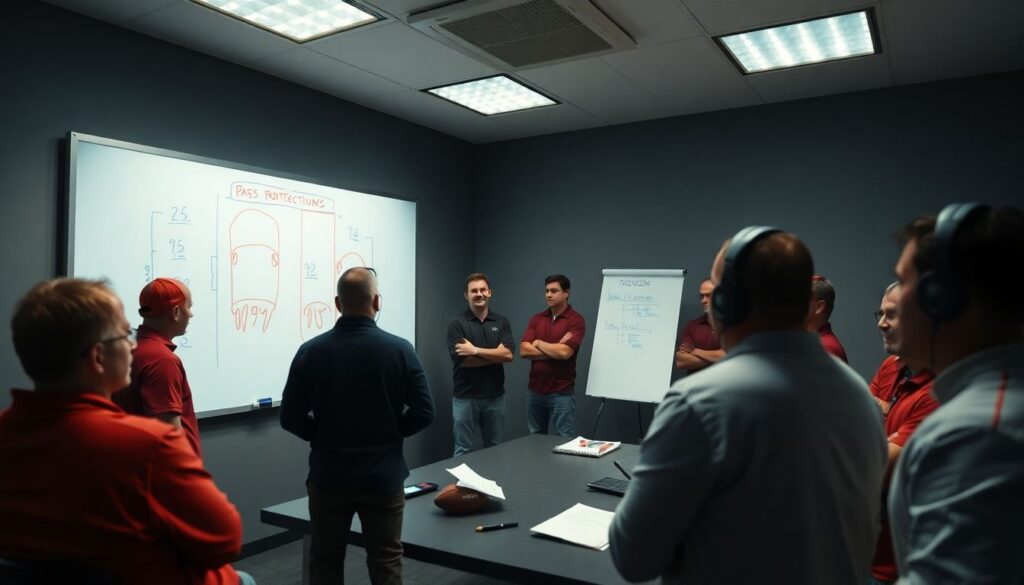
- We have a specific tag or word the OL uses when they feel the elite rusher’s speed or power changing during the game.
- After each series, staff logs which pass protection schemes against edge rushers held up and which ones failed, with down-and-distance noted.
- We adjust where the back aligns (strong/weak) to chip based on the rusher’s current side and mood.
- The QB and center jointly confirm the ID vs every new pressure look before the ball is snapped.
- We vary cadence (hard count, quick count, freeze) at least once per quarter to slow the rusher’s get-off.
- We have at least one screen, draw, or quick throw specifically tagged to punish the rusher when he sells out.
- When they start running more stunts, we simplify to our best “day-one” protection and live with fewer route combinations.
- We track hits on the QB; if they spike, we increase help (chips, max protect) instead of asking the tackle to “just block him.”
- We review sideline tablet or film clips with linemen between series to show adjustments in the rusher’s stance and first step.
Communication Protocols: Cadence Recognition, Mic Checks, and Silent Signals
- Overcomplicating mike IDs so players think the front is changing every snap instead of applying simple rules.
- Failing to review how the defense times the cadence from film, leaving the offense surprised by their jump at the snap.
- Not assigning clear responsibility for last-second changes; sometimes the QB and center both talk and nobody listens.
- Relying only on verbal calls in loud environments instead of building silent hand signals or foot taps.
- Neglecting to rehearse “bad look” checks during the week, so linemen freeze when they see unscouted pressure.
- Ignoring how motions and shifts change the picture for the back who must scan and help on the elite rusher.
- Letting younger players guess at terms they do not fully understand rather than stopping meetings to clarify.
Situational Modules: Third-Down, Two-Minute, and Goal-Line Plans
- Third-and-long heavy help plan
Use max protect or six-man protections with a dedicated chip to the elite edge. This is ideal when you must throw deeper but cannot afford a sack that kills the drive. - Quick-game and RPO emphasis
Build a package of three-step, rhythm throws and RPOs where the ball is out before the rush can win. This works best if your QB is accurate and decisive and your receivers separate quickly. - Movement and sprint-out package
Move the launch point with boots and sprint-outs away from the rusher on key downs. Choose this if your QB throws well on the run and the defense overcommits that edge. - Heavy personnel and condensed splits
In red zone and goal-line, bring in extra tight ends and backs, condense splits, and shorten edges. This suits physical teams that can pass and run from the same looks to keep the rusher guessing.
Practical Clarifications for Implementation
How do I start building a weekly plan if I am new to detailed film work?
Begin by cutting up every third-down and two-minute snap featuring the elite rusher. Focus on his alignment and first two steps, then pair that with basic offensive line coaching tips vs pass rush such as inside-out leverage and firm pocket depth. Add more detail as your staff gains comfort.
How many protections should I carry into a game against an elite edge rusher?
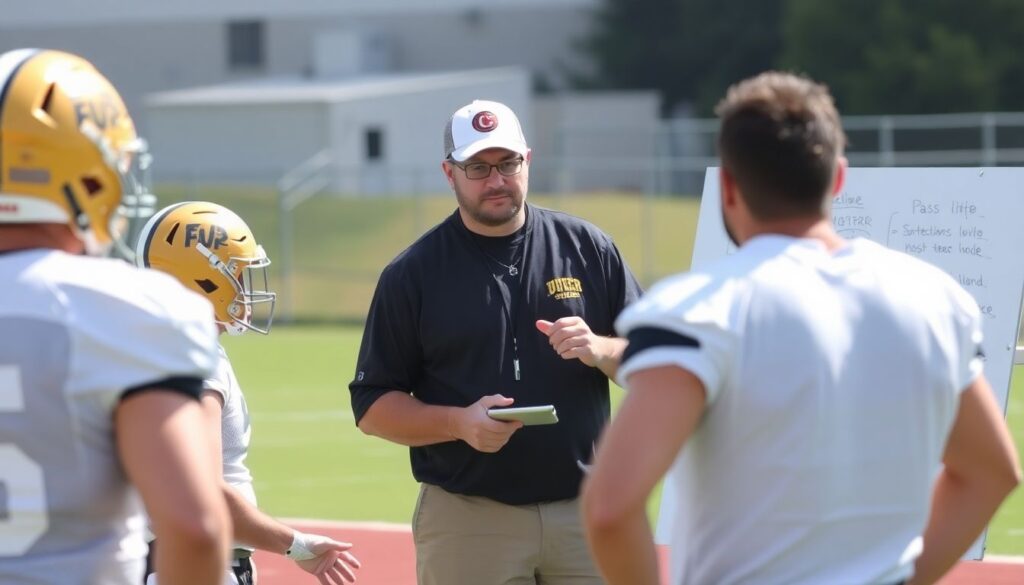
Carry only as many protections as you can teach clearly and execute under pressure, usually a small core with tags for help. It is better to run a few schemes with great detail and communication than a large menu that your players do not fully understand.
What is the simplest adjustment if my tackle is losing one-on-one repeatedly?
First, add chip help from a back or tight end and slide the line toward the rusher when possible. If that still fails, move to more quick game, play-action with heavy protections, and designed movement away from that side.
How can I use film study techniques for blocking elite pass rushers with limited practice time?
Use short, focused film segments and match each clip to one drill on the field. For example, show three clips of a speed rush, then immediately run a five-minute drill on vertical sets and anchor, keeping the transfer clear and efficient.
Do youth or high-school teams need advanced protection schemes to handle a dominant rusher?
No. Simple rules, consistent technique, and a few targeted football coaching clinic pass protection strategies are enough at those levels. Prioritize teaching stance, get-off, leverage, and basic help (chips, slides) instead of complex pro-style protections.
How do I include the quarterback in the plan to slow down elite rushers?
Teach the QB where the weak point of each protection is and which routes are built-in answers against that defender. Emphasize cadence variation, timely snap, and ball-out-on-time as core tools for how to neutralize elite pass rushers.