
Mental preparation in the locker room means running a short, consistent routine that settles your nerves, locks in your game plan, and raises your intensity to the right level. In the last minutes before a big game, you want clear focus, calm body, simple cues, and one or two specific performance targets.
Pre-Game Mental Checklist: What to Cover in the Last 10 Minutes
- Confirm your first three actions after the whistle (e.g., where you move, who you mark, what you call).
- Run one quick visualization of your best version of today’s role, not a perfect game.
- Use breathing to bring your body up or down to a steady, energized state.
- Pick one personal cue word and one team cue phrase you will actually say out loud.
- Agree on clear communication signals for pressure, switches, and resets.
- Commit to a simple recovery plan after mistakes: notice, reset breath, next task.
Routine and Rituals: Building a Reliable Pre-Game Sequence
This section fits athletes who already have basic game-day habits and want a sharper, faster locker-room routine. It is less useful if you are injured, extremely sleep deprived, or dealing with intense personal issues that are better handled with a sports psychologist near me or another qualified professional before game day.
Individual micro-routine (3-5 minutes)
Goal: Create a repeatable sequence that tells your brain it is time to compete.
Time: About 3-5 minutes, during the calm before the final team talk.
- Body reset (30-60 seconds)
Stand or sit tall. Take a slow breath in through your nose and out through your mouth, extending the exhale. Gently roll shoulders and neck to release tension. - Gear check with intention (60 seconds)
As you touch each piece of gear (shoes, jersey, tape), silently attach a word: speed, strength, composure, or one that fits your role. - Role reminder (60-90 seconds)
Quietly review your job on offense, defense, and transitions. Focus on what you will do, not what you must avoid. - Finish with a trigger (15-30 seconds)
Use a small physical ritual: two taps on chest, clap, or deep exhale with a word like ready. Keep it subtle and repeat the same action every game.
Expected result: You feel grounded, clear on your role, and your body recognizes a familiar pre-game pattern that reduces overthinking.
Short team ritual (2-3 minutes)
Goal: Align energy and focus across the group without turning the locker room into chaos.
Time: About 2-3 minutes, right before walking out.
- Circle-up reset
Form a tight circle. One leader guides a single slow inhale and exhale together to unify breathing. - One message, one goal
Coach or captain states a single clear message and one team goal for the first phase of the game. - Unified cue
Finish with a short chant, clap pattern, or phrase you repeat each game. Keep it loud enough to energize, not so wild that breathing and focus spike out of control.
Expected result: The team walks out with the same theme in mind and a shared emotional tone, instead of scattered individual states.
Cognitive Priming: Visualization and Scenario Rehearsal

Mental rehearsal is more effective when it is brief, specific, and grounded in your actual role. You do not need special equipment, but a quiet corner, a clock, and clarity on your tactics help. If you work with a mental performance coach for athletes or use online sports psychology coaching, adapt any scripts they gave you into these quick locker-room versions.
Solo scenario run-through (3 minutes)
Goal: Prime your brain for the exact situations you are likely to face in the opening minutes.
Time: About 3 minutes, seated with eyes open or closed.
- Anchor your body (30 seconds)
Plant feet, relax shoulders, breathe slowly until you feel steady. - See the first plays (90 seconds)
Imagine the first whistle and the first few plays or shifts. See yourself moving decisively, communicating clearly, and executing your role under realistic pressure. - Rehearse one challenge (60 seconds)
Picture a mistake, bad call, or opponent run. Visualize your reset: breath, cue phrase, then the next smart action.
Expected result: Your mind has already “been there” once, so early-game nerves and surprises feel more manageable.
Short guided team visualization (2-4 minutes)
Goal: Align the team on how the game will look and feel in key moments.
Time: About 2-4 minutes, led by coach, captain, or designated leader.
- Set the scene
Leader briefly describes the stadium, crowd, and first phase of the game in present tense: what you see, hear, and feel. - Walk through a key phase
Guide the team through a short, specific sequence (e.g., press, set piece, special-team play), emphasizing communication and effort. - End with success snapshot
Close with a simple image of executing as a unit: correct spacing, fast support, and strong finish to the phase.
Expected result: Players share a common mental picture of success that links directly to your tactical plan.
Arousal Management: Techniques to Find Optimal Intensity
Before adjusting your intensity, quickly notice where you are: too flat, too amped, or roughly right. The goal is not to be perfectly calm, but to hit a steady, aggressive gear where you can think and react. Use the mini-checklist below to prepare safely.
Pre-adjustment mini-checklist
- Confirm you are hydrated, have eaten appropriately, and are medically cleared.
- Avoid breath-holding drills if you feel dizzy, lightheaded, or unwell.
- Leave space to sit or stand without bumping into teammates.
- Stop any technique immediately if you feel pain, chest tightness, or severe discomfort.
- If intense anxiety or panic persists, skip drills and talk to staff or a qualified professional.
Step-by-step locker-room arousal tuning
Goal: Bring your energy level into a controllable, competitive range.
Time: Choose one variant depending on how much time you have: about 30 seconds, about 3 minutes, or about 5 minutes.
- Check your internal dial
Notice your breathing, heart rate, and muscle tension. Ask yourself: “Flat, sharp, or buzzing?” This honest snapshot tells you whether you need to calm down or fire up. - Use breathing to calm or energize
If you are too amped, slow and lengthen your exhale. If you are flat, sharpen your inhale and posture.- 30-second version: Take three controlled breaths: in through nose, out through mouth, matching exhales to a slow count.
- 3-minute version: Do a steady pattern; for example, breathe in, brief pause, longer exhale, and repeat until your body feels more even.
- Add simple movement for fine-tuning
Use your body to adjust the last bit of intensity safely.- If too flat: perform a short burst of dynamic movements like light skips or quick feet, then pause and feel your heart rate rise slightly.
- If too wired: do slow stretches or gentle joint circles, keeping breathing smooth and shoulders low.
- Lock in a posture and gaze
Stand or sit tall with relaxed shoulders and steady eyes. Avoid pacing without purpose or hunching over your phone or bag. - Seal it with a mental cue
Use a brief phrase like locked in, calm and aggressive, or one from your athlete mindset training program. Repeat it once or twice in your head as you feel your chosen intensity level.
Expected result: Your body feels awake but not jittery, your breathing is under control, and you are ready to react without feeling overwhelmed or sleepy.
Team Talk Dynamics: Aligning Focus, Roles and Signals
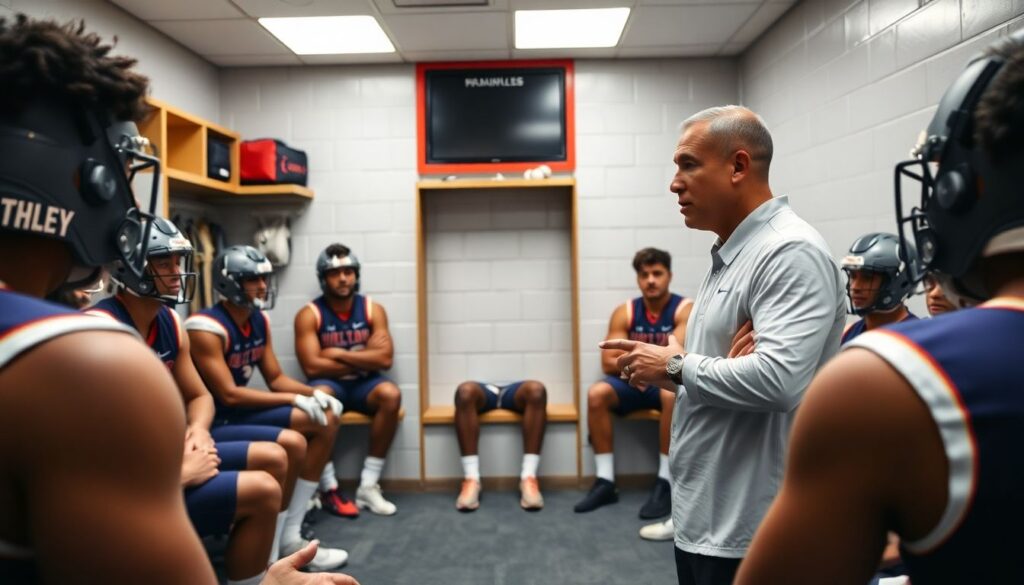
In the last locker-room talk, volume is less important than clarity. Whether led by a coach or captain, the goal is that every player walks out knowing the central focus, their role, and how you will communicate under pressure. Use this checklist to verify you hit the essentials.
Team talk outcome checklist
- The team can repeat one clear game theme in a few words (e.g., “pressure early” or “patient possessions”).
- Each unit or position group knows its first adjustment if the game starts poorly.
- Roles on set pieces, special teams, or key patterns are confirmed, not debated.
- Communication codes for pressure, switches, and resets are stated out loud at least once.
- A captain, not everyone, handles emotional hype so the message does not get diluted.
- Players have a chance for one or two quick questions before the talk ends.
- The talk finishes with enough time for quiet individual focus, not a last-second scramble.
- No one leaves confused about who starts, who rotates first, or who calls main defensive cues.
- The tone is demanding but composed; insults, panic, or blame are shut down quickly.
Self-Talk and Cue Phrases: Scripts for Pressure Moments
What you say to yourself in the locker room and tunnel often shows up in your first few plays. Short, controllable phrases beat long motivational speeches in your head. If you struggle with negative chatter, consider building scripts with a mental toughness training for athletes specialist or through an athlete mindset training program. Watch for these common mistakes.
Frequent self-talk errors to avoid
- Using long, complicated phrases you cannot remember when tired or stressed.
- Focusing on outcomes only (we must win) instead of actions (win first contact).
- Framing cues as negatives (don’t mess up) instead of positives (strong first step).
- Changing phrases every game so nothing becomes familiar or automatic.
- Copying teammates’ or professionals’ phrases that do not match your personality or role.
- Only using self-talk after mistakes, never before key moments or transitions.
- Whispering harsh criticism to yourself that you would never say to a teammate.
- Ignoring how your body feels and repeating cues that do not fit your current intensity.
Replace these with short, action-based scripts you can say under your breath in the locker room, tunnel, and just before plays.
Focus Drills: Short, Locker-Room Exercises to Sharpen Attention
Sometimes the locker room is loud and chaotic; other times it is quiet and tense. You do not always control the environment, but you can control how you focus inside it. Below are alternative drills you can swap in depending on time, space, and team culture.
Alternative 1: Solo focal point drill
When it fits: Limited space, noisy room, and you want a personal reset before walking out.
Goal: Train your brain to come back to one point of focus quickly.
Time: About 30 seconds or about 3 minutes.
- Pick a target
Choose a spot in front of you (logo, screw in the wall, gear detail). - Lock eyes and breathe
Hold a soft gaze on that point while taking a few steady breaths. - Notice and return
When your mind drifts to the crowd or outcome, gently return attention to the spot and your next job on the field or court.
Expected result: You practice dropping distractions and re-centering on demand.
Alternative 2: Short partner focus drill
When it fits: You have a trusted teammate and a minute or two before the final huddle.
Goal: Sharpen attention and communication under mild pressure.
Time: About 2-3 minutes.
- Face each other
Stand or sit facing your partner. One is “caller,” one is “doer.” - Quick-task series
The caller gives short, simple commands like “tap knee,” “look left,” “clap once.” The doer responds as accurately and calmly as possible. - Switch and refine
Swap roles, slightly increasing speed while keeping movements safe and controlled.
Expected result: You walk out tuned into your teammate’s voice and used to processing quick instructions without panic.
Alternative 3: Quiet team reset line
When it fits: The group feels scattered or anxious, and there is enough space to stand in a line or semi-circle.
Goal: Bring everyone’s attention into the same moment without a big speech.
Time: About 1-2 minutes.
- Silent stand
Line up shoulder to shoulder, facing the exit or field direction. No talking. - Collective breath
A leader raises a hand to cue one slow inhale and exhale together. - Shared cue word
On the leader’s signal, everyone says the same word or phrase once, firmly, then walks out.
Expected result: The team exits the locker room with a unified, steady focus rather than scattered conversations.
Common Concerns and Quick Fixes for Locker-Room Prep
What if my routine gets interrupted by coaches or schedule changes?
Have a “minimum version” of your routine that takes less than a minute: one breath cycle, one role reminder, one cue word. If time appears again, you can add more steps, but the core stays intact.
How do I handle teammates who are too hyped or negative?
Protect your own space first: move slightly, adjust your breathing, and use inner cues. If you are a leader, calmly redirect with a short message and offer a simple drill or breath together instead of arguing.
Is it okay to listen to music right up until we walk out?

Yes, if it helps you, but fade the music early enough to switch into team mode. Use the last moments without headphones to align with team cues and communication, not just your personal vibe.
What if visualization makes me more anxious because I imagine mistakes?
Shift from full-game imagining to single-situation rehearsals with clear recoveries. Only visualize short sequences where a challenge happens and you respond well, then stop; you do not need a movie-length script.
How can younger players learn these skills without overcomplicating things?
Start with one tool at a time: simple breathing plus one cue word. As they get comfortable, add quick role reminders or tiny visualization segments, or involve a coach who understands online sports psychology coaching principles for youth.
When should I consider working with a professional on mental prep?
If pre-game stress regularly hurts your performance, sleep, or enjoyment, consider finding a sports psychologist near me or using online sports psychology coaching. A professional can personalize routines and adjust them around your health, schedule, and level of competition.