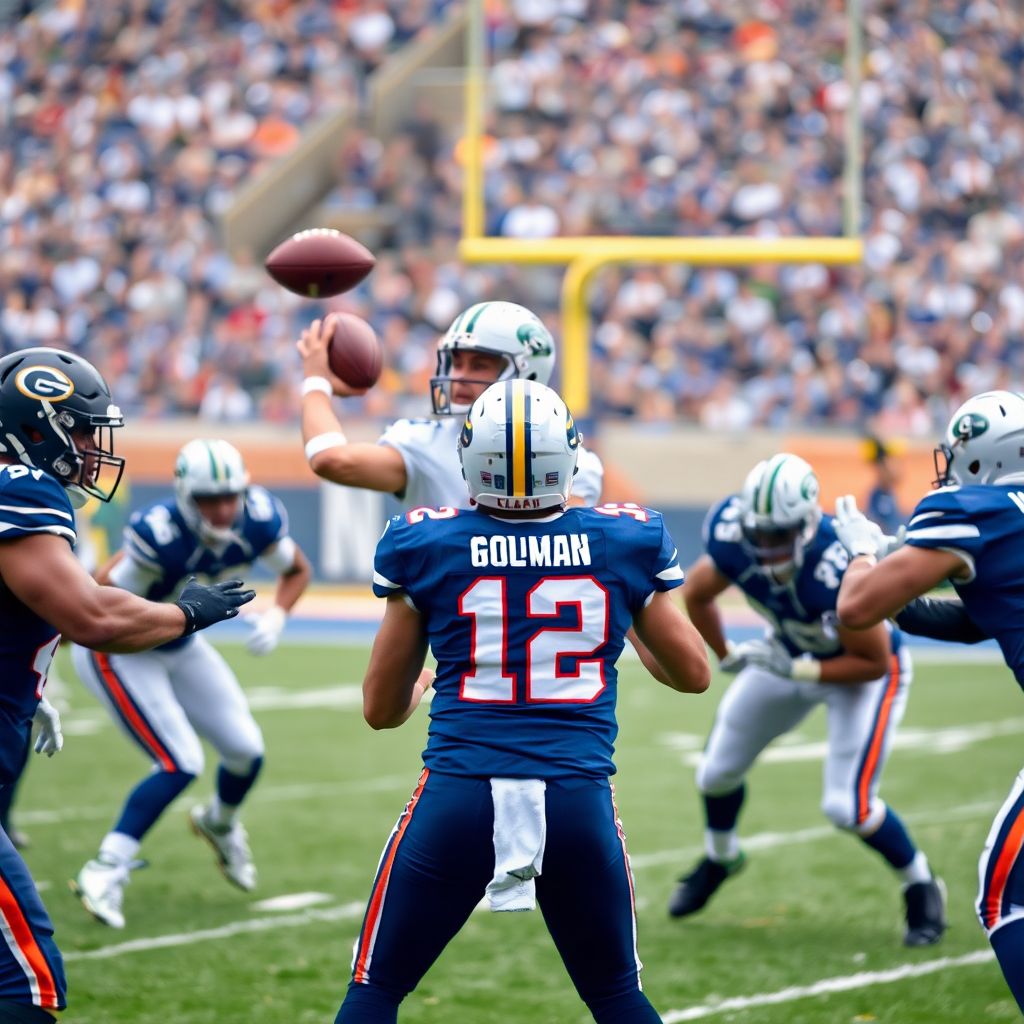
Dual-threat quarterbacks threaten defenses as legitimate passers who are also designed ball-carriers. Their presence changes gap math, pass-rush angles, and coverage rules, forcing defenses to dedicate an extra body to the quarterback. To survive, coordinators need clear plans: rush-lane discipline, option rules, situational spy usage, match personnel, and highly specific practice work.
Core implications of dual-threat quarterbacks
- They turn every play into an 11-on-11 run or pass, breaking traditional defensive number advantages.
- Pass-rush plans must emphasize lane integrity over pure speed off the edge.
- Coverage structures need built-in answers for scramble drills and QB-designed runs.
- Personnel groupings must balance speed (to chase) and size (to fit gaps).
- Game plans must narrow the offenseu2019s menu, not just “play fast and react.”
- Practice loads must shift toward option rules, leverage tackling, and communication versus movement.
Evolution of the dual-threat quarterback
In modern football, a dual-threat quarterback is a player who is a legitimate passing threat while also being a planned, repeatable weapon in the run game. This is not simply a “mobile” quarterback who can scramble, but a primary run option in the offensive structure.
Historically, defenses could treat the quarterback as a non-runner on most downs, letting one defender be “free” in the box. With todayu2019s dual threat quarterbacks, offenses use zone read, QB power, and RPO concepts to make that free defender wrong, or to remove him entirely with option rules.
On film, you see the shift: traditional dropback from under center, to shotgun spread with occasional QB draws, to full systems where the quarterback carries the ball on purpose multiple times each drive. Dual-threat quarterbacks analysis now focuses as much on how they stress structure as on raw arm talent.
This evolution forces defensive schemes vs mobile quarterbacks to become more modular. Fronts, coverages, and pressures must toggle between “QB run” and “QB pass-only” modes based on down, distance, and game plan tendencies, instead of assuming a single static identity.
Quantifying athletic vs. conceptual influence
The impact of a dual-threat QB comes from more than straight-line speed. It is a blend of athletic traits and conceptual stress on the defense:
- Gap math in the run game — When the QB can keep the ball, the offense adds a gap without adding a body. Defenses lose the luxury of a spare defender and must adjust fronts or insert a safety, which exposes coverage.
- Option and RPO conflicts — Reads can isolate one defender (end, OLB, nickel) and make his job impossible: play the QB, the back, and a slant behind him. The QBu2019s running threat makes that conflict sharper because defenders overcommit to the box.
- Pass-rush distortion — Rushers hesitate, widen, or “mush rush” to contain the QB, slowing down pressure. Even moderate athleticism can force conservative rush plans if the QB punishes undisciplined lanes.
- Coverage expansion — Scrambles force DBs to cover longer, and QB keepers from pass looks punish man coverage with defenders running away from the ball. This adds cognitive load to every coverage call.
- Personnel stress — Defenses must choose between lighter, faster packages to chase the QB and heavier boxes to handle QB power. Offenses hunt those mismatches by formation and tempo.
- Playbook compression for the defense — Some favorite pressures or coverages become uncallable against strong QB run game, shrinking the defensive call sheet while the offensive menu remains wide.
Viewed this way, the athletic part (how fast, how elusive) defines the ceiling of the threat. The conceptual part (option structure, RPO tags, scramble rules) determines how consistently that threat shows up on every down and distance.
How mobile passers alter pass-rush and coverage priorities
Before jumping to counters and adjustments, it helps to see concrete game situations. The following mini-scenarios show how mobile passers change core defensive priorities and why traditional calls break down.
Scenario 1: Third-and-medium vs. empty with QB draw
The offense aligns in empty, spreading five receivers across the field. Against a pocket passer, many coordinators call a wide-9 or edge-pressure look to quickly hit the QB. Against a true runner, that same call can gift a vertical lane for QB draw.
Defensive shift: DTs tighten rush lanes, edges convert to controlled “mush” instead of flying upfield, and a second-level defender is tagged to close the interior draw window. The call that used to be “pass-first pressure” becomes a lane-control call.
Scenario 2: Zone read vs. overaggressive edge
Offense runs zone read from shotgun, reading the backside end. If that end chases the running back like traditional zone, the QB pulls the ball and attacks the vacated edge, usually with a lead blocker from the backfield or a crack block from the slot.
Defensive shift: the end must now play the QB first, with the scrape linebacker taking the back. Fits are re-numbered. A defense that fails to teach this re-numbering gets gashed repeatedly on simple reads.
Scenario 3: Man coverage vs. scramble threat
In man free (Cover 1), DBs run with receivers, turning their backs. When the QB breaks contain, there may be nobody in the middle of the field until a low-hole or post safety reacts, which can be too late for a mobile quarterback.
Defensive shift: call more zone-match on known scramble downs, or tag a spy who mirrors the QB instead of matching a receiver. The “best defensive strategies against running quarterbacks” in man coverage often revolve around that dedicated spy plus strict rush-lane rules.
Scenario 4: Red zone, condensed formations
In the red zone, space compresses horizontally and vertically, making windows tight for traditional passers. For dual-threat QBs, this is actually a friendly area: QB power, bash (back away, QB run opposite), and speed options remove one defender and let the QB run like a featured back.
Defensive shift: heavier personnel with plugger types inside, force rules on the perimeter, and explicit QB-first fits. Many nfl playbook for stopping dual threat qbs segments now have red-zone-specific rules that treat the QB as RB1.
Tactical adjustments: fronts, spy schemes and personnel mixes
Once the mechanics and scenarios are clear, the next layer is building a tool kit. Defenses need answers in structure (fronts), roles (spies and force players), and bodies (personnel blends). These tools all trade something away; the aim is to pick the least painful trade for that opponent.
Front and structural tools
- Reduce fronts vs. QB power/GT counter
- Pros: Extra interior body for puller traffic, clearer A/B-gap fits, harder for the offense to create a clean double-team on the nose.
- Cons: Edges can get isolated in space vs. read schemes and bubbles; limited disguise if your personnel is bigger and slower.
- Odd fronts with a “plus” player to the back
- Pros: Balanced presentation versus zone read, easy to set the plus to the RB or QB tendency side, good for “how to defend dual threat quarterback” game plans that lean on consistent rules.
- Cons: If you mis-set the front to formation, you can get numbers outflanked; heavier boxes stress your coverage menu.
- Simulated pressures with contain edges
- Pros: Looks like pressure to the QB, but you still maintain four-man rush rules and two contain players; can steal a hot throw or force the ball out on schedule.
- Cons: Requires smart backers and safeties; busts create huge seams for scrambles.
Spy concepts and coverage selection
- Dedicated linebacker spy
- Pros: Simple coaching point: “You have the QB.” Great against primary scramble QBs who hurt you on third down more than on designed runs.
- Cons: You functionally play 10-on-11 in coverage; if the spy triggers late, you wasted a coverage body for nothing.
- Rotational or “green dog” spy
- Pros: Off-the-ball defender tracks the QB only when his coverage responsibility stays in protection; maximizes numbers when routes release.
- Cons: More moving parts and communication; timing mistakes leave gaps in coverage or late QB containment.
- Zone-match with rat players
- Pros: Multiple eyes on the QB, natural rally on scrambles, better angles to limit explosive QB runs versus spread sets.
- Cons: Requires disciplined pattern-match rules; young DBs can get lost between routes and scramble responsibilities.
Personnel blends and trade-offs
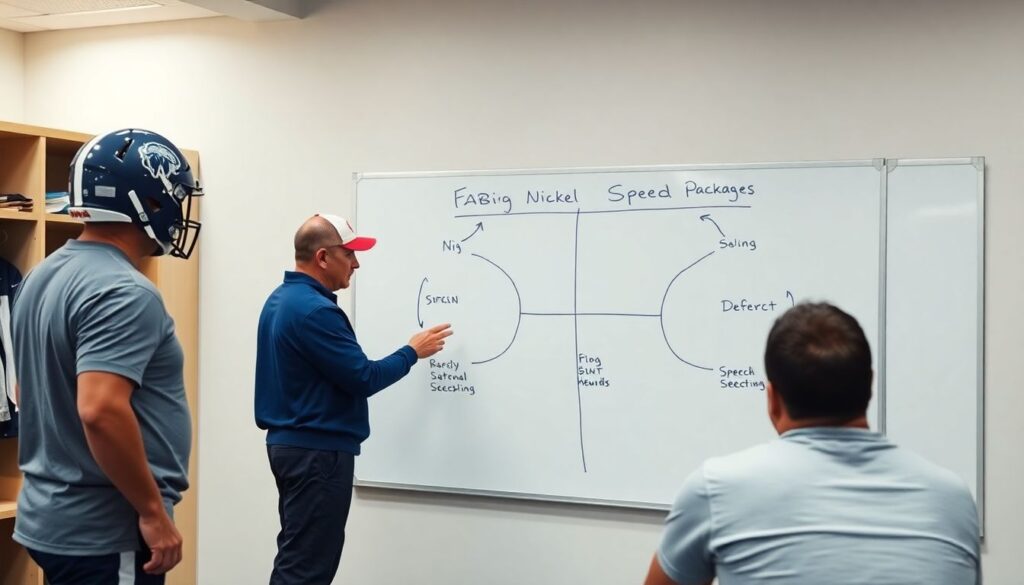
- Big nickel (three safeties)
- Pros: Hybrid body can both fit the run and carry verticals, ideal against 11 personnel with QB run tags.
- Cons: If that hybrid is not a true box player, QB power schemes will target him inside.
- Speed packages (more backers/safeties, fewer big DL)
- Pros: Better pursuit and space tackling; strong versus spread-option looks.
- Cons: Vulnerable to gap schemes and downhill QB runs; you may win horizontally but lose vertically in the run game.
- Heavier fronts with press corners
- Pros: Anchor against QB power/counter, force the offense to throw into tight press looks.
- Cons: If corners lose early, there is minimal help; play-action off QB run looks becomes particularly dangerous.
Scheme case studies: formations that contain or invite QB runs
Common mistakes and myths tend to repeat from level to level. Recognizing them lets you design smarter defensive schemes vs mobile quarterbacks instead of relying on slogans.
- Myth: “Weu2019ll just load the box and be fine.”
Issue: Overloading the box versus a dual-threat QB without clear force and alley rules often creates unfilled gaps and uncovered receivers. The QB run game is usually tagged to simple, quick passes that punish pure numbers-based thinking.
- Mistake: Two-high light box vs. QB GT counter from trips
Issue: Staying in a light 2-high shell when the offense aligns trips into the boundary and runs QB GT counter to the field invites an outnumbered edge. Your apex defender gets kicked, the corner is in conflict, and the QB is on your safety quickly.
- Myth: “Spying the QB solves everything.”
Issue: A spy is only as good as the rush lanes in front of him. If edges lose contain or interior rushers open a big vertical lane, the spy has impossible space to cover. Over-relying on a spy can hide deeper structural issues.
- Mistake: Playing soft zone vs. QB draw in empty
Issue: Sitting in a soft, off zone look versus empty encourages the QB draw because second-level defenders are bailing. There is no immediate second wave in the box, and you concede efficient yardage all game.
- Myth: “Force the dual-threat QB to throw and you win.”
Issue: Many dual-threat QBs are efficient within their defined reads. If you single-cover their best matchups or bust on RPO responsibilities, they donu2019t need to be elite pure pocket passers to beat you through the air.
- Mistake: Calling complex pressures vs. tempo spread option
Issue: Long-winded calls with tags and checks often cannot be communicated versus tempo. Busts against option football are more costly than versus static dropback. Complexity without mastery is worse than simple, well-repped calls.
Defensive preparation: practice drills, communication and film workflows
Preparation is where theory becomes execution. The best defensive strategies against running quarterbacks consistently link film study, practice periods, and game-day communication. Here is a simple week structure that can be adapted from high school to NFL.
Step-by-step weekly workflow vs. a dual-threat QB
- Sunday/Monday — Define the threat profile
- Chart QB runs: designed vs. scrambles, open-field vs. red zone, run concepts (zone read, power read, GT counter, draw).
- Identify “must-stop” concepts and worst-down situations (e.g., third-and-5 QB draw from empty).
- Tuesday — Build the call family
- Select a small menu that addresses their top runs and passes; donu2019t chase every play on the cut-up.
- Tag each call with clear coaching points: force player, QB-responsible player, edge rules, and coverage adjustments.
- Wednesday — Drill rush lanes and fit rules
- Indy: rush-lane drill with four-man and five-man patterns, emphasizing contain, level rush, and counters to escape moves.
- Group: half-line option periods (zone read, power read) with scripted fits and communication checks.
- Thursday — Situational and scramble emphasis
- 7-on-7: scramble rules for DBs and backers, including plaster techniques and “find work” principles.
- Team: third-down package vs. QB movement; mix spy and non-spy calls to avoid tendencies.
- Friday — Review and mental reps
- Walk-through: call it from the sideline exactly as on game day, including motions and formations that dress up their core QB runs.
- Remind players of the 2u20133 critical calls in each situation rather than overwhelming them with the full menu.
Micro-drills that translate on game day
- QB-centric pursuit drill
- Set a mobile QB or RB as the ball-carrier and run escapes in different directions.
- Coach angles, leverage, and “near hip” tracking instead of simply running at the numbers.
- Option responsibility circuit
- Rotate players through positions (end, scrape backer, overhang) to teach who has dive, QB, and pitch.
- Change the formation but keep the rules, so players understand structure, not just pictures.
- Pressure-to-mush conversion drill
- Start in full-speed rush, then on a coachu2019s “option” call, edges convert to a controlled rush and interior players tighten lanes.
- This builds the habit of transitioning from pure pressure to controlled rush if the QB breaks contain.
Integrated over a season, this type of workflow becomes a living nfl playbook for stopping dual threat qbs, aligning dual threat quarterbacks analysis with clear practice habits rather than one-off fixes.
Practical questions and direct answers
What defines a true dual-threat quarterback compared to a mobile passer?
A true dual-threat quarterback has designed run responsibilities built into the offense, not just the ability to scramble when plays break down. His carries are part of the run game menu, with blocking schemes and tags specifically created for him.
How do you start building a plan for how to defend dual threat quarterback play?
Start by charting when and how the QB runs: down and distance, formation, field position, and concept. Then choose a small set of fronts, coverages, and pressures that handle those specific threats, and drill them heavily instead of calling everything you own.
When should a defense use a spy against a mobile quarterback?
Use a spy primarily on key passing downs where scrambles are more dangerous than designed QB runs. It is most effective when paired with disciplined rush lanes and coverage structures that keep eyes on the quarterback, not as a standalone solution.
Is man or zone coverage better versus dual-threat QBs?
Neither is universally better. Man coverage can work with a strong spy and tight rush discipline, while zone-match structures naturally keep more eyes on the QB. The best approach mixes both, tied to situation and opponent tendencies.
How should practice change when facing a true dual-threat quarterback?
Increase option and QB-run periods, emphasize rush-lane drills, and run scramble-rule work for the secondary. Your practice script should mirror their top QB concepts and movement habits, not just generic dropback or standard run plays.
What is the biggest coaching mistake against dual-threat quarterbacks?
Calling a wide, complex menu of pressures and coverages instead of a focused package players can execute at full speed. Busts versus option-based offenses lead to explosive plays; simplicity and clarity often win more than cleverness.
Can you stop a dual-threat QB without changing base personnel?
Yes, if your base personnel includes at least one true hybrid who can function as an overhang defender and your interior fits are sound. However, many defenses benefit from at least a change-up package that adds speed or flexibility to the second level.