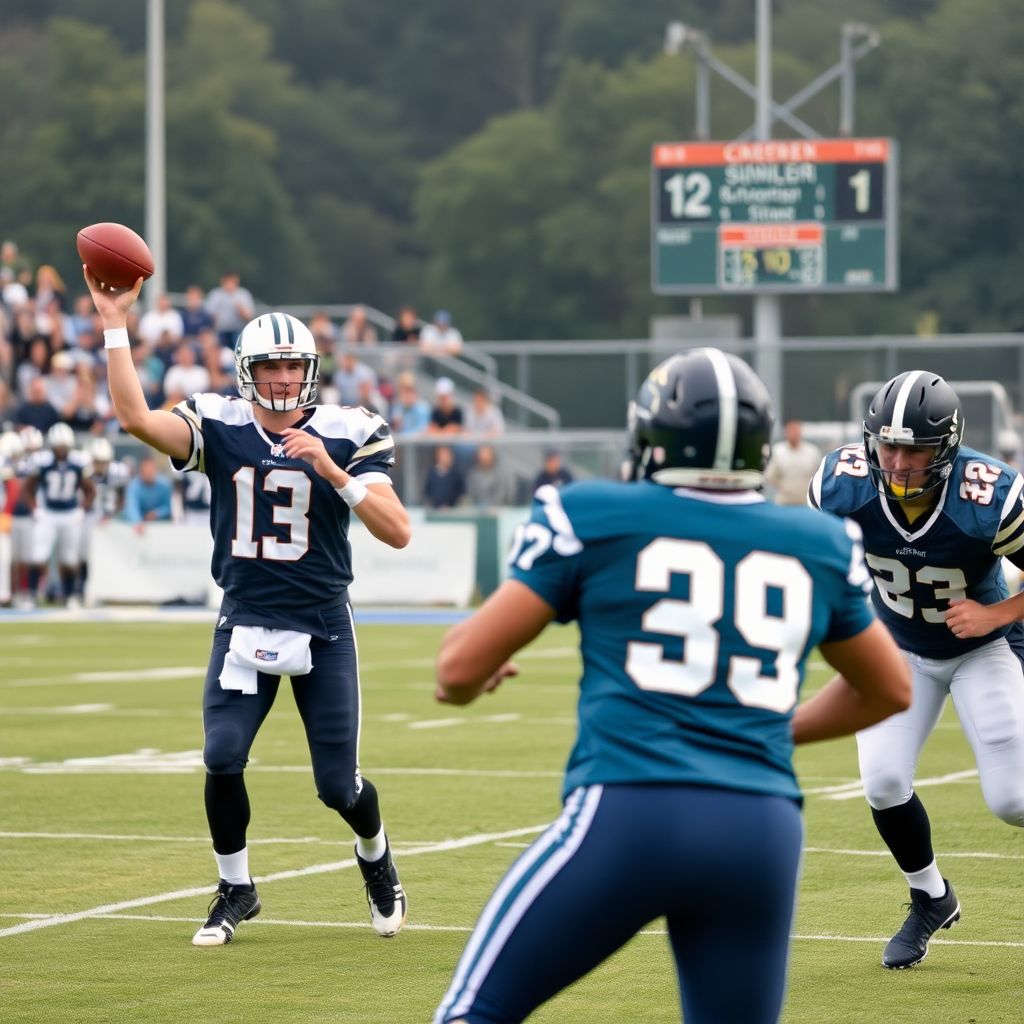
A safe, effective game-winning drive comes from a clear pre-drive plan, strict down-and-distance rules, and disciplined clock management. Use a simple call menu, repeatable concepts, and built-in contingency calls. Protect the ball, the quarterback, and the middle of the field, while creating sideline access and defined shot windows, not freelancing.
Quick Tactical Summary of the Drive
- Start with a pre-defined two-minute menu built around 3-5 concepts you already execute well.
- Call by situation, not by feel: down, distance, field zone, timeout count, and hash.
- Pair every aggressive call with a safe “out” (checkdown, throwaway, QB reset rule).
- Use the sideline intelligently: gain first downs first, then chase chunk plays.
- Communicate clock, kill word, and fourth-down go/no-go before the drive starts.
- After each snap, instantly re-check: time, timeout, hash, down, distance, and personnel.
Initial Situation: Clock, Field Position, and Personnel
This structure fits intermediate coaches and quarterbacks who already operate basic no-huddle and want practical, safe guidelines for how to design a game winning drive football plan. Do not adopt full-drive complexity if your offense struggles with communication, hurry-up mechanics, or basic ball security; simplify to 2-3 core concepts first.
| Situation Dimension | Prep Checklist | Practical Note |
|---|---|---|
| Clock | Define “fast,” “normal,” and “urgent” tempos | Agree what changes once the clock hits two minutes or less. |
| Field Position | Mark backed-up, mid-field, fringe, and true red zone | Link each field band to risk tolerance and shot rules. |
| Score Context | Clarify if you need TD only, FG acceptable, or just FG | This sets your real goal line and your kicker’s “must-reach” line. |
| Personnel Group | Choose one base grouping; avoid swapping mid-drive | Frequent substitutions burn time and invite misalignments. |
| Quarterback Rules | Set no-sack, no-middle-late, and throwaway rules | Protect field position and the clock over low-percentage hero throws. |
Before the ball is snapped on a final drive, treat it as a compressed game winning drive analysis brief.
- Confirm score target: touchdown only or field goal acceptable.
- State exact time, timeout count, and whether clock starts on ready or on snap.
- Announce the kicker’s realistic range and preferred hash.
- Lock in one personnel group and tempo word for the entire drive.
- Review QB boundaries: sack avoidance, scramble rules, and throwaway locations.
Play Sequencing: Building Momentum and Setting Traps
Think of sequencing as a compact american football play by play breakdown where each snap sets up the next two. Your offensive play calling strategy nfl-style framework should define openers, answers versus pressure, and at least one constraint play to punish over-aggressive defenders without adding mental overload.
| Element | Sequencing Checklist | Usage Tip |
|---|---|---|
| Openers | Script 3-4 high-completion plays | Use to calm the QB and force base coverage looks. |
| Core Concept | Select 1-2 pass concepts and 1 run/RPO | Repeat these; change formation and presentation, not reads. |
| Constraint | Install 1 screen and 1 draw or trap | Call when rush or coverage tilts too aggressive. |
| Shot Window | Tag 1-2 vertical or double-move shots | Use near midfield when clock and protection allow. |
| Safe Exit | Include a quick-game or run “reset” call | Settle the drive after chaos, penalty, or negative play. |
Your sequence should cover three lanes: safe completion, intermediate chunk, and constraint. Attach quick tags (e.g., “alert shot,” “kill to run”) so you can shift between them based on the front, shell, and leverage picture without burning time or creating confusion.
Down-and-Distance Protocols: Tactical Choices by Situation
This is where your american football play by play breakdown becomes a repeatable “if-then” system. Establish down-and-distance protocols in advance so your QB and staff recognize the call types before you even send the play.
| Situation | Primary Call Types | Safety Checks |
|---|---|---|
| 1st & 10 (normal) | High-percentage pass, draw/RPO, or simple flood | Built-in checkdown and throwaway landmark. |
| 2nd & 5-6 | Shot concept with underneath outlet | QB allowed to take easy stick/flat if picture is cloudy. |
| 3rd & short (1-3) | Best short-yardage run or quick-game | Emphasize ball security over extra yards. |
| 3rd & long (7+) | Flood, dagger, or levels with checkdown | Never throw short of sticks into tight coverage. |
| 4th down (go zone) | Concept QB loves vs your expected coverage | Define read-simple route combo; no grey-area throws. |
Pre-drive prep checklist before you apply the step-by-step system:
- Group calls by down-and-distance band in your play sheet or wristband.
- Mark safe quick-game options for every band, especially 3rd and 4th down.
- Define go/no-go rules for fourth down by yard line and distance.
- Choose one “emergency” call usable versus any coverage in stress moments.
-
Identify the current band and next likely band.
After each play, immediately confirm down and distance, then anticipate what the next down-and-distance is if you gain an average result. This keeps you one call ahead and stops panic if a play is incomplete or stopped short. -
Use 1st down to stabilize, not to gamble.
Early in the drive, lean on high-percentage concepts: quick outs, hitches, spacing, or your best RPO. Avoid low-probability deep shots unless the coverage is clearly vulnerable and the clock is extremely tight. -
Attack 2nd & medium with layered options.
Design calls that offer both a shot and a safe conversion path.- Option A: Take the vertical or deep dig if the shell rotates favorably.
- Option B: Hit the underneath route if leverage is soft underneath.
- Option C: Throw it away if protection collapses and no outlet is clean.
-
Standardize 3rd & short calls.
Use your best short-yardage runs or quick isolations you already major in. Limit reads: one-on-one matchup outside, quick slant, or power run behind your best double team. This removes indecision in the biggest leverage situations. -
Protect yourself on 3rd & long.
Call concepts like dagger, four verts with a strong checkdown, or levels that naturally create a horizontal outlet. Remind the QB: never take a drive-killing sack; throw to the checkdown with space or sail the ball safely out of bounds. -
Apply pre-set fourth-down rules without debate.
Before the drive, decide where you are willing to go for it and what distances you like. On the field, simply execute that plan. Have one or two fourth-down calls you practice weekly so execution stays clean under pressure.
Clock Management, Timeouts, and Sideline Coordination
Effective clock management turns your two minute drill offensive tactics into repeatable process instead of chaos. Your sideline must operate off a shared checklist so timeouts, kill calls, and sideline throws are used with intent.
| Category | Management Checklist | Execution Focus |
|---|---|---|
| Timeouts | Assign one coach to own timeout decisions | Prevent random burns; save at least one for kick setup. |
| Tempo | Define words for “no-huddle,” “huddle fast,” and “clock burn” | QB echoes tempo word in the huddle or at the line. |
| Sideline Use | Tag 2-3 sideline concepts and out routes | Favor these when clock is running under heavy strain. |
| Middle of Field | Allow middle throws only with clock and timeout cushion | Teach immediate ball-to-official mechanics. |
| Substitutions | Freeze subs late; stick with one personnel group | Avoid illegal substitution and delay penalties. |
- Confirm before each snap: down, distance, clock, hash, and timeout count out loud on the sideline and in the huddle.
- Use timeouts only to prevent catastrophic situations: running clock with confusion, sack with no time to regroup, or final kick setup.
- Prioritize sideline routes once you cross midfield with little time and limited timeouts remaining.
- Coach receivers and backs to hand the ball directly to the official, not celebrate, after every play.
- Signal kill words (“clock,” “spike”) clearly and practice them; never improvise spike mechanics in a live game.
- Align special teams early: get the field goal unit staged as soon as the kick line is in range.
Play Design: Route Concepts, Blocking Priorities, and Protection
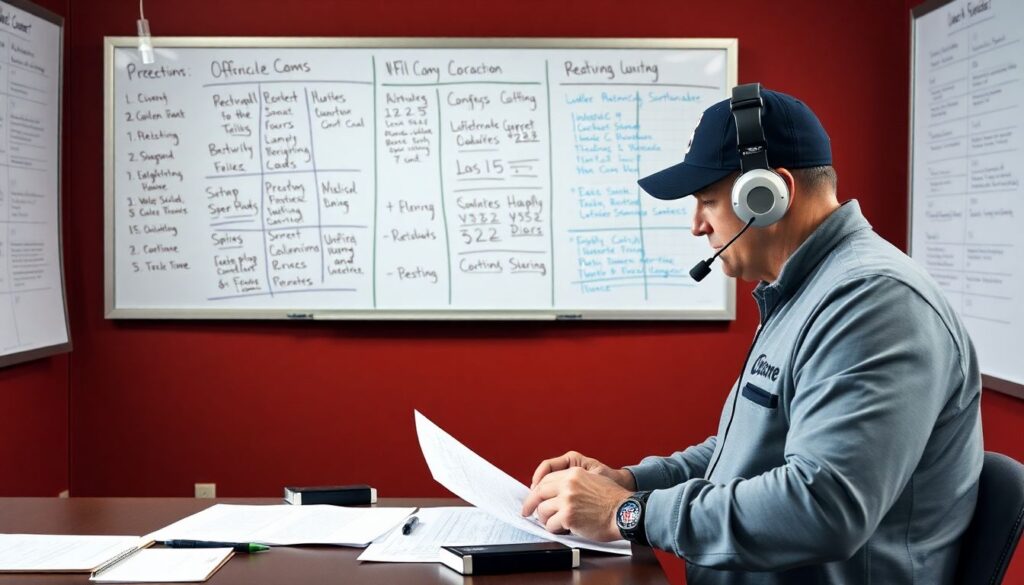
Your call menu must be built from concepts you already execute cleanly; the drive is not the moment to experiment. Treat this as applied offensive play calling strategy nfl where protection rules and route spacing are non-negotiable.
| Design Aspect | Prep Checklist | Drive-Day Emphasis |
|---|---|---|
| Concept Selection | Limit to core quick, intermediate, and screen packages | Fewer concepts, more reps; call what players trust. |
| Protection | Define full-slide, half-slide, and max-pro calls | QB must know where free rusher can appear. |
| Hot Rules | Tag a hot or sight-adjust for each protection family | Do not rely solely on QB heroics versus blitz. |
| Route Spacing | Standardize depths for outs, curls, digs, and posts | Prevents two receivers arriving in same window. |
| Checkdowns | Design at least one outlet in every pass concept | Teach QB to find outlet immediately post-snap. |
- Overloading the call sheet with concepts the offense barely practiced during the week.
- Calling long-developing routes behind a pass protection the line does not fully understand.
- Ignoring the back or tight end in protection and releasing them into crowded routes instead of using them as checkdowns.
- Stacking multiple receivers into the same throwing window, making defender assignments easy.
- Designing middle-of-the-field concepts with no sideline outlet when clock and timeout situations demand stopping the clock.
- Failing to communicate hot rules versus specific pressure looks, leaving the QB to guess in critical moments.
- Tagging double moves that require maximum protection without adjusting the blocking scheme.
Contingencies: Two-Minute Adjustments and Risk Mitigation
These contingency paths keep your plan stable when coverage, pressure, or execution differ from the scouting report. Here you bring together your two minute drill offensive tactics and your pre-planned game winning drive analysis work.
| Contingency Type | Adjustment Checklist | When to Use |
|---|---|---|
| Coverage Shift | Flip to mirrored concept or quick-game | Defense abandons expected shell or leverage picture. |
| Heavy Pressure | Move pocket, screen, or max-pro shot | Repeated free rushers or overload blitz looks. |
| Execution Issues | Call reset run or simple mirrored pass | Miscommunication, drops, or QB clearly rattled. |
| Time Collapse | Shift to pure sideline and spike mechanics | Clock under severe strain with no timeouts. |
-
Option A – Conservative “Field Goal First” track.
When a field goal ties or wins, tighten risk: emphasize inside zone, draws, and simple quick-game outs. Use the sideline to manage the clock and treat the kicker’s range line as your true objective yard line. -
Option B – Aggressive “Touchdown or Nothing” track.
When only a touchdown matters, expand vertical concepts and red-zone isolation routes while still preserving checkdowns. Move the QB with boots and sprint-outs to simplify the read and shrink the field horizontally. -
Option C – Hybrid “Start safe, finish aggressive” track.
Start with conservative chunk plays to cross midfield, then flip to more aggressive calls once the clock and field position justify the risk. This hybrid model is often the safest teaching baseline for coaches learning how to design a game winning drive football framework. -
Option D – Emergency scramble protocol.
If a play breaks down, pre-teach scramble rules: nearest receiver to QB works back, deep route breaks off to sideline, backside route crosses field, and the QB either throws it away safely or runs out of bounds rather than taking a hit in bounds.
Troubleshooting Execution and Decision Points
How do I keep the quarterback from forcing deep throws under pressure?
Pre-wire explicit rules: no-sack, no-middle-late, and “checkdown or throwaway over forced hero ball.” Build each concept with a defined outlet and practice end-of-drive situations where the correct decision is to throw the ball away.
What if the defense changes coverage looks from the scouting report?
Use mirrored concepts (same routes to both sides) and simple, coverage-beating staples like levels and floods. Give the QB a pre-snap rule: throw to the best leverage side, not to a specific pre-determined receiver.
How should I adjust if my offensive line struggles with blitz pickup?
Shift to quick-game, screens, draws, and moving pockets. Call more max-protection shots with fewer receivers and clear reads instead of spreading out and asking the QB to solve complex blitz pictures.
When is it worth using a timeout on a game-winning drive?
Use a timeout to prevent a disastrous play: confusion with a running clock, a critical fourth-down where the call is not clear, or the final setup for a potential game-winning kick. Do not waste them stopping the clock after routine plays.
How can I practice these drives without overloading players?
Install a small, repeatable two-minute package and rehearse it weekly in short segments. Run scripted drives at the end of practice with the same personnel, tempo words, and sideline communication you will use on game day.
What if my receivers struggle to get out of bounds in time?
Teach catch mechanics near the sideline: turn up-field only when you have clear yards and enough clock; otherwise, plant and step directly out. Drill awareness with a coach calling “clock” or “sideline” during team periods.
How do I blend analytics with on-field feel in late-game decisions?
Use analytics during the week to set fourth-down and kick-line rules, then commit to those rules on game day. In the drive, rely on your pre-made plan instead of making emotional, on-the-fly choices.