
NFL analytics are reshaping game strategy by turning every play into data that informs decisions on fourth downs, passing vs. running, personnel packages, and clock management. Using tracking data, play-by-play logs, and predictive models, teams quantify risk and reward in real time, aligning game plans with probabilities rather than gut feel alone.
Strategic Insights at a Glance
- NFL analytics convert film and stats into probabilities that guide play-calling, roster usage, and clock strategy.
- Expected points and win probability models frame fourth-down, two-point, and time-out decisions.
- High-quality data pipelines are as critical as the models used to interpret them.
- Opponent-specific tendencies matter more than league averages on critical downs.
- Analytics must be translated into clear, fast sideline rules to be useful on game day.
- Bias, incomplete data, and overfitting can quietly undermine even sophisticated systems.
Fast Practical Coaching Pointers
- Pre-build a simple fourth-down chart based on your roster and field conditions; do not improvise it mid-game.
- Tag every practice rep with down, distance, hash, and coverage; review tendencies weekly with position groups.
- Limit dashboards to 3-5 metrics per coach so signals are clear under pressure.
- Script first 10-15 plays with 2-3 analytics-driven constraint plays vs. opponent tendencies.
- After each game, pick one analytics recommendation you ignored and review the outcome with staff.
How Advanced Metrics Changed Play-Calling
NFL analytics refers to the systematic use of data, models, and football analytics tools to inform decisions across scouting, game-planning, and in-game management. Instead of relying mainly on intuition, staffs integrate probabilities and expected outcomes into their call sheets and situational rules.
Advanced metrics have shifted the focus from raw totals (yards, attempts, completions) to efficiency and context. Coordinators now ask how a concept performs by down, distance, box count, and coverage, not just whether it gains yards. Metrics like success rate, EPA (expected points added), and win probability leverage play-by-play context to define what a “good” play actually is.
This has changed play-calling in three big ways. First, fourth-down aggressiveness: teams are more willing to go for it when models show the long-run benefit. Second, early-down pass rates: coordinators increasingly use the pass on early downs to avoid predictable third-and-long situations. Third, defensive structure: calls are tuned to deny opponent “money” concepts that analytics flag as high EPA, even if that means inviting lower-value checkdowns.
At a practical level, this means call sheets and wristbands now embed analytics: color-coded boxes for go/no-go decisions, preferred concepts by situation, and alerts for clock and timeout usage based on win probability swings.
Data Sources and Pipeline: From Tracking to Decisions
NFL analytics only works when the data pipeline is clean, reliable, and fast enough to support coaching timelines. Most teams build a chain from raw inputs to simple outputs tied directly to football language and decisions.
- Collection and tracking: Player-tracking chips, video, and play-by-play logs capture positions, speed, routes, and outcomes on every snap.
- Tagging and structuring: Analysts or NFL data analysis services label formations, coverages, fronts, motions, and concepts so plays can be compared apples-to-apples.
- Storage and access: A central database or football performance analytics platform organizes data by game, opponent, situation, and player, with fast query tools.
- Modeling and metrics: Sports analytics software computes custom metrics such as success rate by concept, explosive play rate allowed by coverage, or QB performance vs. pressure.
- Translation and visualization: Results are surfaced as cut-ups, simple charts, and rules-of-thumb that coaches can digest quickly midweek and on game day.
- Feedback and iteration: After each game, predicted vs. actual outcomes are reviewed, models tuned, and new questions logged for upcoming opponents.
Effective football analytics tools prioritize clarity and speed over complexity. A coordinator may never see the database or code; they see outputs like “Trips Right – opponent checks to Cover 3 buzz 80% of the time on 3rd-and-medium” plus associated cut-ups.
Modeling Win Probability and Expected Points
Win probability and expected points models take that data pipeline and put a number on game situations. Instead of vague statements like “this is risky,” coaches see how each option changes their chances of winning and their expected points on the drive.
- Fourth-down decisions: On 4th-and-2 at midfield, models estimate the win probability of punting vs. going for it. If going boosts win probability more than the cost of failure, the analytics recommendation is to be aggressive, especially with a high-performing short-yardage package.
- Two-point vs. extra point: Late-game score states (down 8 vs. down 7, time remaining, timeouts) are run through models to decide whether to chase two early or extend the game with one. These rules are often pre-scripted so the head coach is not calculating under pressure.
- Clock and timeout management: Win probability charts show when using a timeout before the two-minute warning, spiking the ball, or running the clock down meaningfully changes the chance to win.
- Play selection by situation: Expected points added per play type informs choices like run vs. pass on 2nd-and-short near midfield or shot plays after sudden changes (turnovers, big returns).
- Risk calibration in plus territory: Rather than using only field goal range as a cutoff, teams consider the expected points gain from pushing for a touchdown vs. preserving three points, especially against high-powered offenses.
In practice, these models sit behind simple sideline prompts. Example pseudo-rule: “Inside opponent 45, 4th-and-3 or less, win probability gain from going is positive unless backup QB is in; default is go.” The numbers are baked into rules long before kickoff.
Opponent Profiling and Situational Game Plans
Opponent profiling uses analytics to map what another team truly is on the field, beyond reputation. By breaking down tendencies by down, distance, field zone, and personnel, staffs can construct situational game plans that attack or deny an opponent's favorite looks.
Advantages of Opponent-Focused Analytics
- Reveals hidden tendencies, such as a defense's surprising blitz rate vs. empty on 2nd-and-long, regardless of their overall blitz percentage.
- Improves call sequencing by aligning your best concepts against the coverages and fronts the opponent is most likely to call in specific situations.
- Supports player-specific strategies, like double-teaming a receiver only in high-leverage downs where their target share spikes.
- Enhances special teams strategy by identifying return lane weaknesses and directional kicking patterns.
- Allows efficient practice planning by concentrating reps on the 10-15 most probable game situations.
Constraints and Practical Limits
- Tendencies can flip after bye weeks, coordinator changes, or injuries, so models built on older data may mislead.
- Over-focusing on analytics can make a defense or offense predictable if opponents know your “right” answers and game-plan counters.
- Sample sizes for rare situations (e.g., 4th-and-5 inside the 10 vs. a specific team) are often too small to support confident conclusions.
- Human elements like weather, crowd noise, QB health, and confidence are hard to encode but meaningfully affect play outcomes.
- Analytical labels (e.g., coverage tags) can be noisy or inconsistent across scouts, polluting downstream insights.
Integrating Analytics into Coaching Workflows
Even strong NFL analytics work provides little value if it is not woven into daily routines. Integration is mostly about communication, timing, and scope: the right information to the right coach at the right moment.
Common Missteps That Block Adoption
- Overloading coaches with dashboards: Presenting dozens of charts instead of three clear tendencies and corresponding cut-ups overwhelms decision-makers.
- Delivering insights too late: Reports that arrive after scripts and game plans are set tend to be ignored, regardless of quality.
- Failing to speak football language: Describing output in generic model terms, not in concepts, personnel, and coverages that coaches use daily.
- Treating models as absolute truth: Ignoring context like backup linemen, QB injuries, or extreme weather when applying generic recommendations.
- Not closing the feedback loop: Skipping post-game reviews where coaches and analysts jointly examine when analytics-based calls did or did not work.
A practical approach uses a small set of agreed metrics, lightweight sports analytics software interfaces customized for each role, and a cadence: weekly opponent brief, midweek review after additional self-scout, then a short pregame refresh focusing on the highest-leverage decisions.
Limitations, Biases, and Ethical Considerations
Analytics can fail quietly when underlying data or assumptions are flawed. Bias creeps in through selective tagging, overemphasis on recent games, or building models on league-wide data that does not fit a specific roster's strengths.
Mini-case: a team's model shows that aggressive fourth-down decisions usually pay off, based on league trends. Their offensive line, however, is injured and underperforming. They go for multiple fourth-and-short attempts, fail, and lose. The problem is not analytics in general but mismatched priors: applying league baselines without adjusting for local context.
Ethically, teams must consider privacy and data ownership for players as tracking becomes more detailed. When evaluating contracts or rotation decisions, organizations should avoid using opaque metrics that players and agents cannot reasonably understand or contest. Transparency about which analytics drive major decisions builds trust and helps ensure data is used to enhance performance, not simply to justify predetermined choices.
Common Practitioner Questions
How do smaller staffs start using NFL analytics without big budgets?
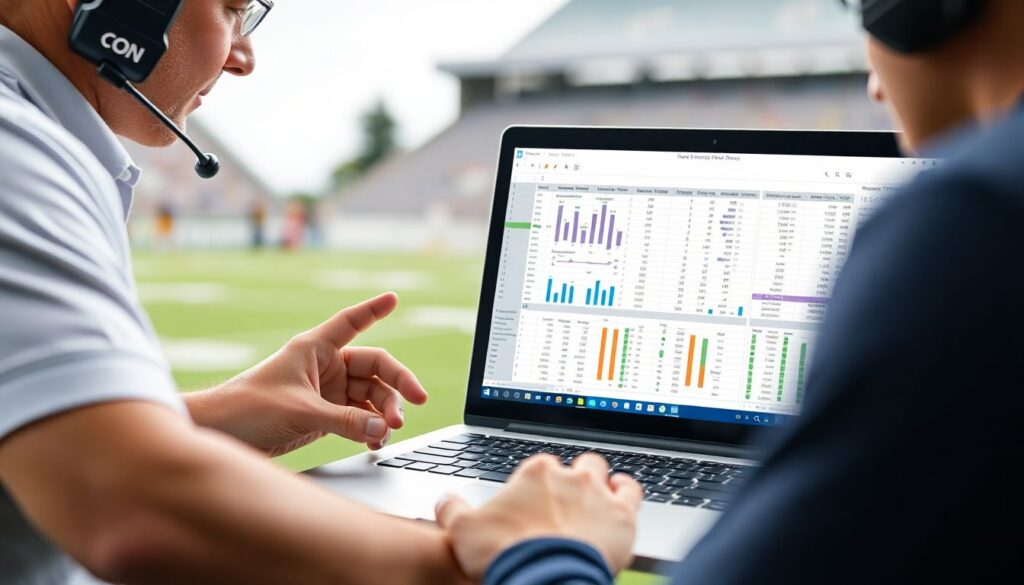
Begin with charting your own games in detail: down, distance, formation, coverage, pressure, and result. Simple spreadsheets and basic sports analytics software can reveal tendency gaps and efficiency trends before you invest in heavier tools or external NFL data analysis services.
Which metrics matter most for offensive play-calling?
Focus on success rate and expected points added by concept, formation, and personnel grouping, broken down by situation. These directly connect to drive outcomes and highlight which calls actually move the chains and generate scoring chances, not just total yardage.
How can a defensive coordinator use a football performance analytics platform?
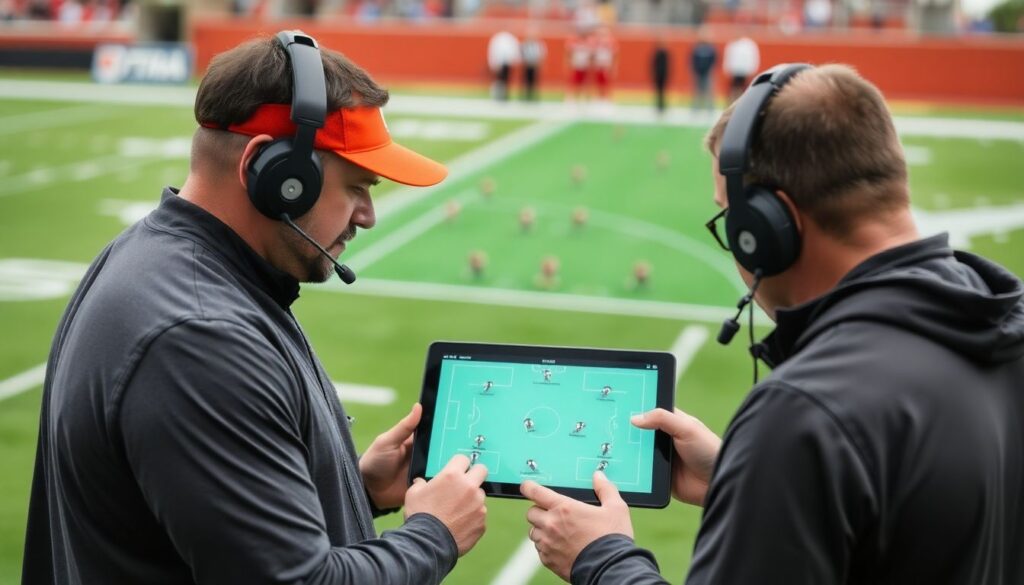
Use it to filter opponent plays by down, distance, hash, and personnel to see their top concepts and explosives. Then create cut-ups and practice scripts that specifically target stopping those looks, especially in third-down and red-zone situations.
What is the most important in-game analytics tool on the sideline?
A pre-built decision sheet combining win probability and expected points for fourth-down, two-point, and clock decisions is usually the highest-impact aid. It compresses complex models into fast yes/no guidance when time is limited.
How do you prevent analytics from clashing with a head coach's philosophy?
Align early by translating analytics into the coach's language and stated identity. Rather than forcing generic league tendencies, tailor recommendations to how the coach wants to play, and show how data-backed choices reinforce that identity.
Can analytics help with player development, not just game-planning?
Yes. Detailed practice and game data can highlight where a player struggles by situation and technique, guiding individualized drills and film study. Quantifying incremental improvements also helps players see progress beyond basic stats.
Do you need custom-built software, or are off-the-shelf football analytics tools enough?
Many programs start effectively with off-the-shelf football analytics tools and basic NFL data analysis services, then add custom layers once their questions and workflows are clear. Custom builds make the most sense when your processes and terminology are stable.