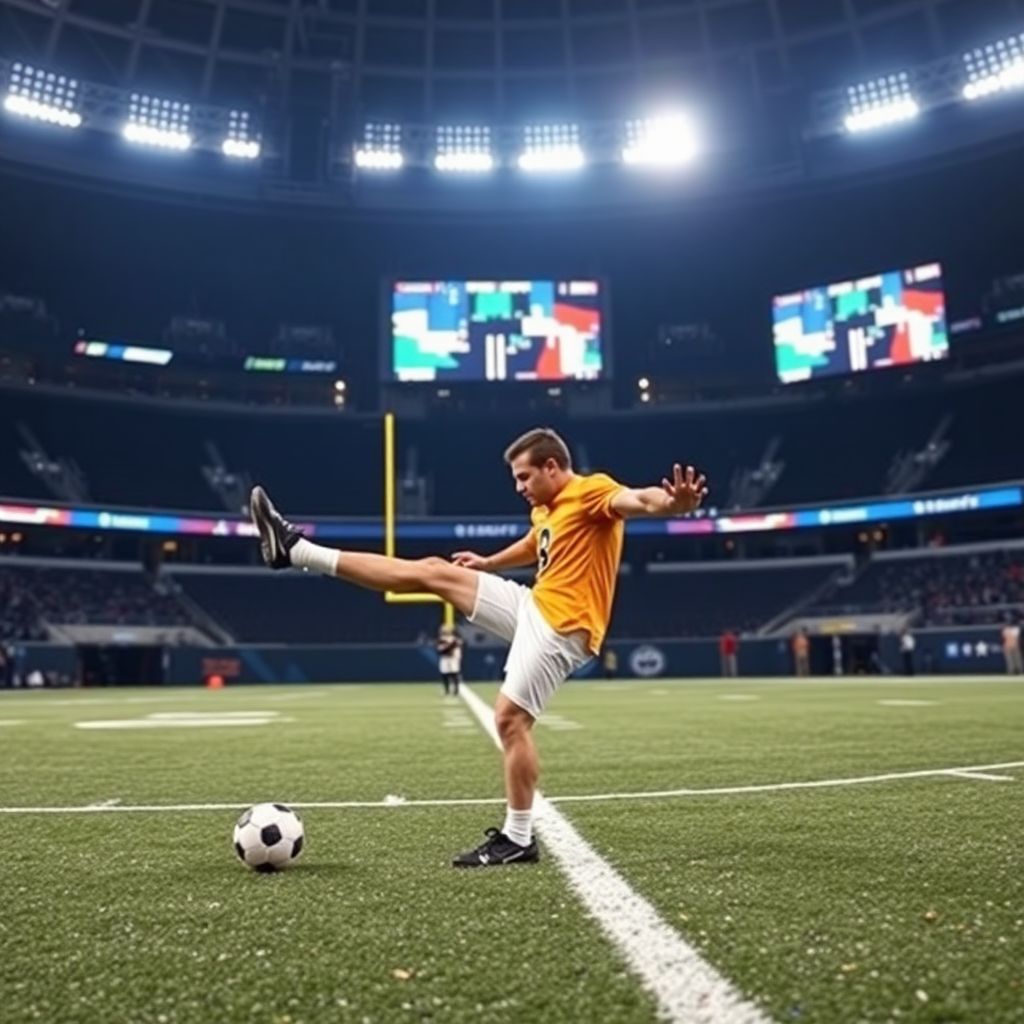
Elite NFL kicking accuracy combines repeatable biomechanics, precise timing under pressure, optimized ball flight, and practice that mimics game conditions. The best kickers control approach angle, plant-foot location, hip-foot whip, mental rhythm, and environmental adjustments. With smart drills and data, even athletes without expensive facilities can systematically close the gap.
Core Principles Behind Consistent NFL Kicking
- Stable, repeatable approach path and plant-foot position relative to the ball.
- Efficient kinetic chain: hips and core initiate, leg and foot finish.
- Consistent contact point on both the ball and the kicking foot.
- Automatic pre-kick routine to lock in timing under pressure.
- Realistic practice that mirrors snap-hold timing and game distances.
- Awareness of wind, turf, and stadium patterns and how to adjust aim.
- Use of simple analytics (charts/video) to detect small technical drift early.
Biomechanics of an Accurate Field Goal
Biomechanics of an accurate field goal describes how body segments coordinate to send the ball on a precise line and trajectory. It covers approach steps, plant-foot location, hip rotation, swing path, and follow-through. When these elements are repeatable, distance and accuracy become predictable instead of hopeful.
The approach is typically a curved or slightly angled path that lets the kicker open the hips toward the target. The plant foot lands slightly ahead and to the side of the ball, pointed generally toward the uprights. Too close, and the swing jams; too far, and power and control leak away.
From there, the hips and core initiate rotation, followed by a relaxed-but-fast leg swing. The striking surface (laces or instep) should contact a consistent panel of the ball, usually slightly below its center, with the ankle locked. The follow-through continues on the target line, not across the body.
Simple measurement to track: mark plant-foot distance. Place tape on the ground so your plant foot lands the same distance (for example, roughly one shoe-length beside and half a shoe-length ahead of the ball) on every kick. Film from the side once a week and compare against that reference.
If you lack a full field: use a small grass area or park, a portable tripod, and cones as uprights. Focus on repeating your approach, plant spot, and ball contact at shorter distances instead of chasing long kicks without feedback.
Neurology and Motor Patterns: Timing Under Pressure
Neurology and motor patterns explain how the nervous system automates kicking so it holds up when the rush, crowd, and stakes increase. The snap-hold-kick sequence becomes a single, rehearsed motor program triggered by the cadence, not a collection of conscious decisions.
- Pre-kick routine encoding: A consistent routine (breath, steps back and over, glance at target) becomes a neurological cue that prepares the same muscle activation each time.
- Snap-to-kick timing window: Kickers learn a tight time window from snap to foot-ball contact. Drilling this rhythm builds an internal metronome that is resilient under pressure.
- Chunked movements: The brain groups the approach and swing into one pattern. Overthinking any single piece (like foot angle) during a game can corrupt the whole pattern.
- Pressure rehearsal: Adding noise, countdowns, or punishments for misses in practice trains the nervous system to see stress as a familiar signal, not a threat.
- Error correction and plasticity: Video and immediate feedback let the brain update the pattern after each rep, gradually shrinking variability in plant location and swing path.
- Focus of attention: Directing attention to external targets (a specific spot on the net or upright) instead of body parts often leads to more natural, accurate timing.
Concrete timing drill: Run 10-rep sets with a holder and a stopwatch: same snap count, same aiming point. Record snap-to-kick time and aim to keep every rep within a narrow range. This is essentially a mini nfl kicking training program for your internal clock.
Low-resource alternative: If you do not have a holder, clap or tap your foot to simulate the snap and start your approach on that cue, focusing on a consistent time from cue to imaginary contact.
Ball Flight Physics and Equipment Choices
Ball flight physics in field goals and kickoffs covers how launch angle, ball speed, and spin interact with air to produce distance and accuracy. Small changes in contact height or foot angle significantly change trajectory, especially on long kicks where the margin over the crossbar is small.
In live play, this appears in several common scenarios:
- Short, high-percentage field goals: Slightly higher launch angle and firm contact prioritize getting the ball up quickly over maximum distance, helping avoid line blocks.
- Long-range attempts near the edge of range: The kicker optimizes for a slightly lower, more penetrating trajectory that trades some clearance height for extra distance.
- Kickoffs aimed for hang time: Higher launch angle and more backspin keep the ball in the air longer so coverage can get downfield.
- Directional field goals in wind: The kicker may start the ball outside the upright, anticipating curve from side winds or slight draw from spin.
- Onside or specialty kicks: Contact moves lower or off-center to create topspin or irregular bounces, prioritizing recoverability over distance.
Equipment trade-offs: Well-fitted professional football kicking shoes with a firm striking surface can improve feel and consistency. However, if you lack access to elite gear, prioritize a snug boot with minimal padding on the instep so you can clearly sense the ball and reproduce contact.
Simple trajectory drill: From 25 yards, pick a fixed target above the uprights (for example, a banner edge). Track how often the ball passes through that vertical “window.” Adjust your contact point slightly up or down the ball to fine-tune launch angle.
Environmental Variables: Wind, Turf, and Stadium Effects
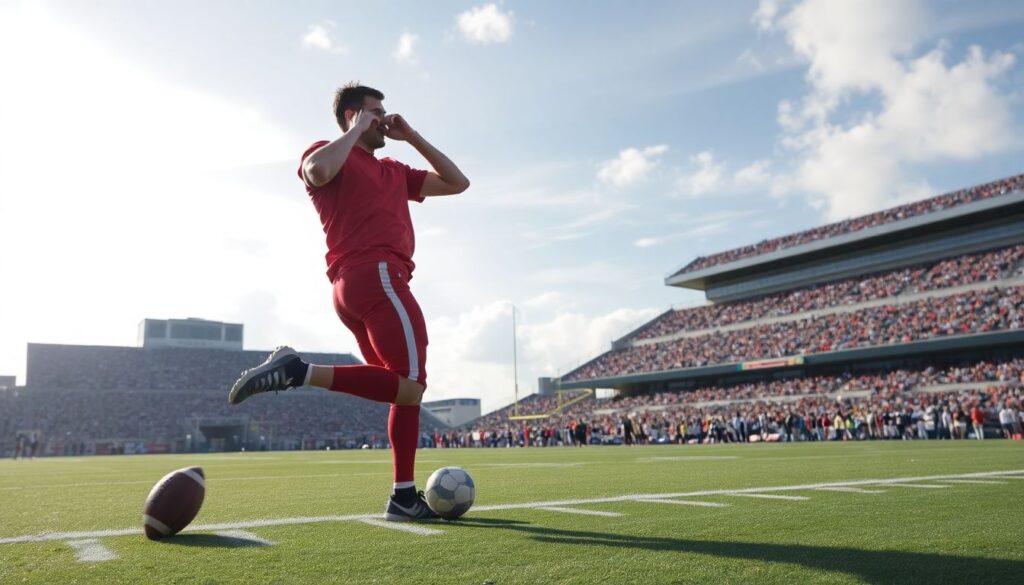
Environmental factors modify how good mechanics and physics play out in real games. Wind, turf hardness, and stadium layout all influence both the kick itself and how confident the kicker feels in their plant and swing. Learning to read and adapt to conditions is part of elite accuracy.
Scenario 1 – Crosswind in an open stadium: During warmups, you notice the ball drifting right on end-over-end kicks. For game kicks, you intentionally start the ball just inside the left upright, using your usual swing but aiming as if the uprights were slightly shifted.
Scenario 2 – Soft turf and unstable plant: On a rainy field, your plant foot sinks deeper than in practice. You shorten your approach by half a step and reduce swing speed slightly to stay balanced, trading a little distance for better contact and accuracy.
Scenario 3 – Tight indoor stadium with no wind: Indoors, air is still and footing is predictable. You can trust your maximum-range swing and focus on micro-consistency: exact plant spot, repeatable tempo, and ball strike.
Advantages of Understanding Environment
- Improves pre-game planning of realistic range in each direction on the field.
- Reduces surprise: you have a clear plan for wind, rain, or turf softness before critical kicks.
- Boosts confidence by turning “bad conditions” into known adjustments instead of excuses.
- Helps coaches call smarter plays, knowing how conditions affect your effective distance.
Limitations and Challenges of Environmental Factors
- Conditions can change within a game (wind shifts between quarters), demanding constant reassessment.
- Limited practice access to certain stadiums or climates makes real-time adaptation harder.
- Amateur fields may be inconsistent week to week, making it harder to form stable expectations.
- Without video or note-taking, it is easy to misremember how past kicks behaved in similar conditions.
Low-resource adaptation tip: Keep a simple notebook or phone log about wind, turf, and results each time you kick on a field. Over time you will build your own environmental playbook, even without fancy tracking tools.
Practice Design: Drills That Replicate Game Conditions
Elite accuracy relies on practice design that mirrors game timing, pressure, and decision-making. Doing casual, slow, perfect holds in ideal conditions builds comfort but not game reliability. Drills should include realistic operations, misses, and consequences so the nervous system learns exactly what Sundays feel like.
- Myth: More distance before accuracy. Chasing personal-best distance first often ruins mechanics. Start with accurate 25-35 yard kicks, then gradually stretch range while preserving your technique and timing.
- Myth: Volume alone creates consistency. Hundreds of unfocused kicks build random habits. Fewer, deliberate reps with clear cues and feedback create a stable motor pattern faster.
- Error: Ignoring snap-hold operations. Practicing off a block or stick forever means your first real snap-hold will be a shock. At least some reps every week should be with a live or simulated holder.
- Error: No pressure simulation. Without time limits or consequences, players may look great in warmups but struggle in games. Add countdowns, sprints before the kick, or score penalties in drills.
- Myth: You must attend expensive camps to improve. While field goal kicking camps for adults can help, you can also build a structured plan with a teammate holding, phone video, and online breakdowns if budget is tight.
Simple structure template: 10 warmup swings (no ball) → 10 short kicks focusing on plant spot → 10 game-speed kicks with snap timing → 5 competition kicks with consequences (for example, sprint for each miss). Repeat this twice a week as a basic nfl kicking training program at almost any field.
Performance Analytics: Using Data to Predict and Improve Accuracy
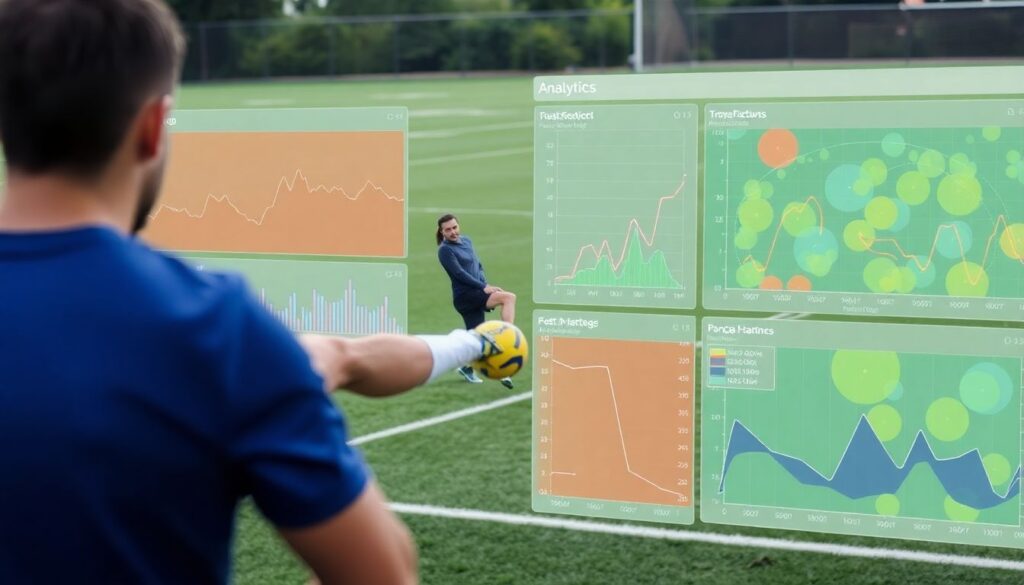
Performance analytics for kicking means turning every rep into information: where you aimed, where you missed, timing, and conditions. Even basic tracking with pen and paper quickly reveals patterns that are invisible in memory, such as a consistent miss side or distance where mechanics start to break down.
Mini-case: Over four weeks, a kicker logs every attempt by distance and result. Reviewing the chart, they notice most right-side misses happen beyond 45 yards. Video confirms that on longer kicks they overstride the plant foot, pulling the ball right. The training plan then adds focused 40-50 yard sessions emphasizing plant control.
Simple pseudo-workflow for self-tracking:
for each kicking session:
    record distance, hash (L/M/R), result (L, R, short, good)
    note wind (none / slight / strong) and surface (grass / turf)
end

analyze weekly:
    find distance where miss rate increases
    check if misses cluster left or right
    pick 1 mechanical focus and 1 drill for next week
No-tech alternative: Draw a simple field diagram after each session and mark make/miss spots with a pen. Even without spreadsheets or apps, repeated diagrams show where to target your next block of practice.
If you cannot find the best football kicking coach near me locally, consider combining remote video feedback with an online course to become nfl kicker, plus periodic in-person tune-ups or short camps when possible. Use structured logs to make those limited coaching sessions much more productive.
Practical Concerns Coaches and Kickers Ask Most
How can I improve accuracy if I only have a few hours and a basic field each week?
Prioritize a short, repeatable routine and 25-35 yard kicks from all hashes. Track every rep and focus on consistent plant-foot location and ball contact. Quality, filmed sessions once or twice a week beat random daily kicks without feedback.
Do I really need specialized shoes and balls to get better?
Professional football kicking shoes and brand-new balls help at the margins but are not prerequisites. Use the firmest, best-fitting boots you own and a ball in decent condition, then focus on consistent mechanics. Upgrade gear once your technique is stable.
Are paid camps and private coaches necessary to reach a high level?
High-level coaching accelerates progress, and targeted field goal kicking camps for adults can refine technique. However, many athletes can reach a strong intermediate level using video analysis, structured practice, and occasional clinics instead of weekly private sessions.
How many kicks should I take in a typical practice session?
A rough guideline is to stop before fatigue changes your form. Organize practice into small sets (for example, 8-12 focused attempts) with rest and evaluation between sets, rather than chasing a big total number of kicks.
What should I look for when choosing a coach or program?
Whether searching for the best football kicking coach near me or an online course to become nfl kicker, look for clear technical language, use of video, individualized feedback, and an organized progression instead of one-size-fits-all tips.
How can coaches integrate kickers into team practice without wasting time?
Schedule blocks that align with team periods: warmup and technical work early, live operation kicks during special-teams segments, then limited situational kicks at the end. Provide quick feedback and avoid turning every team period into a max-distance showcase.
What is the simplest data point to start tracking for improvement?
Begin with distance, hash, and result (left, right, short, good). After a few weeks, patterns emerge that point to specific technical issues. Add video only once this basic charting habit is consistent.