
Analytics are reshaping football game planning by turning film, tracking, and scouting data into specific calls: what to run, when, and with whom. For both college and NFL staffs, the impact comes from a clear workflow: centralize data, standardize reports, link insights to play-calls, test on small packages, then scale what works.
Analytics at a Glance for Coaches
- Start small: one or two high-impact questions (fourth-down, early-down run-pass, personnel matchups).
- Use football analytics software for coaches that integrates video, tracking, and scouting in one place.
- Translate numbers into simple rules your staff can remember on the sideline.
- Test new ideas in low-risk situations, then expand once you see on-field confirmation.
- Document every analytic rule in game-plan cutups and call sheet tags.
- Review postgame: what analytics were used, ignored, or contradicted and why.
- Continuously refine thresholds as your roster and opponents evolve.
From Wearables to Play-by-Play: Data Sources for Football Analytics
Problem: Many staffs collect tons of data but do not know which sources are worth the effort for game planning. The goal is to pick a minimal, reliable set and avoid overload.
In both college and the NFL, focus on data that directly supports opponent scouting, self-scout, and player availability decisions. These sources are usually worth integrating:
- Play-by-play and charting data
- Down, distance, field position, time, score, personnel, formation, motion, result.
- Use to build call-tendency tables and situational efficiency metrics.
- Video-linked event data
- Tag every play with concepts and coverage fronts, then link clips to each analytic rule.
- Critical for teaching staff and players the “why” behind numbers.
- Player tracking and GPS/wearables
- Speed, acceleration, workloads, distance, high-speed running counts.
- Translates into snap-count guidance and practice intensity management.
- Scouting and practice data
- Win-loss on one-on-ones, blitz pick-up, contested catches, pressure rate in team periods.
- Helps define matchups to attack or protect in the game plan.
- Depth chart and medical status
- Limits for snaps, special packages that key off specific players, injury flags.
- Feeds into risk-controlled personnel decisions.
Teams without in-house infrastructure often lean on a college football data analytics platform or broader sports analytics solutions for football teams that bundle play-by-play, video, and basic models in a managed environment.
There are also moments when you should not expand data collection:
- If coaches already struggle to review the core game plan by deadline.
- If data is not trusted (inconsistent tagging, missing plays, or late delivery).
- If you cannot connect a dataset to a specific decision (call, matchup, personnel, or practice design).
Turning Raw Feeds into Playable Insights: Processing, Models and Validation
Problem: Raw stats and exports do not help on their own. The staff needs simple metrics, clear rules, and proven reliability before analytics influence calls.
At minimum, you will need:
- Data infrastructure
- Central storage (database, spreadsheets, or a college football data analytics platform).
- Access rules so position coaches and analysts share the same single source of truth.
- Software and tooling
- Video and tagging system (for example, integrated with football analytics software for coaches).
- Basic analysis environment: spreadsheets, Python/R, or built-in reporting.
- Player performance analytics software for football to connect workloads and game metrics.
- Standard data model
- Shared definitions for formations, coverages, fronts, and concepts.
- Consistent opponent and self-scout tagging rules.
- Validation routine
- Weekly checks for missing data or illogical values (e.g., negative distances where impossible).
- Coach sign-off on new reports before they influence calls.
Simple processing templates can live in spreadsheets or scripts. For example, to rank an opponent’s tendencies by situation:
// Pseudocode: opponent tendency by down and distance
for each down in {1, 2, 3, 4}:
  for each distance_band in {short, medium, long}:
    plays = filter(all_plays, down == down and distance_band == distance_band)
    run_pct = count(plays where play_type == "run") / count(plays)
    pass_pct = 1 - run_pct
    store_tendency(down, distance_band, run_pct, pass_pct)
Another example, to flag explosive matchups you should feature in the plan:
// Pseudocode: identify favorable WR vs CB matchups
for each wr in our_receivers:
  for each cb in opponent_corners:
    targets = filter(all_plays, wr_on_cb(wr, cb))
    if count(targets) >= min_sample:
      success_rate = count(targets where result == "success") / count(targets)
      if success_rate >= success_threshold:
        mark_as_featured_matchup(wr, cb)
Before using any model or rule in nfl game planning analytics tools or internal dashboards, test it on past games:
compare what it would have recommended vs what you actually called and see whether its decisions correlate with better outcomes.
Tactical Applications: How Analytics Shape College and NFL Game Plans
Problem: Coaches need a repeatable process to turn opponent and self-scout data into specific calls, packages, and in-game adjustments.
- Define 3-5 core game-plan questions. Examples: how aggressive to be on fourth down, which concepts beat their top coverage, and how to manage tempo. Write them explicitly and make every report tie back to at least one question.
- Build situation and tendency reports. Use your sports analytics solutions for football teams to summarize opponent calls by down, distance, formation, motion, and field zone.
- List “favorite” calls in each key situation (3rd-and-medium, red zone, 2-minute, backed-up).
- Flag situations with no clear tendency, where you rely more on sound base calls than guesses.
- Translate numbers into simple sideline rules. For each opponent tendency, define one or two plain-language rules that can be printed on the call sheet.
- Example defense rule: “On 3rd-and-4 to 6 in field zone +40 to +25, expect trips and quick game — favor match coverage and simulated pressure.”
- Example offense rule: “On 1st-and-10 after explosive gain, defense leans single-high — call shot concepts from 12 personnel.”
- Design call sheet and scripts around analytic rules. Group calls directly under the rules they support rather than by broad concept labels only.
- Mark “analytics-backed” calls with a symbol so you can track usage in real time.
- Include corresponding cutup IDs so coaches can quickly revisit teaching clips during the week.
- Integrate player-specific recommendations. Use player performance analytics software for football to decide snap counts, rotations, and matchup hunting.
- Tag plays where a certain player’s strengths are maximized (speed in space, jump-ball ability, blitz versatility).
- Tie personnel packages to predicted stamina and injury-risk zones.
- Plan in-game decision support. Define what analytics will be live on game day (e.g., fourth-down chart, two-point chart, run-pass box count feedback).
- Assign one coach or analyst to own each in-game tool, ensuring communication is concise and timely.
- Rehearse communication in practice (for example, mock late-game scenarios with real-time analytics calls).
- Run postgame review and feedback loop. After the game, log which analytic rules were followed or overridden and with what results.
- Update thresholds and remove rules that consistently mislead or add confusion.
- Feed lessons into next week’s game-plan templates.
Быстрый режим: condensed process for busy weeks
- Pick two questions only (for example, fourth-down aggression and main coverage beaters).
- Run a single opponent tendency report for 3rd downs and red zone.
- Write three plain rules per side of the ball and attach 3-5 cutups to each.
- Highlight analytics-backed calls on the sheet; track whether you used them.
- Postgame, decide if each rule stays, changes, or gets deleted.
Integrating Analytics into Coaching Workflows and Communication
Problem: Analytics fail when they live only in slides or dashboards instead of daily coaching habits. Use this checklist to confirm that insights are embedded in your workflow.
- Every analytic report is tied to a specific decision (call, personnel, practice emphasis, or schedule).
- Call sheets visibly reference the key analytic rules and situations (not just raw stats).
- Position coaches can explain each major rule to their room in clear football language.
- Cutups exist for every rule, with examples of both successful and failed executions.
- Game-week meetings include five minutes to walk through analytic priorities.
- On game day, one coach or analyst is designated to communicate each tool’s output.
- After games, staff reviews where analytics were followed, missed, or overruled and why.
- Off-season self-scout includes checking whether your own tendencies are being effectively countered.
- New ideas are tested in controlled environments first (preseason, early downs, or specific packages).
- Analytics tasks are sized to staff bandwidth; no one is building reports that coaches do not read.
Concrete Cases and High-Impact Metrics to Track
Problem: With endless possible stats, staffs often track too much that does not move wins. Focus on a small set of metrics and avoid these common mistakes.
- Tracking raw yards instead of situational efficiency (success on key downs and in key zones).
- Ignoring sample size and overreacting to a handful of plays or one opponent tendency.
- Using generic league averages without adjusting for your roster, scheme, or opponent style.
- Failing to link metrics to specific calls; numbers stay abstract and unused during games.
- Overfitting play designs to last week’s opponent instead of building robust, repeatable answers.
- Confusing athletic testing metrics with on-field performance under game conditions.
- Not tracking communication delays; great insights arrive too late to influence the call.
- Ignoring special teams analytics, which often yield leverage on field position and hidden yards.
- Neglecting injury and workload data when planning tempo and snap counts.
- Assuming that more dashboards are better instead of curating one simple weekly packet.
High-impact examples that typically deserve a place in your core packet:
- Early-down success rate for your top three concepts versus the opponent’s base fronts and coverages.
- Third-down conversion rate by route depth or pressure type (for offense and defense respectively).
- Explosive play rate allowed or created from each personnel grouping and formation family.
- Red-zone touchdown rate by run-pass mix and motion usage.
- Pressure rate, time to throw, and scramble outcomes for your quarterback and opponent quarterbacks.
- Special teams starting field position by kick direction, hang time, and return alignment.
Limitations, Biases and NCAA/NFL Regulatory Constraints
Problem: Analytics exist within rules, technology limits, and human bias. Coaches must understand when to adjust expectations or use alternative approaches.
- Alternative 1: Film-first, data-light workflow. When staff or budget is limited, prioritize rigorous film study and manual charting of 3-4 critical opponent tendencies. Use simple spreadsheets instead of full nfl game planning analytics tools and keep rules very narrow.
- Alternative 2: Outsourced analytics services. If you lack in-house analysts, contract a provider whose sports analytics solutions for football teams deliver weekly opponent reports and self-scout with clear coaching notes, while you own final interpretation.
- Alternative 3: Developmental focus over aggressive optimization. In some college settings, roster development and academic balance may limit aggressive game-by-game optimization. Use analytics mainly to protect players, manage workloads, and focus practice on teachable concepts.
- Alternative 4: Compliance-driven constraints. NCAA rules, team policies, and CBA-like agreements can restrict data collection (e.g., certain wearables or in-helmet tech). When technology is limited, emphasize standardized manual tagging that still supports core game-plan decisions.
Always coordinate with compliance staff and league or conference guidance before adopting new tracking hardware or software platforms, especially any college football data analytics platform that integrates athlete biometrics or academic data.
Common Implementation Questions Coaches Ask
How many analytics questions should we focus on each week?
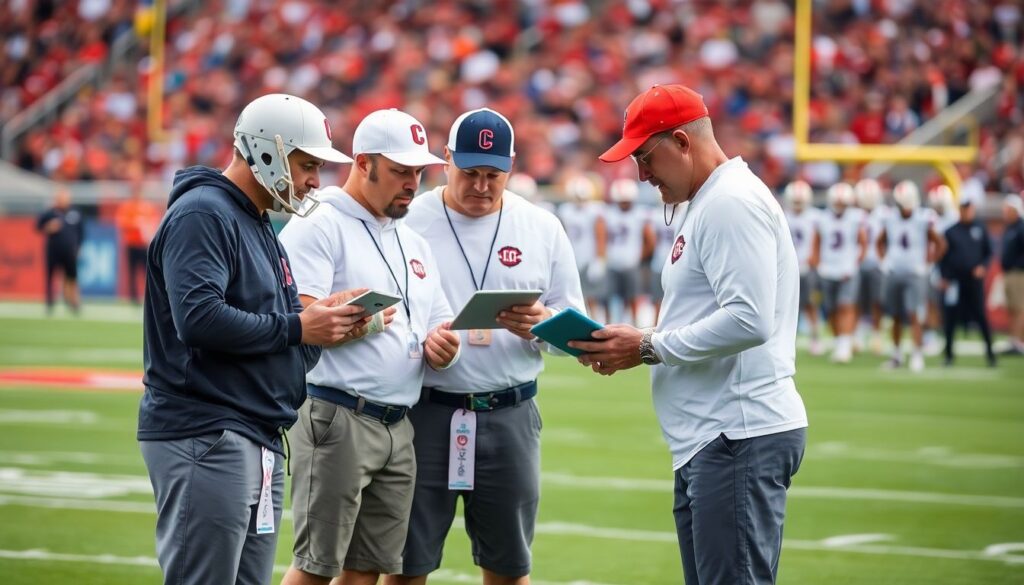
Limit yourself to three to five core questions that directly affect calls, such as fourth-down strategy, coverage beaters, or pressure plans. Too many questions dilute focus and reduce the chance that analytics actually show up on game day.
Do we need a full-time analyst to benefit from analytics?
No, but you need clear ownership. One coach can handle basic reports if you standardize templates and restrict scope. As workload grows, a dedicated analyst or an external service becomes valuable to maintain quality and timeliness.
How do we choose between different analytics tools and platforms?
Prioritize tools that integrate video, tagging, and reporting over standalone stats. Evaluate whether a platform answers your specific coaching questions, fits your staff’s technical comfort, and can export data cleanly if you later change providers.
What is the safest way to start using analytics in game decisions?
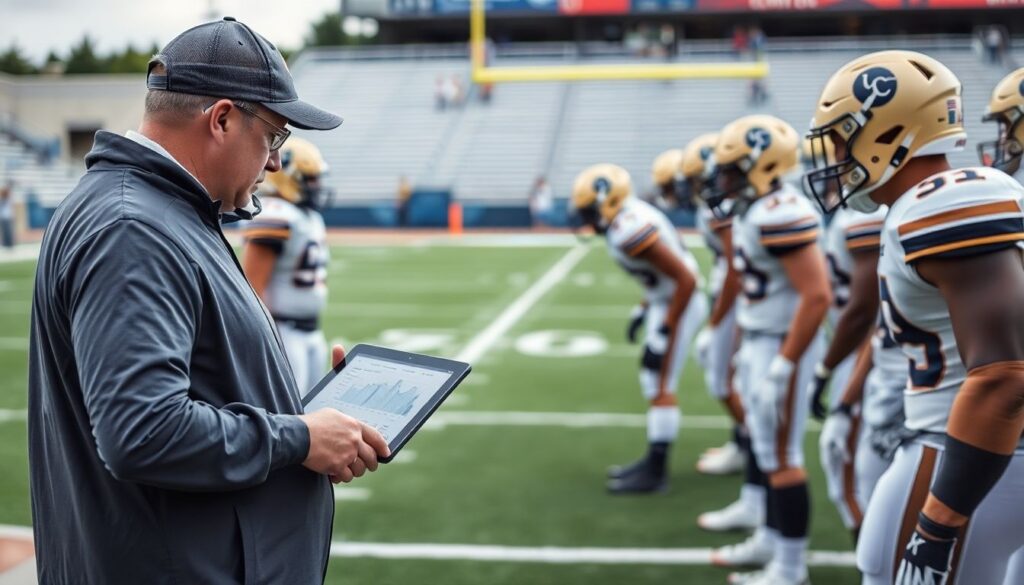
Begin with low-risk situations, such as first-half fourth-down calls around midfield or red-zone play selection inside the 10. Track outcomes, refine thresholds, and only then extend analytics guidance to higher-leverage decisions.
How should we handle disagreements between analytics and coaching intuition?
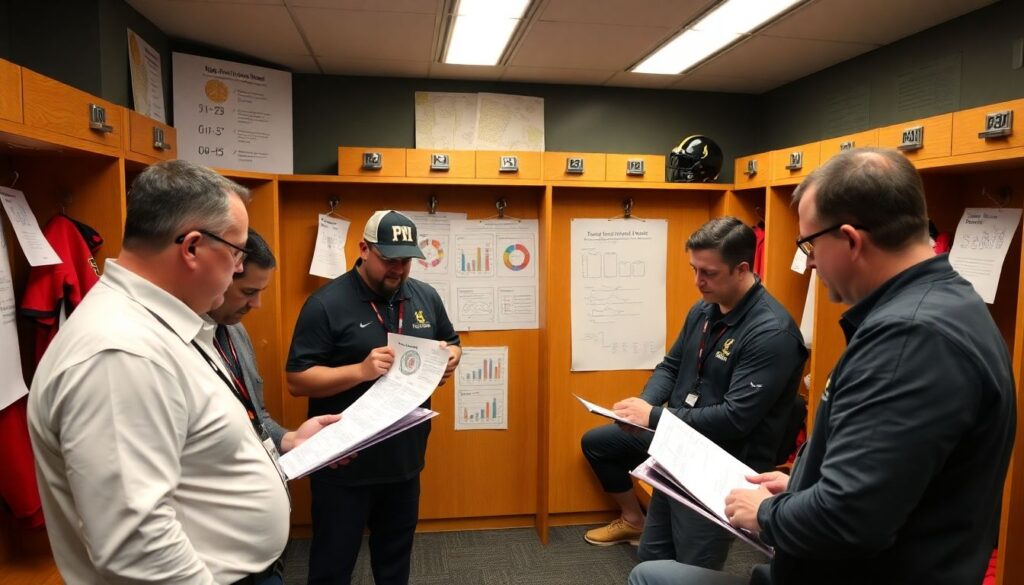
Treat disagreements as learning opportunities. Log the situation, the analytic recommendation, and the coach’s choice. Review postgame and off-season to see which side performs better over time, then adjust rules, models, or your tolerance for risk.
Can analytics help with player development, not just game plans?
Yes. Use workload data and performance metrics to set individualized goals, monitor progress, and tailor practice reps. Analytics can highlight specific skills or situations where a player needs focused coaching or different usage.
How do we prevent players from feeling reduced to numbers?
Keep analytics as a tool for better preparation, not judgment. Share insights in football language, emphasize how data helps showcase their strengths, and invite player feedback when analytic rules appear to conflict with on-field experience.
| Aspect | College Programs | NFL Teams |
|---|---|---|
| Typical data volume | Varies widely; may rely more on external college football data analytics platforms. | Generally larger tracking, medical, and scouting datasets across multiple seasons. |
| Staffing and roles | Often one coordinator or GA splitting time between coaching and analytics. | Dedicated analytics staff plus coordinators; deeper specialization and tooling. |
| Technology constraints | NCAA and institutional policies can limit wearables and in-game tech. | League rules guide on-field tech; broader use of tracking and nfl game planning analytics tools. |
| Primary objectives | Mix of winning, development, and recruiting impact. | Win optimization and roster value management are primary drivers. |
| Vendor relationships | Heavier use of bundled sports analytics solutions for football teams for efficiency. | More in-house models integrated with external data providers and custom software. |