
Why in‑game decisions will never be the same
For years, most coaching decisions during games rested on “gut feel”, experience and a quick glance at the scoreboard.
Now the game has changed. Literally.
From high schools to pro leagues, coaches are running a quiet revolution: they’re letting numbers, live tracking and smart tools guide what happens on the field or court, play by play. Not replace their intuition — sharpen it.
Let’s break down how this works in practice, what tools actually help, and where to start if you don’t have a data department sitting behind the bench.
—
From gut feelings to measurable edges
What “analytics” really means for a coach during a game
Analytics in games isn’t about drowning in spreadsheets. It’s about answering a few brutally concrete questions faster and more accurately:
– Who is playing well enough to stay in — and who is quietly dragging the team down?
– Which plays work right now, against this opponent, with this lineup?
– When do we push the tempo, and when do we slow the game down?
– Where are we actually losing points or yards: shots, turnovers, penalties, bad matchups?
An effective in-game decision making analytics system does three things:
1. Collects live data (events, tracking, basic stats).
2. Translates it to simple, visual signals.
3. Fits into your coaching routine without chaos.
If any “analytics” tool fails on point 3, it’s just noise.
—
Case #1: High school basketball team that stopped guessing matchups
A mid-level high school program in the US used to rely on one assistant to “feel” which lineup worked best. Some nights it clicked. Others, they were down 12 before realizing they had the wrong five on the court.
They adopted a lightweight basketball analytics platform for teams that showed:
– Plus/minus per lineup in real time
– Shot chart by player and zone
– Rebounding and turnover differential by lineup
Outcome over one season:
– They discovered their “energy” bench player created the most positive point differential when paired with the starting point guard, not with the second unit.
– In tight games, the head coach stopped guessing and simply checked which 5-man group had the best net rating that night — and used that lineup for key defensive possessions.
– Record in games decided by 6 points or less improved from 3–7 to 8–4.
Nothing magical. Just more clarity, faster.
—
Key metrics that actually matter in real time
Don’t track everything — track what changes your decisions
The biggest trap: collecting more data than you can process while the clock is running. Start small.
For basketball coaches
Focus on metrics that directly affect substitutions, play calls and tempo:
– Lineup net rating (points scored vs allowed per lineup)
– Shot quality (open vs contested, location, early vs late clock)
– Turnovers by type (live-ball vs dead-ball)
– Rebounding margin while specific players are in
With the right sports analytics software for coaches, these are surfaced as:
– Simple green/red indicators for each lineup
– Live shot charts that show “hot” and “cold” zones
– Alerts when turnover sources spike (e.g., vs full-court press)
For football (soccer & American football) coaches
Again, stick to what you can actually use during the game:
– Expected goals / quality chances vs actual shots
– Where possessions are won or lost (zones, flanks)
– Pressure success rate when pressing high
– Run/pass balance (for American football) by down and distance
– Matchup success: which defender is getting targeted and beaten
The best football data analysis tools for coaches convert this to:
– Heatmaps that highlight exploited spaces
– Notifications like “Right flank conceded 4 entries in last 10 minutes”
– Recommendations to adjust pressing height or coverage focus
If the tool isn’t turning raw numbers into obvious coaching decisions, it’s the wrong tool.
—
From dashboards to decisions: how to actually use analytics mid-game
1. Decide who looks at the data — and who doesn’t
A common mistake is expecting the head coach to stare at a tablet and the field at the same time.
Create a simple chain:
1. One staff member (or analyst) monitors the system.
2. They filter noise and report only actionable insights.
3. The head coach hears short, decision-focused cues, not stats.
Example callouts:
– “Our small-ball lineup is +9 in 5 minutes — we can go back to it now.”
– “They scored 3 times attacking our left side; suggest deeper fullback.”
– “Our press just forced 4 turnovers in 6 possessions; stay aggressive.”
2. Translate analytics into pre-defined triggers
Before the season, define what certain numbers will mean in terms of decisions.
For example:
– If defensive rebound rate drops below 65% → stronger rebounder in, reduce transition risk.
– If opponent scores twice in a row from the same set play → immediate timeout + adjustment.
– If shot quality falls below a set threshold over 8–10 possessions → change play-calls to generate easier looks.
This way, analytics don’t argue with intuition; they activate plans you made in advance.
—
Case #2: College football team that stopped panicking on 4th down
A mid-tier college American football team was notoriously conservative on 4th-and-short. They installed one of the best football data analysis tools for coaches that integrated with live down-and-distance, field position and opponent tendencies.
What changed:
– Before the season, staff defined a 4th-down “go chart” informed by analytics.
– During games, the system instantly showed “Go” or “Punt/FG” based on win-probability impact, not just yardage.
– On the sideline, the headset call was: “Chart says go — +4% win prob”, instead of a vague “We should probably go for it.”
Result over two seasons:
– 4th-and-short attempts increased by ~35%.
– Offensive staff built specific “4th-and-2” packages, making the team more prepared and less emotional under pressure.
– They stole two key wins where aggressive, analytics-guided decisions turned the tide late in the game.
—
Player performance: more than points, yards and goals
Why real-time tracking beats “eye test only”
Even elite coaches misjudge individual performance when emotions are high:
– A player hits two big shots, and we ignore their 5 defensive lapses.
– A striker misses a sitter, and we bench them despite great off-ball work.
– A defender looks “tired”, but tracking data says otherwise.
Modern athlete performance tracking and analytics solutions fill these gaps by measuring:
– Distance and intensity (sprint repeats, high-speed efforts)
– Involvement in key events (pressure, contests, duels)
– Effect on team outcomes (plus/minus, expected goals impact, drive success rate)
The goal isn’t to micromanage players. It’s to avoid costly misreads in the 60th, 70th, 80th minute.
—
Case #3: Pro basketball club that stopped benching the wrong guy
A European pro basketball team signed a forward known for “energy” and hustle. After a few games, the head coach felt he was invisible and considered cutting his minutes.
Their basketball analytics platform for teams showed something different:
– With him on the floor, defensive rating improved significantly.
– Opposing field goal percentage at the rim dropped.
– He set more on-ball and off-ball screens than any teammate, opening easier shots for others.
In-game adjustment:
– Instead of pulling him after a quiet offensive start, staff checked lineup net ratings and defensive impact.
– The coach kept him in during critical sequences, using him to guard the opponent’s main scorer and anchor defensive schemes.
Season outcome:
– The player’s scoring stayed modest, but the team’s defense climbed from bottom third to top third in the league.
– The coach started using the platform to identify other “invisible impact” players, changing rotation philosophy entirely.
—
Practical roadmap: how to bring analytics into your in-game routine
Step-by-step, without burning out your staff
Step 1: Define 3–5 key questions you want answered live
Examples:
– Which lineup should I close the game with?
– Where exactly are we losing the possession battle?
– Who is our best defender on their star today — not on paper, but tonight?
– Is our pace hurting us or helping us right now?
Everything you track should serve these questions.
Step 2: Choose tools that are narrow and sharp, not broad and vague
Start with:
– Simple, mobile-friendly sports analytics software for coaches that:
– Connects to your sport’s data feed (or allows quick tagging).
– Offers pre-built widgets for lineups, shot zones, or drive outcomes.
– Lets you build a “coach view” with only 4–5 tiles.
Avoid platforms that look impressive in demos but require a full-time analyst to operate under game pressure.
Step 3: Create game-day communication rules
Decide:
– Who sits with the device?
– How often they can interrupt you? (e.g. only during dead balls, timeouts, quarter breaks)
– What format they use:
– Never: “We’re 31.8% from three.”
– Always: “We’re fine from three; problem is turnovers on drives left. Suggest more pick-and-roll middle.”
Step 4: Rehearse analytics usage in scrimmages
Use practice games to:
1. Test what’s actually readable on-screen at a glance.
2. Train assistants to summarize insights in one short sentence.
3. Adjust which metrics really change your decisions — and which are interesting but irrelevant in the moment.
Step 5: Review post-game and tighten the loop
After the game:
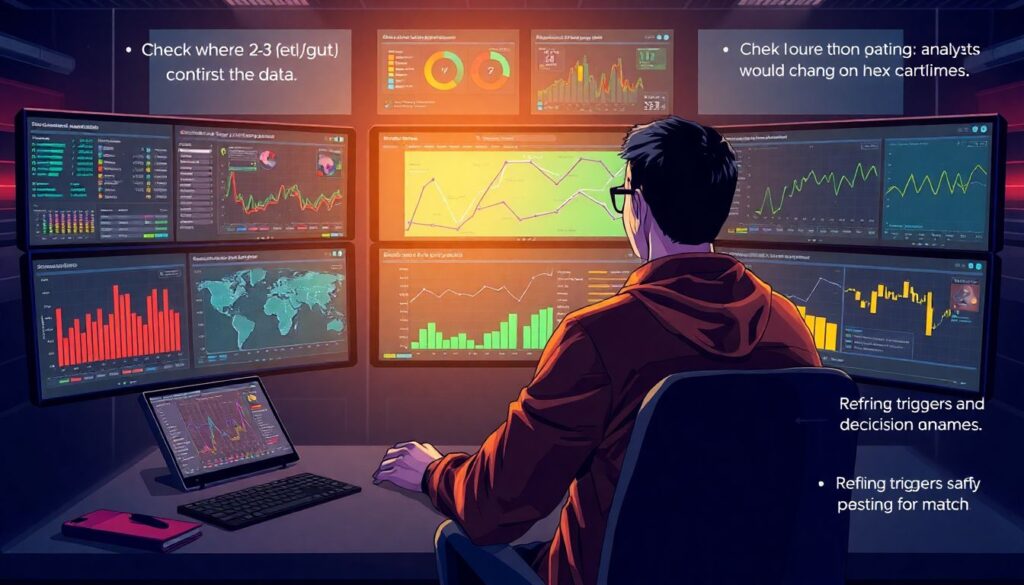
– Check where your gut contradicts the data.
– Mark 2–3 moments where listening to analytics would have changed the outcome.
– Refine your triggers and rules for the next match.
This is how your in-game decision making analytics system gets smarter each week — because it’s tuned to your style, not a generic model.
—
Common pitfalls (and how to dodge them)
Mistake 1: Treating analytics as a verdict, not a tool
Analytics don’t know:
– Which player is on the verge of emotional collapse.
– Who picked up a minor knock.
– How a referee is calling contact that night.
Use data as a strong suggestion, not a dictator. The best coaches ask:
“Given what I know and what the numbers say, what’s the highest-percentage move?”
Mistake 2: Chasing too many metrics too early
More numbers ≠ better decisions.
Start with:
1. One lineup impact metric.
2. One efficiency/shot quality metric.
3. One defensive or possession metric.
Add more only when you’re consistently using the first three.
Mistake 3: Ignoring player buy-in
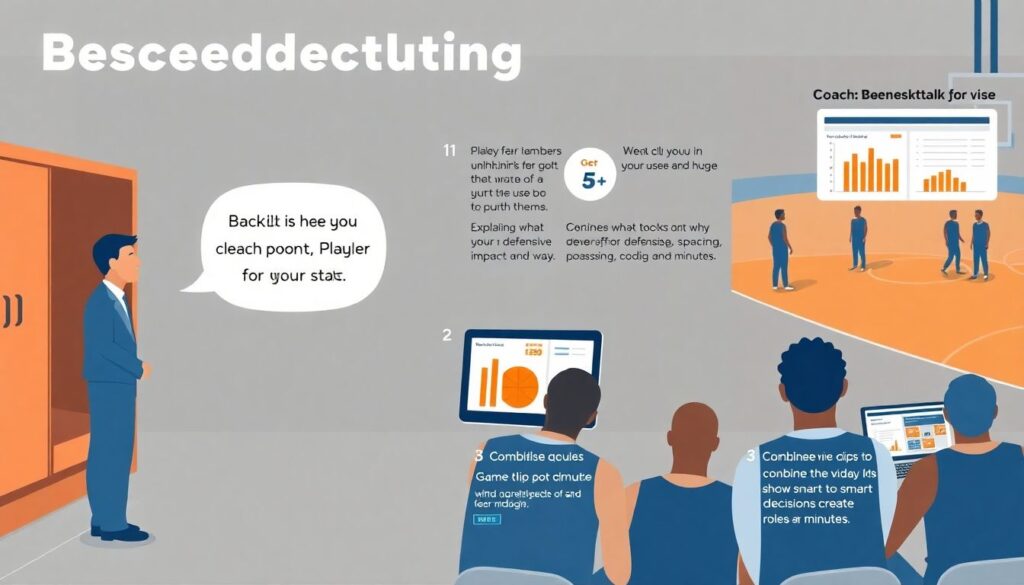
Players fear numbers when they think they’ll be used only to punish.
Counter this by:
– Sharing positive stories: “We kept you in because your defensive impact was huge.”
– Explaining what you track and why.
– Using clips plus data to show how smart decisions create roles and minutes.
—
How top coaches think about analytics now
It’s not about being “data-driven” — it’s about being less wrong
Elite coaches don’t brag about being ruled by stats. They quietly use analytics to:
– Cut out avoidable mistakes (wrong matchups, late subs, bad 4th-down choices).
– Focus their emotional energy on leadership, not on mental arithmetic.
– Turn chaotic, fast-moving games into a series of manageable, informed decisions.
In other words, the question isn’t:
“Should I trust analytics or my gut?”
It’s:
“How do I use analytics so that when I trust my gut, it’s based on clearer, sharper information?”
—
Where to start tomorrow
If you want analytics to redefine how you coach during games, not just after:
- Write down 3 in-game decisions you struggle with most (subs, tempo, matchups, 4th downs, etc.).
- Pick or configure tools that answer only those 3 questions in real time.
- Assign one staff member to filter the data and speak to you in one-line recommendations.
- Test it in a scrimmage and cut any metric that doesn’t affect your choices.
- After each game, refine your triggers so your system becomes truly your own.
Do that consistently, and over a season you’ll notice something subtle but powerful:
You’re calmer in tight moments, your decisions feel less like guesses, and your team starts winning the kinds of games it used to lose by a possession or a drive.
That’s how analytics quietly, steadily, redefine in-game decisions for coaches at every level — not with buzzwords, but with a few better choices, made at the right time.