Most fans can rattle off quarterback stats in seconds but struggle to name more than two linemen on their own team. Yet every explosive play, every clean pocket, usually traces back to some 310‑pound technician winning a rep in a three‑second fistfight. This spotlight is about those unsung offensive linemen who quietly dominate the trenches, rarely get on TV, and almost never trend on social media—unless they jump offside in the red zone. We’ll mix conversational breakdowns with some hard technical detail, real scouting notes, and advanced metrics, including offensive line player stats and grades from 2023–2024, to show why these guys should stop flying under the radar.
—
Why “Unsung” Linemen Matter More Than You Think
In modern offenses, protection rules and run schemes are built around the least reliable blocker, not the best. If your right guard constantly loses on inside moves, coordinators start chipping, sliding, and calling quick game to hide him, shrinking the playbook for everyone else. That’s why underrated NFL offensive linemen are secretly massive force multipliers: when your “worst” lineman is still solid, you can call deeper drops, slower‑developing play‑action, even those long-developing shot plays that fans love. League tracking shows that when a team keeps its starting five intact for at least 12 games, sack rates drop by roughly a full percentage point compared to units that constantly shuffle, and explosive pass plays tick up. Stability—and quiet competence—wins.
Even the best NFL offensive linemen 2024 can’t save an offense alone if the weak links are turnstiles.
—
How We’ll Judge Them (Without Getting Lost in the Weeds)
We’re not just going on vibes or highlight clips. When we talk about top offensive linemen rankings, the good lists blend film, context, and data: pressure rate allowed, penalties, run‑block win rate, and how often coaches put these guys on “islands” with no help. PFF grades, ESPN’s pass‑block and run‑block win rates, and coaching staff evaluations all matter, but they only make sense when you pair them with scheme and assignment. Allowing three pressures sounds ugly until you notice the lineman was left one‑on‑one against a top‑5 edge rusher in must‑pass situations all game.
That’s where real NFL offensive linemen scouting reports come in—combining numbers with what the tape actually shows.
—
Technical Focus: Key Metrics for Linemen
– Pass block win rate (PBWR): % of snaps where the OL holds his block for 2.5s+
– Run block win rate (RBWR): Ability to generate initial displacement or secure his gap
– Pressures / sacks allowed: Charted by player, not just by unit
– Penalties: Especially holds and false starts in high‑leverage downs
– Double‑team vs. solo rate: How often a lineman is trusted without help
These give a far better picture than just “sacks allowed by the line.”
—
Case Study 1: Jordan Mailata – From Rugby Project to Blindside Bulldozer
Jordan Mailata is one of the best “you’d never know it from TV” left tackles in football. While his teammate Lane Johnson gets deserved love, Mailata quietly locks down Jalen Hurts’ blind side. In 2023, Mailata allowed roughly one pressure per game over the second half of the season per PFF charting, while playing in a system that loves slow‑developing RPO and play‑action concepts. That means a lot of snaps where he has to sell run, then reset his anchor when a rusher converts from run fit to pass rush on the fly.
Mailata’s story adds to the mystique. He came into the league with no real football background, and now he’s regularly stonewalling NFL speed rushers using textbook vertical sets, independent hand usage, and a surprisingly consistent inside foot. Offensive line coaches rave about his ability to absorb power and re‑anchor without giving up the corner, a rare combo for a player his size. He might not head many top offensive linemen rankings yet, but line coaches around the league talk about him like a future perennial Pro Bowler.
—
Technical Breakdown: Why Mailata Wins
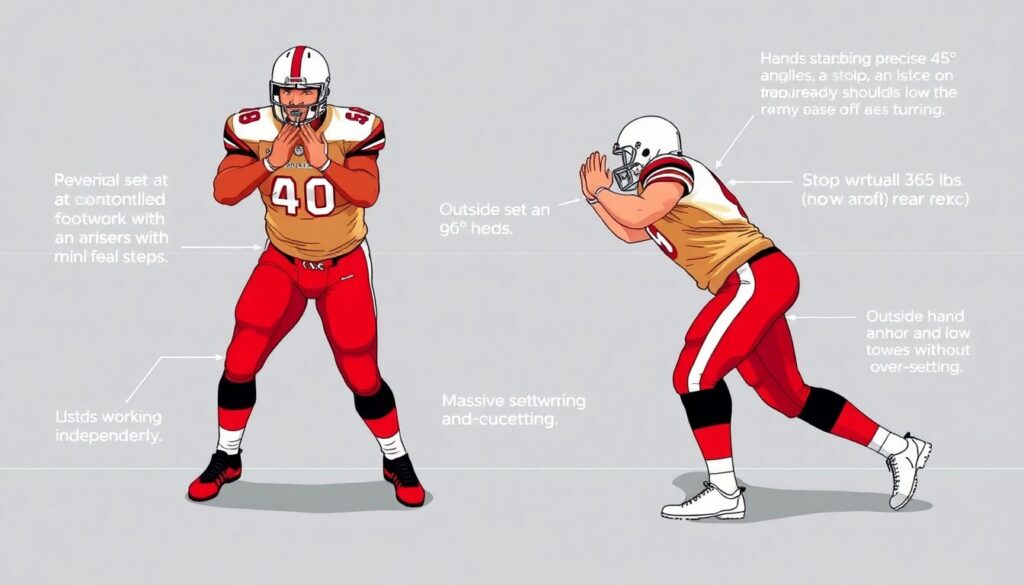
– Footwork: Smooth vertical set at 45° angles, minimal false steps
– Hands: Independent punches—he’ll stab with his inside hand to stop an inside counter, then replace with his outside without turning his shoulders
– Anchor: Can sit down vs. bull rushers at 6’8”, ~365 lbs without over‑setting
– Scheme fit: Ideal for wide‑zone and RPO; can reach 5‑techs and climb to backers with surprisingly clean angles
This is high‑end tackle play, just without the constant broadcast praise.
—
Case Study 2: Kevin Zeitler – The Metronome at Right Guard
Kevin Zeitler has been one of the league’s most reliable interior linemen for a decade, yet casual fans often can’t name him. In 2023 with the Ravens, he posted pass‑blocking grades in the top tier of guards while committing very few penalties and allowing minimal interior pressure, according to multiple analytic outlets. That’s not glamorous, but when you’re running a Lamar Jackson offense with heavy play‑action and deep drops, keeping the A‑gap clean is critical. One blown assignment inside and your QB is immediately off his spot.
Zeitler’s game is all about predictability. He doesn’t have the highlight‑reel pancakes of some maulers, but he rarely loses clean or off balance. Offensive line coaches love guys like this: they can design protections knowing the right guard will be in the correct spot with the correct leverage at the correct depth almost every snap. That lets coordinators slide help toward a less dependable tackle or an inexperienced center. Zeitler has quietly been the backbone of multiple offenses across different teams—Cincinnati, Cleveland, New York, Baltimore—proving his skill set translates regardless of scheme.
—
Technical Breakdown: Zeitler’s Interior Masterclass
– Sets on a 45°: Gains depth without oversetting, keeping the inside half protected
– Strike timing: Late, tight hands—he doesn’t show his punch early, which reduces swipe‑and‑rip wins for rushers
– Run game: Excellent on down blocks and combination blocks to the linebacker level
– IQ: Consistently passes off twists and interior games, which is why his offenses see fewer free runners up the gut
If you’re building a clinic cut‑up on “how to play guard in the NFL,” you’re using his film.
—
Case Study 3: Braden Smith – The Quiet Fortress at Right Tackle
Look at the Colts’ offense when Braden Smith is healthy versus when he’s out, and you see his value immediately. Sack rates climb, the run game efficiency on the right side nosedives, and coordinators start calling more quick game to hide replacement tackles. Smith entered the league as more of a mauling run blocker, but by 2022–2023 he was consistently posting strong pass‑blocking grades at tackle, with multiple seasons allowing fewer than 25 total pressures despite facing a heavy diet of premier edge rushers in the AFC South.
Smith embodies what makes certain underrated NFL offensive linemen so important: he lets you be multiple. The Colts can run wide zone, duo, pin‑pull, and gap schemes all behind him because he’s powerful enough to down block but nimble enough to reach a 9‑tech in outside zone. When Anthony Richardson or Gardner Minshew dropped back, the staff regularly trusted Smith on an island, sliding help away from him. That trust shows up in the film: lots of true one‑on‑one sets against top edges with very little cleanup pressure leaking from his side.
—
Technical Breakdown: Braden Smith’s Versatility
– Run game: Generates vertical displacement on double teams, excellent hip roll on contact
– Pass sets: Compact kick slide, doesn’t overextend—makes inside counters tough for rushers
– Hands: Heavy, accurate strikes; once he latches, rushers struggle to disengage
– Scheme usage: Frequently used as the “point of attack” blocker on critical 3rd‑and‑short and goal‑line runs
He’s a prototype for what a modern right tackle should look like in a balanced offense.
—
Case Study 4: Mitch Morse – The Center Who Makes Everyone Look Smarter
Centers rarely become household names unless something goes horribly wrong with the snap. Mitch Morse, during his run in Buffalo and beyond, has been the opposite: a calming force in the middle who quietly orchestrates protection schemes against some of the most complex fronts in football. Across several seasons, his pressure numbers have stayed impressively low for a center in a pass‑heavy offense, and Josh Allen’s best EPA per dropback stretches line up closely with periods when Morse was healthy and in sync with his guards.
What doesn’t show on a box score is how often Morse fixes problems pre‑snap. Watching Bills tape, you’ll regularly see him identify mugged‑up linebackers, change the protection point, and redirect the slide to pick up simulated pressures. Many NFL offensive linemen scouting reports emphasize that mental processing is as valuable as physical traits at center, and Morse grades off the charts there. The staff trusted him to handle exotic double A‑gap looks and delayed blitzes, freeing Allen to focus more on coverage than on counting bodies in the front.
—
Technical Breakdown: Morse’s Command of the Front
– Line calls: Handles Mike I.D., slides, and checks vs. late rotation safeties
– Reach ability: Can reach shaded noses in wide‑zone concepts, a premium trait for OC’s
– Anchor: Not the biggest center, but wins with leverage and quick hand resets
– Communication: Constantly re‑pointing and signaling, which is why free runners were rare in Buffalo’s interior protection
His impact is part physical, part mental, and completely under‑appreciated.
—
Case Study 5: Charles Leno Jr. – The Steady Blindside Shield
Charles Leno Jr. isn’t flashy, and that’s precisely why coaches love him. In Washington, while everything around the offense seemed to change—coordinators, quarterbacks, skill players—Leno quietly held down left tackle with solid‑to‑good play. Even on a struggling unit, he routinely posted respectable pass‑protection grades and kept his pressure and sack numbers modest relative to the chaos around him. That’s not easy when you’re often trailing, facing obvious passing downs, and defenders can tee off.
From a technique standpoint, Leno is a master of “good enough” wins. He doesn’t always stonewall rushers, but he consistently rides them past the pocket, giving his quarterback a workable platform. For offensive coaches, that half‑second can be the difference between a checkdown and a 20‑yard dig. His durability also matters: seasons of 16–17 starts give a unit continuity, and offensive line player stats and grades almost always improve when the same tackle plays every meaningful snap. For a franchise constantly in flux, Leno has been a rare constant.
—
Technical Breakdown: Leno’s Subtle Strengths
– Pocket awareness: Knows where the QB sets up and steers rushers accordingly
– Recovery: Even if he loses early, he has the balance to re‑fit his hands and widen the arc
– Run game: Solid on backside cutoffs, allowing more outside‑zone calls to his side
– Durability: High snap counts year after year, stabilizing a line that often rotates at other spots
That type of reliability is unsexy but incredibly valuable over a 17‑game season.
—
Why These Guys Stay Under the Radar
There’s a reason these names don’t dominate best NFL offensive linemen 2024 hype cycles. Linemen don’t accumulate fantasy points, their dominant snaps rarely make highlight reels, and many analytics packages still focus on skill‑position production. On top of that, protection is a five‑man (often six‑ or seven‑man) puzzle. A guard might look bad on TV giving up a late pressure, but the actual bust was from a back who missed his scan read or a tackle who failed to pass off a twist. Without nuanced film work, it’s easy for the wrong players to get blamed—or for the right ones to get ignored.
The other factor: when understated veterans like Zeitler or Morse do their job, the offense looks “normal.” Drives stay on schedule, 3rd‑and‑7 becomes 3rd‑and‑3, coordinators can call aggressive concepts. Fans give credit to the QB, OC, or wide receivers. But ask defensive coordinators which players they game‑plan around, and these names come up far more often than casual observers realize.
—
Spotting the Next Unsung Star
If you want to identify the next wave of quietly elite linemen, don’t just wait for top offensive linemen rankings to come out. Watch for teams whose sack numbers suddenly drop without a major quarterback change, or for offenses that start leaning heavily on one side of the line in short yardage and red zone. Check advanced metrics: guards and tackles who consistently post strong grades and win rates despite playing in pass‑heavy, long‑developing schemes are probably better than their name recognition suggests.
And above all, listen to how coaches and teammates talk about them. When a QB says, “I never worry about my blind side,” or a coordinator casually notes, “We can run left on anything,” that’s often code for, “We have a guy who’s quietly dominating.” Those are the players this spotlight is about—the ones who may never trend on Sunday, but who stack win after win in the trenches, and who make explosive offenses possible in the first place.
Комментарии