
Name, image and likeness money has gone from side topic to main storyline in college sports in just a few years. If you follow recruiting at all, you’ve probably noticed that every commitment tweet now has a quiet subtext: “What’s the NIL situation there?” By the mid‑2020s, you really can’t talk about the future of the sport without talking about NIL deals college football recruiting dynamics at the same time. Let’s walk through, step by step, how this new market actually works, where the real leverage points are, and what traps players and families keep falling into.
—
Step 1. Understand What NIL Really Is (And What It Isn’t)
Before jumping into offers and promises, it helps to strip NIL down to basics. Name, image and likeness rules let college athletes earn money from their personal brand: social media posts, autograph signings, local commercials, apparel collabs, even running their own camps. Importantly, schools still can’t directly pay athletes “salary” for on‑field performance under current NCAA rules; money has to be tied, at least on paper, to marketing value. That’s why you hear about college football NIL sponsorships rather than straight‑up contracts to “play for us.” The recruiting twist is that everyone knows NIL opportunities are a huge factor in choosing a school, even if coaches and boosters technically can’t promise a specific amount to sign.
Common early misunderstanding is thinking “NIL = free money for everyone.” In reality, NIL is a market. Big‑name quarterbacks at blue‑blood programs may see six‑figure packages, while a backup offensive lineman at a mid‑major might just get free meals and occasional small deals. For recruits and parents, the first task is accepting that NIL ranges from life‑changing to symbolic, depending on talent, position, program, and how you present yourself online. That mindset shift alone makes later decisions much more rational and less emotional.
—
Step 2. See How NIL Is Reshaping Recruiting Strategy

The old recruiting equation—playing time, coaching, facilities, academics, winning tradition—now has another big variable: earning potential while you’re still on campus. NIL collectives college football programs rely on have become shadow infrastructure, quietly as important as weight rooms or stadium upgrades. These collectives, usually run by donors and business people connected to a school, pool money and broker deals so athletes can, legally, “work” with brands or community initiatives. Recruits aren’t just asking “How many of your receivers got drafted?” but also “What kind of NIL ecosystem do your current receivers have?”
This shift has changed how staffs allocate time and resources. Some schools lean into data, showing recruits dashboards of average NIL outcomes by position or follower count, while others highlight local business partnerships or alumni networks. On the player side, high‑end recruits weigh short‑term NIL bags versus long‑term development: is it better to take slightly less money today but join a staff that consistently gets your position into the NFL? That tension—fast cash versus platform and coaching—sits at the heart of modern recruiting and is already reshaping which programs rise and which quietly fall back toward the pack.
—
Step 3. Follow the Money: From Local Deals to Structured Ecosystems
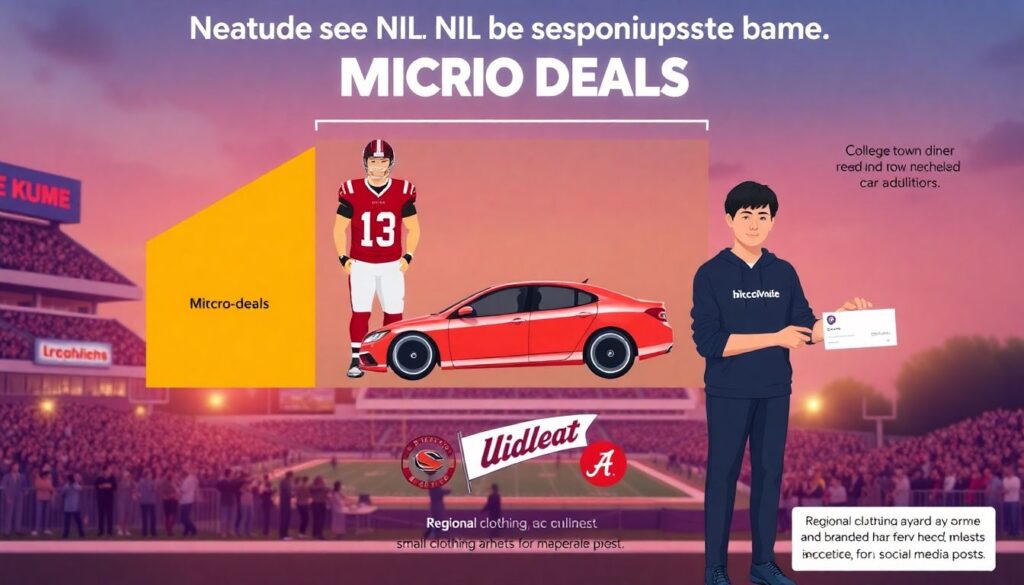
To see how college football NIL sponsorships operate in the wild, picture three layers. At the bottom are micro‑deals: local restaurants giving free food, a car dealership lending vehicles, a regional clothing brand paying a few hundred dollars for posts. These are most common and often tied to local fan favorites. In the middle sits structured collective‑driven opportunities: appearances at charity events, content shoots with sponsor logos, standardized “rosters” where players get a monthly payment for doing a minimum amount of promotional work. At the top are individualized brand partnerships—national campaigns with shoe companies, tech brands, trading cards, or big‑name apparel—usually reserved for stars with real national visibility.
For recruits, it’s important to understand that most NIL money currently flows through collectives and institutional ecosystems, not just random DMs from brands. That means choosing a school often means choosing an existing NIL infrastructure, with its own rules and culture about who gets what and why. Some programs emphasize broad distribution—more players getting something, even if it’s modest—while others prioritize “marquee” names. Knowing which model matches your expectations can prevent a lot of frustration once you’re actually on campus and see who’s on the billboards and who isn’t.
—
Step 4. Build Your Personal Brand Before You Sign Anywhere
If you’re wondering how to get NIL deals college football recruits actually benefit from, the work starts long before you put on a college jersey. In the NIL era, your social media and public persona are part of your scouting report. Coaches and collectives scan your Instagram, TikTok and X profiles not just for red flags but for potential: Are you comfortable on camera? Do you tell your story well? Do you show consistent training and game clips? Brands and boosters want athletes who can move the needle, not just on the field but on timelines.
Practical things recruits can do in high school to get ahead: post consistent, quality content that shows both your game and your personality; clean up anything that looks immature, offensive or wildly unprofessional; and learn at least basic creator skills—how to frame a shot, how to speak naturally to camera, how to write a decent caption. None of this has to feel fake; the goal is to present an authentic version of yourself that’s still brand‑safe. By 18, the gap between athletes who’ve thought about this and those who haven’t can literally be worth tens of thousands of dollars in NIL opportunities.
– Simple brand‑building habits for high‑school players:
– Post game clips and training sessions with short, clear captions adding context.
– Engage respectfully with fans, teammates and even rivals; avoid online arguments.
– Highlight community work, leadership roles and off‑field interests that sponsors might love.
—
Step 5. Navigating Offers, Promises and Red Flags
Once NIL enters the chat, the recruitment process can get blurry very fast. You might hear vague assurances like “Our collective really takes care of our guys” or very specific numbers thrown around unofficially. Remember that, under current rules, schools are limited in what they can formally promise, so a lot of what you hear rests in a gray area involving third parties and “projections.” This is where young athletes and families are especially vulnerable to being misled by overly aggressive reps or boosters. Verbal NIL “offers” that aren’t on paper, with clear deliverables and timelines, should always be treated as speculative.
Common warning signs include pressure to commit quickly “before the money runs out,” requests to sign confusing documents you don’t fully understand, or adults insisting you don’t need to tell your parents, high‑school coach, or a lawyer what’s going on. If someone can’t explain the basic who/what/when/how of a proposed deal in plain language, they either don’t understand it themselves or are hoping you won’t ask questions. In both situations, the safest move is to slow down, get trusted adults involved, and remember that walking away from a sketchy arrangement is usually better than being locked into a bad one that might even threaten your eligibility.
—
Step 6. Agents, Advisors and the Role of NIL Agencies

The rise of serious money has naturally drawn in agents and consultants. The best NIL agencies for college athletes combine three skills: understanding NCAA and state rules, negotiating with brands and collectives, and long‑term career planning that connects college visibility to potential pro contracts. Not every player needs a full‑service agency—many will be fine with school‑provided education resources and small, straightforward deals—but high‑profile recruits should assume professionals on the other side of the table know what they’re doing financially and legally. Bringing your own expertise to the conversation helps level the field.
That said, the “agency” label is not a guarantee of quality. Some outfits are essentially glorified social‑media managers; others are hustle‑heavy but light on legal knowledge. Before signing anything, check how they get paid (percentage of deals, flat fees, or something else), what services are actually included, and whether you can leave if the relationship isn’t working. Talk to current or former clients if possible, and don’t be shy about asking what specific deals they’ve negotiated for athletes like you in your sport and position. A good agency relationship can expand your NIL world; a bad one can box you into weak, long‑term contracts that look impressive at first but age badly as your value grows.
—
Step 7. Using NIL Wisely: Financial and Career Decisions
NIL has introduced a new kind of decision calculus to recruiting and the transfer portal. In the past, players might stick with a program through a tough year because the long‑term football fit still seemed right. Now, immediate NIL upside at another school can tempt even satisfied players to move, creating constant churn. For recruits, the smart move is to treat NIL as one factor among several, not the only one. Ask: Will this staff develop me? Do their schemes fit my skill set? How stable is the coaching situation? And then: Does the NIL landscape here give me realistic earning potential without dictating every choice I make?
On the financial side, even modest NIL income turns teenagers into small business owners overnight. Taxes, budgeting, and basic investing suddenly matter. Players who don’t set aside money for taxes can be shocked the first time the government comes calling. Those who spend every check on cars, jewelry or trips may find themselves with nothing to show for a solid college career. The ones who build a cushion, maybe invest in training, recovery and education, and think beyond the next season tend to come out far ahead—even if their total NIL income isn’t the highest in their class.
– Smart money habits for NIL athletes:
– Save a fixed percentage of every payment for taxes and emergencies.
– Avoid long, inflexible contracts that severely limit your future options.
– Invest in things that actually improve your game and marketability: training, nutrition, content quality.
—
Step 8. Common Mistakes Recruits Make in the NIL Era
Even with more education available, the same avoidable errors keep popping up. One big one is chasing headline NIL numbers without digging into details. A quote like “up to $200,000” might depend on impossible performance incentives or unrealistic social‑media deliverables. Another mistake is ignoring fit and culture, then entering the transfer portal after a year because the depth chart or coaching style wasn’t what you expected. Each transfer reset can hurt your long‑term development, even if the NIL checks look better in the short run.
A quieter but costly error is neglecting academics and eligibility. Missing credit requirements, failing classes, or violating team and school conduct codes can blow up both your roster spot and any NIL obligations tied to it. There’s also the digital footprint trap: athletes losing deals or scaring off sponsors because of old posts, inflammatory comments, or risky brand associations. In a market where perception is currency, a single screenshot can erase months of relationship‑building. The underlying pattern is simple: treating NIL as free, consequence‑free money instead of a professional environment with expectations, contracts and reputations at stake.
—
Step 9. Practical Tips for Newbies and Their Families
If you’re just starting to attract serious interest, the whole NIL‑plus‑recruiting picture can feel overwhelming. A helpful way to simplify it is to separate what you can control today from what you can’t. You can control your performance, your body language, your online presence, and whether you ask good questions on visits. You can’t fully control what a collective might look like in two years or whether a coach will still be at that school when you’re a junior. Focus your energy accordingly. Strong habits and a clean reputation make you attractive to any future buyer in the NIL market, regardless of which logo ends up on your helmet.
When you go on visits or hop on calls, bring a short list of questions: How does NIL work here, practically, for players in my position? Who runs the collective, and how transparent are they? What percentage of the roster has active deals? Are there resources for taxes, contracts and financial literacy? As you gather answers from multiple schools, patterns emerge quickly. Programs that take NIL seriously in a structured way will sound different from those still improvising or leaning on vague booster talk. That contrast is one of the clearest signals of where the sport is heading over the next few recruiting classes.
—
Step 10. The Bigger Picture: Where This Is All Going
By the mid‑2020s, NIL has moved from experiment to core feature of the sport, and its influence on recruiting will only deepen. We’re likely to see more professionalization around deals, with clearer standards for what collectives can and can’t do, and more collaboration between schools, donors and brands to keep things both competitive and sustainable. The transfer portal will keep interacting with NIL in complex ways, with some players moving primarily for financial reasons and others using deals as a bonus to already smart football decisions. Programs that handle both pieces well will become magnets not just for talent, but for long‑term attention from fans and media.
At the same time, the fundamentals of being a successful college football player haven’t changed: you still have to show up, work, learn, adapt and perform. NIL just adds a visible economic layer on top of that reality. For recruits, the goal isn’t to become a full‑time influencer or a part‑time athlete, but to weave both worlds together in a way that supports your growth, protects your future, and gives you options—whether that’s the NFL, another pro league, or a career outside of football. Used wisely, the new NIL landscape can turn the college years into a launching pad rather than just a stopover, reshaping not only recruiting decisions but the entire arc of an athlete’s life after the final whistle.